
Part 8 of 14 in our Independence Day series.
Youm-e-Azadi Mubarak: 79 Years of a Nation on the Move
Every year on 14 August, the green-and-white flag rises across Pakistan, from the Presidential Palace in Islamabad to the smallest school courtyard in a remote village. Streets fill with laughter, music, and the joyful cry of Pakistan Zindabad! But Pakistan Independence Day is far more than a public holiday. It is a living reminder of where this nation came from, how much it has sacrificed, and, especially for those of us who love technology, just how far it has traveled in less than eight decades.
The Birth of a Nation: 14 August 1947
Pakistan emerged as a sovereign nation on 14 August 1947, free from British colonial rule, under the leadership of Quaid-e-Azam Muhammad Ali Jinnah. It was a moment that had been earned through years of tireless political struggle. The demand for a separate homeland for Muslims of the Indian subcontinent was rooted in the need to safeguard their religious, cultural, and political rights, a demand formally articulated in the Lahore Resolution of 1940, also known as the Pakistan Resolution.
In Karachi, the Constituent Assembly met for its first session on 14 August, where Muhammad Ali Jinnah, now Governor-General of Pakistan, addressed the assembly, emphasising the challenges ahead and the necessity of tolerance and law. The new national flag, green with a white vertical stripe and a crescent and star, was raised, streets were decorated, processions were held, and slogans of Pakistan Zindabad filled the air.
Independence Day commemorates the end of British rule in 1947, brought about by the Indian Independence Act passed on 18 July that year, and the creation of the independent state of Pakistan as a homeland for Muslims of the Indian subcontinent. Every year, Pakistan’s President also awards medals to citizens who have made a significant contribution to the country in recognition of their hard work and dedication on Independence Day.
Where It All Started: Pakistan’s Tech Inheritance in 1947
When Pakistan was born, its technological starting point was humble, to say the least. Upon independence in 1947, Pakistan inherited a rudimentary telecommunications system from British India, comprising approximately 12,436 fixed telephone lines and a modest telegraph network, largely serving administrative functions in urban areas. The telegraph had first been introduced to the subcontinent during British colonial rule in the mid-1800s, and after independence in 1947, Pakistan inherited that established telegraph network, which it later expanded and modernised.
Not long after the country’s birth, the establishment of the Pakistan Posts & Telegraph Department in 1949 laid the foundation for the nation’s focus on connectivity as a means to bridge society and business. Later, in 1962, this became the Pakistan Telephone & Telegraph Department, which further helped to grow the country’s telecom industry. It was a slow but steady start, and the first chapter of a remarkable tech story.
Decade by Decade: The Long Road to the Digital Age
Pakistan’s technology journey did not happen overnight. Each decade brought its own milestone, often reflecting the determination of a young nation to keep up with a rapidly changing world.
- 1940s, 1960s: At independence Pakistan inherited around 14,000 landlines, and by 1949 Karachi, the then capital, had five telephone exchanges in operation.
- 1990s: In 1991, Instaphone, a subsidiary of Millicom International Cellular, started the first mobile phone service in Pakistan. It was a luxury for the few, but it planted the seed of a mobile revolution.
- Early 2000s: Internet, in the form of international USENET newsgroups, was introduced in Pakistan in 1993, and Pakistan getting its submarine Fibre Optic cable connection in 2000 also helped the internet service provider market flourish like never before.
- 2000s, 2010s: Mobile networks expanded rapidly. 2G gave way to 3G and then 4G, and smartphones moved from being a status symbol to being something almost every pocket in Pakistan holds today.
- 2020s: By 2024, Zong became the first mobile operator in Pakistan to reach 1 Tbps of internet traffic, demonstrating infrastructure capable of supporting a truly digital-first society.
The 5G Era: Pakistan’s Next Giant Leap
This Pakistan Independence Day, one of the biggest conversations in the country’s tech world is 5G. After years of planning, Pakistan is finally making this next-generation network a reality. The Ministry of IT and Telecom has emphasised that the launch of 5G represents a significant milestone in the country’s strategic telecommunication transformation aimed at ensuring uninterrupted, high-speed internet services nationwide.
Islamabad and Rawalpindi were among the first cities to receive 5G coverage, followed by Lahore and Karachi in phases, with selective expansion also reaching Faisalabad, Multan, Peshawar, and Quetta as of 2025. Authorities have confirmed that local manufacturing of 5G-enabled smartphones has already begun, with around 500,000 to 600,000 units produced so far.
5G offers ultra-fast internet speeds, up to 100 times faster than 4G, low latency for smoother gaming, streaming, and remote work, and smart city integration with IoT and AI-powered systems, with improved e-services in education, healthcare, and governance. These are not just numbers on a spec sheet; they translate to real improvements in the daily lives of Pakistani students, doctors, farmers, and entrepreneurs.
AI: The Frontier Pakistan Is Stepping Into
Beyond 5G, artificial intelligence is quietly reshaping how Pakistan works. Artificial Intelligence represents the next layer of Pakistan’s digital infrastructure, and telecom companies have already introduced AI-powered network fault prediction systems for proactive network management and service reliability. Pakistani startups, freelancers, and software houses are increasingly building AI-driven tools, and Pakistan consistently ranks among the world’s top countries for freelance talent. At the ITCN Asia Expo, IT Minister Shaza Fatima Khawaja emphasised that 5G will drive economic growth, enable AI adoption, and open new career paths for Pakistan’s youth.
From Allama Iqbal’s dream of a people who think, create, and rise, to a generation of young Pakistanis today building apps, coding platforms, and competing in global hackathons, the spirit of innovation has always been part of who we are. Pakistan Independence Day is a good moment to remind ourselves of that.
Celebrating Progress, Remembering Sacrifice
Pakistan’s Independence Day is both a remembrance of the past and a reaffirmation of the country’s aspirations for the future. The elders who lived through Partition did not fight for a country that would stand still. They dreamed of a Pakistan that would grow, learn, and lead. Every fibre optic cable laid under a mountain, every student who learns to code in a government school, every woman entrepreneur who runs a business from her smartphone, these are all continuations of that original dream.
We still have challenges ahead. Affordable internet access in rural areas, digital literacy, and bridging the urban-rural tech divide are real issues. But the trajectory of the past 79 years, from inherited telegraphs and 14,000 landlines to 5G networks and AI systems, tells a story of a nation that refuses to stop moving forward.
Frequently Asked Questions (FAQ)
When is Pakistan Independence Day and what is it called in Urdu?
Pakistan Independence Day is a national holiday celebrated annually on 14 August. Its official name is Youm-e-Azadi, which translates to “Independence Day.”
What was Pakistan’s telecom situation at the time of independence in 1947?
Upon independence in 1947, Pakistan inherited a rudimentary telecommunications system comprising approximately 12,436 fixed telephone lines and a modest telegraph network, largely serving administrative functions in urban areas. It was a very limited foundation, but Pakistani engineers and planners built upon it steadily over the following decades.
Has 5G been launched in Pakistan yet?
Yes. Islamabad and Rawalpindi received 5G coverage first, followed by Lahore and Karachi in phases, with selective expansion to cities including Faisalabad, Multan, Peshawar, and Quetta as of 2025. However, coverage is still concentrated in specific urban zones and is expanding gradually.
How is AI being used in Pakistan’s tech sector today?
Artificial Intelligence represents the next layer of Pakistan’s digital infrastructure, and telecom companies have already introduced AI-powered network fault prediction systems for proactive network management and service reliability. Beyond telecom, Pakistani startups and freelancers are actively using AI tools in software development, e-commerce, healthcare, and education.
Pakistan Zindabad, Long Live Pakistan
On this Pakistan Independence Day, we at TechX.pk salute the founders who gave us this land, the engineers and entrepreneurs who have wired it together, and every young Pakistani who sits down today, whether in Karachi, Lahore, Peshawar, or Quetta, and imagines a better, smarter, more connected tomorrow. The journey from the first telegraph line to 5G and AI is extraordinary. And the best chapters of this story are still being written, by you.
Pakistan Zindabad. 🇵🇰
- How the Demand for Pakistan Began, The Story Behind Independence Day
- How Pakistan Won Its Independence on 14 August 1947
- Part 3: Pakistan Independence Day Heroes of the Independence Movement
- Part 4: The Partition, the Migration, and the Birth of a Nation
- Part 5: The Green Flag and the Anthem That Gave Pakistan Its Voice
- Part 6: Quaid-e-Azam’s Dream for Pakistan and What It Means for Us Today
- Part 7: Pakistan Independence Day Stories of Sacrifice from the 1947 Migration
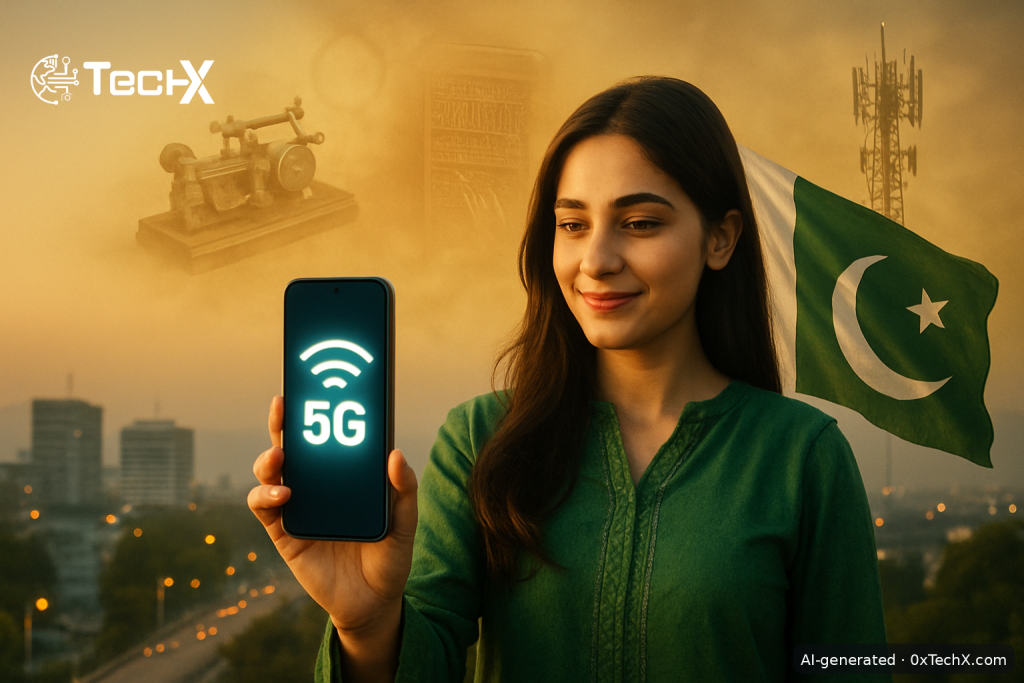
Disclaimer: This article has been compiled from information publicly available on the internet and from published sources. The featured image is AI generated and is for illustration only. If you notice anything that needs correction, please contact us.