
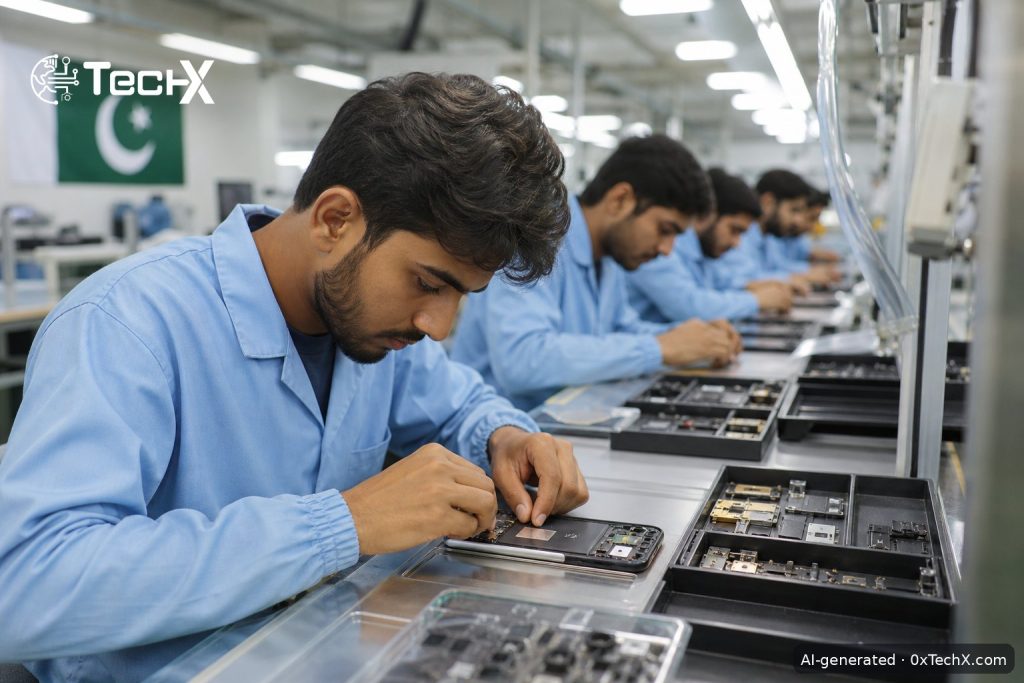
Pakistan mobile manufacturing has hit a new milestone: local plants assembled 23.03 million handsets in just the first ten months of 2026. That is almost six times the number of phones Pakistan imported commercially during the same period. VGO TEL has emerged as the top brand in local assembly, pushing past Infinix, which had led the market for two straight years.
Pakistan Mobile Manufacturing by the Numbers
Pakistan’s local mobile phone manufacturing and assembly plants produced 23.03 million handsets during January-October 2026. To put that in perspective, that figure is almost six times the 3.85 million units imported commercially.
Local manufacturers assembled 2.95 million mobile phones in October 2026 alone, making it one of the stronger single months of the year.
The full-year trend is also encouraging. Local manufacturing and assembly plants produced 30.21 million mobile handsets during the full calendar year 2025, compared to just 2.37 million imported commercially. So 2026 is on a similar path.
Smartphones vs 2G Phones: A Split That Matters
Of the 23.03 million handsets assembled, about 9.62 million were smartphones, and about 13 million were 2G phones. That means more than half of everything assembled locally is still basic 2G. Yet PTA data shows that smartphones account for 71 percent of active mobile devices on local networks.
This gap tells an important story. Locally assembled 2G phones are cheap and widely used in rural areas and among lower-income buyers. But the mobile users already on networks are mostly using smartphones. The industry is producing a lot of entry-level hardware to reach people who do not yet own any phone at all.
VGO TEL Leads Pakistan Mobile Manufacturing in 2026
VGO TEL has emerged as Pakistan’s leading locally assembled mobile phone brand during January-October 2026, a major shift in a market where Infinix had long dominated.
Previously, Infinix dominated the local assembly market in both 2024 (3.98 million units) and 2025 (3.65 million units). VGO TEL has now reversed that trend. VGO TEL led January-September 2026 with 2.50 million units, followed by Infinix at 1.96 million and Itel at 1.59 million.
Other brands filling out the top tier include TECNO at 1.16 million, Samsung at 1.04 million, Vivo at 0.99 million, Nokia at 0.97 million, and China Mobile at 0.72 million for the first nine months. The four leading brands, VGO TEL, Infinix, Itel and TECNO, accounted for about 59 percent of total production during that period.
5G Assembly Is Growing but Still Small
One figure that often gets missed in the headline numbers is 5G. During 2025, local manufacturing and assembly plants produced 553,079 5G-enabled handsets, and by September 2026 that figure had reached 78,463 units in a single month, suggesting the ramp-up is gaining pace. Pakistan’s 5G rollout is still in early stages, but local factories are quietly building the hardware pipeline for it.
Assembly vs Manufacturing: The Gap Nobody Talks About
Here is what most coverage of these figures skips over: the difference between assembly and actual manufacturing. Domestic value addition in mobile manufacturing is estimated at only 10 to 20 percent. That means the bulk of a phone’s value, its chips, screens, and core components, still comes from outside Pakistan, mainly from China.
The government is aware of this. The government wants to move beyond basic assembly, since domestic value addition in mobile device manufacturing currently hovers at around just 10 to 20 percent. A new policy targets raising that figure to 50 percent over time. That would be the difference between Pakistan being a screwdriver economy for phones and a real phone-making nation.
For Pakistani consumers and the tech industry, this distinction matters. High assembly volumes reduce import costs and create factory jobs. But deep manufacturing, making the parts locally, is what builds lasting industrial capability and exports. The Pakistan Telecommunication Authority (PTA) tracks and publishes these production figures regularly, and the data is worth watching as policy shifts.
How Local Assembly Affects Consumers
Locally manufactured and assembled phones met 97 percent of Pakistan’s mobile phone demand in July 2026, up sharply from earlier months. This dominance of local supply over imports keeps phone prices more stable and reduces the effect of rupee fluctuations on handset costs.
Local assembly met around 95 percent of domestic mobile phone demand in August, while locally manufactured and assembled devices accounted for approximately 87 percent of total demand during the first eight months of the year. For the average buyer in Lahore or Peshawar, that means the phone on the shelf is far more likely to have been put together in Pakistan than shipped in from abroad.
This also connects to Pakistan’s broader push to grow its technology sector. The country’s freelance and digital economy is expanding fast, and affordable locally assembled smartphones are part of the base layer that makes digital participation possible for more Pakistanis. For more on how Pakistan’s digital economy is growing, see our report on Pakistan freelancer earnings hitting $758 million in four months.
Frequently Asked Questions
How many mobile phones did Pakistan make in 2026 so far?
Pakistan’s local mobile phone manufacturing and assembly plants produced 23.03 million handsets during January-October 2026. That covers the first ten months of the year.
Which brand leads Pakistan’s local mobile phone assembly?
VGO TEL emerged as Pakistan’s leading locally assembled mobile phone brand during January-August 2026, assembling 2.45 million units and ending Infinix’s two-year reign as the market leader. It has maintained that lead through October.
Are phones made in Pakistan actually manufactured here?
Not fully. Most phones are assembled here using imported parts. Domestic value addition in mobile manufacturing is estimated at only 10 to 20 percent, meaning most of the value in each phone still comes from components made elsewhere, primarily in China. The PTA classifies these as local manufacturing and assembly.
How do local phone numbers compare to imports?
Pakistan local mobile phone manufacturing hit 23.03 million units in January-October 2026, almost six times the 3.85 million units imported commercially in the same period. Local assembly clearly dominates supply.