
Part 3 of 14 in our Independence Day series.
A Nation Born from a Dream
Every year on 14th August, Pakistan bursts into green and white. Flags fly from rooftops, children paint their faces, cities light up, and the national anthem fills every screen and speaker across the country. Pakistan Independence Day is more than a public holiday, it is a reminder of an extraordinary journey. A journey that took decades of struggle, sacrifice, and unshakeable belief to complete.
But behind every independence is a cast of remarkable human beings. People who gave their time, their careers, and sometimes their lives so that future generations could live free. On this Pakistan Independence Day, let us remember the leaders who made it all happen.
The Background: A Long Road to Freedom
For nearly two centuries, the Indian subcontinent lived under British colonial rule. By the early 20th century, a powerful independence movement was gathering force across the region. For the Muslims of the subcontinent, this period also raised deep questions about their future: would their rights, identity, and way of life be protected in a unified, independent India?
The All-India Muslim League, founded in 1906, became the main political platform for Muslims to raise these concerns. Over time, the question of a separate homeland moved from a distant idea to a firm political demand. That demand reached its clearest expression on 23rd March 1940, when the historic Lahore Resolution was passed, formally calling for independent states for Muslims in the north-western and eastern regions of British India. Seven years later, on 14th August 1947, Pakistan became a reality.
The Founding Fathers: Who Were They?
Quaid-e-Azam Muhammad Ali Jinnah, The Father of the Nation
No story of Pakistan Independence Day can begin anywhere but with Quaid-e-Azam Muhammad Ali Jinnah. Born on 25 December 1876 in Karachi, Jinnah trained as a barrister in London and returned home as a sharp legal mind with a passion for constitutional politics. He initially advocated for constitutional reforms and unity among diverse communities, particularly Hindus and Muslims.
Jinnah served as leader of the All-India Muslim League from 1913 until Pakistan’s independence on 14th August 1947. His thinking evolved as political circumstances changed. By 1940, Jinnah had come to believe that Muslims of the Indian subcontinent should have their own separate state. In that year, the Muslim League, led by Jinnah, passed the Lahore Resolution, demanding a separate state.
He was subsequently recognised as the sole representative of India’s Muslims and led the Muslim League to victory in the 1946 elections. After independence, as the first Governor-General of Pakistan, Jinnah led efforts to lay the foundations of the new state, frame national policies, and rehabilitate millions of Muslim refugees who had migrated from India. He passed away on 11th September 1948, just over a year after the country he built came into being.
Allama Muhammad Iqbal, The Visionary Poet
If Jinnah was the builder of Pakistan, Allama Iqbal was its dreamer. Known as the "Poet of the East" and the "Spiritual Father of Pakistan," Allama Muhammad Iqbal was a visionary philosopher, poet, and politician whose ideas laid the intellectual foundation for the creation of Pakistan.
Allama Iqbal advocated for a separate Muslim state and first proposed the idea of Pakistan in his 1930 Allahabad Address. He did not just dream from a distance, he actively corresponded with Jinnah to push the idea forward. Iqbal wrote letters to Quaid-e-Azam in 1937 and suggested a separate homeland for the Muslims. Iqbal’s poetry stirred the hearts of millions, giving the Pakistan Movement a spiritual and cultural energy that political speeches alone could never achieve. Allama Iqbal unfortunately passed away in 1938, nine years before he could see his dream become a nation, but his vision lived on in every step of the movement.
Liaquat Ali Khan, The Loyal Deputy
Standing firmly at Jinnah’s side throughout the most critical years of the Pakistan Movement was Liaquat Ali Khan. Liaquat Ali Khan served as the first Prime Minister of Pakistan and Deputy Leader of the Muslim League. His role behind the scenes was enormous. After Jinnah decided to move to England during the 1930s, it was Liaquat Ali Khan who convinced him to come back and steer the Muslim struggle under the All-India Muslim League.
Liaquat was with Jinnah in these crucial dialogues to decide the course to Pakistan, and played a pivotal role as the "right hand" man of the Quaid-i-Azam during the latter’s dialogues with the Cabinet Mission. Liaquat Ali Khan stabilised the fledgling state with political foresight and diplomacy. Tragically, he was assassinated on 16th October 1951 while still serving as Prime Minister, a loss that Pakistan felt deeply.
Fatima Jinnah, Madar-e-Millat, Mother of the Nation
The Pakistan Movement was not won by men alone. Fatima Jinnah, the Quaid’s devoted sister, stood by him at every difficult turn. She remained the closest aide to Jinnah and played an important role in the Pakistan Movement, supporting the cause while opposing British colonial rule. After the independence of Pakistan, she co-founded the Pakistan Women’s Association, which played a pivotal role in the rehabilitation of women migrants in the newborn country.
Fatima Jinnah also showed that women belonged at the heart of national life, not just on the sidelines. The Quaid himself believed this deeply, he said that no nation can make any progress without the cooperation of its women, and that if Muslim women supported their men as in the days of the Prophet of Islam (PBUH), they would soon realise their goal.
Sir Syed Ahmed Khan, The Educator Who Started It All
Before there was a Pakistan Movement, there was an awakening. Sir Syed Ahmed Khan founded the Aligarh Movement and proposed the Two Nation Theory, arguing Hindus and Muslims were two distinct nations. He believed that Muslim progress required modern education, and his work in the 19th century planted the seeds that would, decades later, grow into the independence movement. Sir Syed Ahmed Khan empowered the Muslim community through education at a time when the community was at one of its lowest points. Without his efforts, the intellectual confidence to demand a separate homeland may never have been built.
The Significance of Their Sacrifice
These leaders came from different backgrounds, had different styles, and played different roles. Yet they shared one thing: an unshakeable belief that the Muslims of the subcontinent deserved a homeland where they could live freely, govern themselves, and build their own future. Millions of ordinary Pakistanis also paid enormous personal costs, leaving homes, crossing borders, starting over, to make that homeland real.
- Quaid-e-Azam Muhammad Ali Jinnah, Led the political movement and became Pakistan’s first Governor-General
- Allama Muhammad Iqbal, Provided the intellectual and spiritual vision of a separate Muslim homeland
- Liaquat Ali Khan, Served as the loyal deputy during the movement and Pakistan’s first Prime Minister
- Fatima Jinnah, Stood as the movement’s moral backbone and champion of women’s participation
- Sir Syed Ahmed Khan, Laid the educational and ideological groundwork that made it all possible
Their Legacy in Modern Pakistan
Today, as Pakistan grows into a young, digitally connected nation, the legacy of these leaders takes on new meaning. Pakistani startups are solving real problems. Pakistani engineers are building software used around the world. Pakistani students are studying at top universities across the globe and coming home to contribute. The freedom that these leaders fought for has opened every one of those doors.
Pakistan Independence Day is the perfect moment to ask: how are we honouring their work? Each time a Pakistani entrepreneur launches a business, a doctor saves a life, a teacher educates a classroom, or a young coder writes a line of code that makes someone’s life easier, they are carrying forward what Jinnah, Iqbal, Fatima Jinnah, Liaquat Ali Khan, and Sir Syed Ahmed Khan gave everything to create.
Frequently Asked Questions
When is Pakistan Independence Day celebrated?
Pakistan Independence Day is celebrated every year on 14th August. It marks the day in 1947 when Pakistan came into being as an independent nation after the end of British rule in the subcontinent.
Who is considered the founder of Pakistan?
Quaid-e-Azam Muhammad Ali Jinnah is universally recognised as the founder of Pakistan. He led the All-India Muslim League and successfully steered the Pakistan Movement to its goal. He served as Pakistan’s first Governor-General after independence.
What was Allama Iqbal’s role in the Pakistan Movement?
Allama Iqbal is known as the Spiritual Father of Pakistan. He first proposed the concept of a separate Muslim homeland in his famous 1930 Allahabad Address. He also wrote letters to Jinnah encouraging him to push for a separate state. Though he passed away in 1938, his vision directly shaped the movement that created Pakistan.
Who was Fatima Jinnah and why is she important?
Fatima Jinnah, known as Madar-e-Millat (Mother of the Nation), was the sister and closest companion of Quaid-e-Azam Muhammad Ali Jinnah. She was a key supporter of the Pakistan Movement, later co-founded the Pakistan Women’s Association, and remained an active public figure long after independence. She represents the vital role women played in building Pakistan.
Pakistan Zindabad, A Hopeful Closing
On every Pakistan Independence Day, we do not just wave flags, we renew a promise. A promise to the men and women who gave so much so that we could have so much more. Pakistan is a young country with an ancient spirit, enormous talent, and a future full of possibility. The best way to honour the founders is not just to remember them, but to build something worthy of what they dreamed.
Happy Independence Day, Pakistan. 🇵🇰
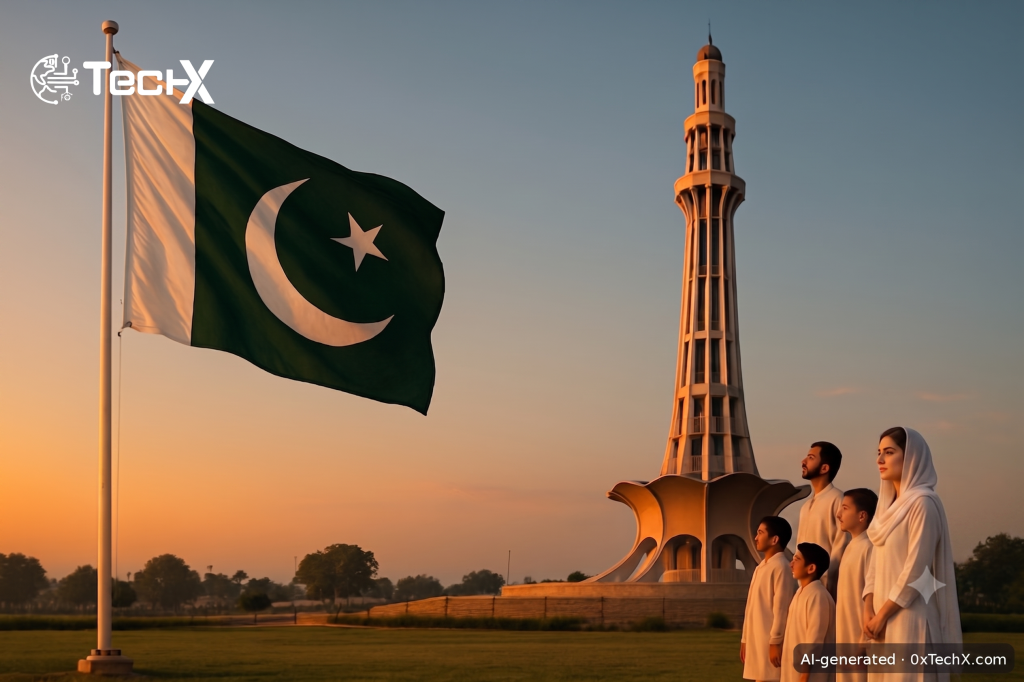
Disclaimer: This article has been compiled from information publicly available on the internet and from published sources. The featured image is AI generated and is for illustration only. If you notice anything that needs correction, please contact us.