
Part 4 of 14 in our Independence Day series.
A Date Carved Into History Forever
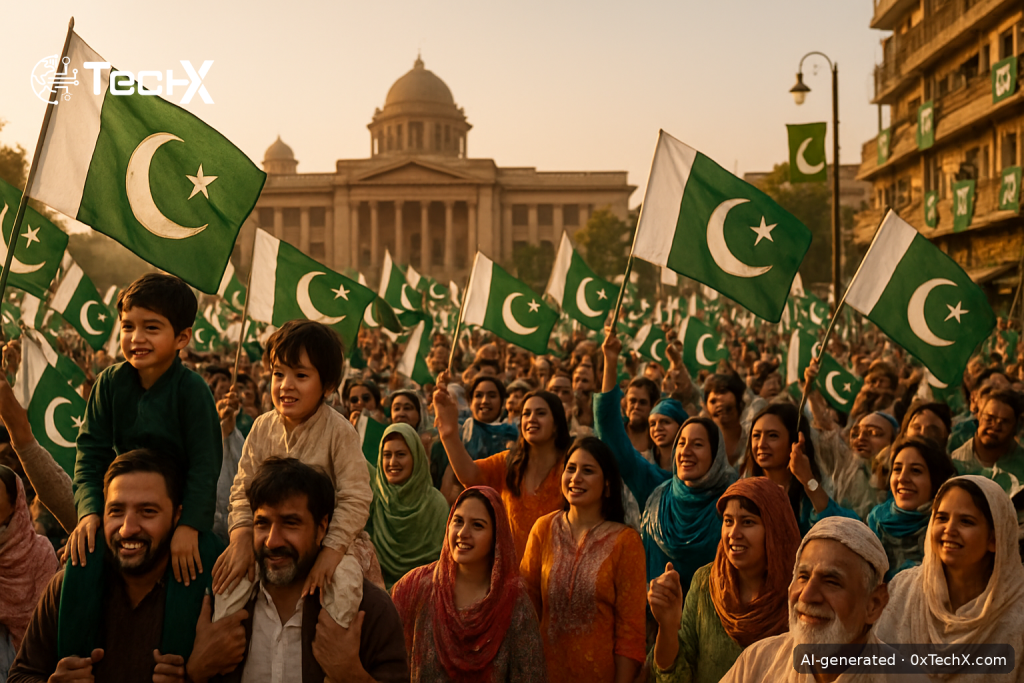
Every year on August 14, the entire country bursts into green and white. Flags wave from rooftops, children paint their faces, and the air fills with the sound of national songs. Pakistan Independence Day is more than a public holiday, it is the birthday of a nation that was dreamed of, fought for, and paid for with immense sacrifice. To truly appreciate what this day means, we need to go back to the remarkable, painful, and triumphant year of 1947, and walk through it moment by moment.
Decades of Struggle: The Road to 1947
Before there was a Pakistan, there was a vision. For decades, the Muslims of the Indian subcontinent lived under British colonial rule, which had held firm control of the region since the mid-19th century. Over time, it became clear to Muslim leaders that a united, undivided India under a single government would not fully protect the political, cultural, and religious rights of the Muslim population.
The All India Muslim League, led by the brilliant lawyer and statesman Muhammad Ali Jinnah, whom we proudly call Quaid-e-Azam, or “Great Leader”, became the driving force behind the demand for a separate homeland. Allama Iqbal, the Poet of the East, had earlier given this dream its philosophical and poetic foundation. His 1930 presidential address to the Muslim League at Allahabad planted the seed of Pakistan in the hearts and minds of millions.
After years of negotiations, failed political compromises, and a growing sense of urgency, the British finally agreed to leave, and to divide the subcontinent along religious lines.
The 1947 Timeline: Month by Month
March, June 1947: The Plan Takes Shape
Lord Louis Mountbatten arrived as the last Viceroy of India in March 1947 with a clear mandate: end British rule as quickly as possible. After consultations with all major political parties, he announced the Partition Plan on June 3, 1947, declaring that British India would be divided into two independent dominions. The announcement accelerated everything, hopes, fears, and tragically, violence as well.
July 1947: The Law Is Passed
The British Parliament passed the Indian Independence Act, which formally set the legal framework for the creation of two sovereign states. Separate provisional governments were established, boundaries were being drawn, and the clock was ticking. The man tasked with drawing the border, Sir Cyril Radcliffe, had never visited the subcontinent before and completed his work in just a few weeks. Millions of people waited anxiously to learn which country their homes, villages, and farms would fall into.
August 14, 1947: The Moment Pakistan Was Born
On August 14, 1947, at the stroke of midnight, Pakistan emerged as a free, sovereign nation. The formal transfer of power was completed in Karachi, which was declared the first capital of the new country. Quaid-e-Azam Muhammad Ali Jinnah was sworn in as Pakistan’s first Governor-General, with Liaquat Ali Khan serving as the first Prime Minister. The green-and-white crescent flag rose for the very first time.
Just days earlier, on August 11, 1947, Quaid-e-Azam had addressed the Constituent Assembly of Pakistan. He spoke of an inclusive government, religious freedom, rule of law, and equality for all citizens, a powerful vision for the new state he had worked his entire life to create.
It is worth noting that because the power transfer happened at midnight between August 14 and 15, some early documents listed August 15 as Independence Day. The following year, August 14 was officially confirmed as Pakistan Independence Day, and it has remained so ever since.
The Great Migration: A Human Story Like No Other
The creation of Pakistan was one of history’s most extraordinary human events, but it came at a devastating cost. In the weeks surrounding Partition, approximately 12 to 15 million people crossed the new border, making it one of the largest migrations in human history. Muslims headed toward Pakistan; Hindus and Sikhs moved in the other direction.
Families were separated. Villages were abandoned overnight. People left behind everything they had ever known, their homes, their fields, the graves of their ancestors, and walked, rode trains, or traveled in caravans toward a place they had never seen but already called home. The roads and railways of Punjab and Bengal carried streams of humanity in both directions, often passing each other in silence and grief.
Tragically, this migration was also marked by terrible communal violence. Estimates suggest that between one and two million people lost their lives during this period. Entire communities suffered. The pain of Partition left a wound that many families still carry across generations, in stories passed from grandparents to grandchildren, in old photographs, and in the poetry of loss and longing.
Yet through all of it, those who came to Pakistan carried with them something unbreakable: a belief in the idea of this country, and the determination to build something new from the ground up.
Building a Nation from Scratch
The new state of Pakistan faced almost unimaginable challenges from day one. There were millions of refugees to house and feed. Government offices had to be set up from scratch in Karachi. Pakistan had to establish its own currency, military, civil service, and institutions, all at the same time, while managing the humanitarian crisis of mass migration.
Quaid-e-Azam Muhammad Ali Jinnah worked tirelessly in those early months, but his health was already fragile. He passed away on September 11, 1948, just over a year after the nation he founded had come into being. The nation mourned deeply, but his legacy lived on as the guiding star of Pakistan’s identity.
Pakistan became an Islamic Republic on March 23, 1956, when it adopted its first constitution, another milestone in the young nation’s journey.
How Pakistan Celebrates Youm-e-Azadi Today
Pakistan Independence Day, Youm-e-Azadi, is celebrated with tremendous energy and love across the country. The main ceremony is held in Islamabad, featuring a full military parade, flag-hoisting ceremonies, and addresses by national leaders. From Karachi to Peshawar, from Lahore to Gilgit, the country is draped in green and white. People decorate their cars, wear traditional clothes, and gather on rooftops to wave flags under the night sky lit by fireworks.
In the digital age, Pakistan Independence Day has taken on a new dimension. Social media platforms light up with patriotic messages, digital artwork, and tributes to the founding generation. Pakistani tech startups, media companies, and content creators produce videos and campaigns that reach millions, telling the story of 1947 to a new, connected generation of Pakistanis who may never have heard it directly from someone who lived it.
Apps, online quizzes, virtual exhibitions, and digital archives now help young Pakistanis explore their history in ways that were unimaginable even a decade ago. The Citizens Archive of Pakistan, for example, has been collecting oral histories from those who witnessed Partition, preserving those irreplaceable voices for future generations.
Frequently Asked Questions About Pakistan Independence Day
Why is Pakistan Independence Day celebrated on August 14 and not August 15?
The formal transfer of power from British rule to Pakistan took place at midnight between August 14 and 15, 1947. Some early records listed August 15. However, from 1948 onward, August 14 was officially established as Pakistan’s Independence Day, and this date has been observed every year since.
Who was Pakistan’s first Governor-General?
Quaid-e-Azam Muhammad Ali Jinnah was sworn in as Pakistan’s first Governor-General on August 14, 1947. He held the office until his passing on September 11, 1948. He is also honoured with the title Baba-e-Qaum, Father of the Nation.
How many people migrated during the Partition of 1947?
Historians estimate that between 12 and 15 million people crossed the newly created borders during and after Partition in 1947, making it one of the largest migrations in recorded human history. Tragically, between one and two million people are believed to have lost their lives during this period of communal violence and hardship.
What was the Indian Independence Act and when was it passed?
The Indian Independence Act was passed by the British Parliament in July 1947. It provided the legal framework for the partition of British India into two independent sovereign states, Pakistan and India, and formally ended nearly two centuries of British colonial rule over the subcontinent.
A Hopeful Closing: 77 Years and Still Standing
The story of Pakistan’s birth is not a simple one. It is woven from thread after thread of courage, sacrifice, grief, and unshakeable hope. Every Pakistani family carries a piece of 1947 within them, whether it is a memory passed down, a city left behind, or simply the knowledge that this country exists because someone, somewhere, believed it was worth everything.
As we mark another Pakistan Independence Day, let us remember those who walked through fire to give us this land. Let us honour their memory not just with flags and fireworks, but with the commitment to build a Pakistan that lives up to the vision of Quaid-e-Azam and Allama Iqbal, a nation of justice, knowledge, unity, and dignity.
The journey that began at midnight on August 14, 1947 is still going. And the best chapters are yet to be written, by us, by you, by every Pakistani who dares to dream.
Pakistan Zindabad.
Disclaimer: This article has been compiled from information publicly available on the internet and from published sources. The featured image is AI generated and is for illustration only. If you notice anything that needs correction, please contact us.