
Part 9 of 14 in our Independence Day series.
Youm-e-Azadi Mubarak, 79 Years of a Nation That Never Stopped Dreaming
Every year on the 14th of August, the green-and-white flag climbs high above Parliament House in Islamabad, schoolchildren sing the national anthem, and a wave of pride sweeps from Karachi to Khyber. This is Pakistan Independence Day, Youm-e-Azadi, and in 2026, the nation marks its 79th anniversary as a free, sovereign state. It is a day to remember where we came from, celebrate how far we have come, and look clearly at where we are going. This year, that future looks more digital, more connected, and more ambitious than ever before.
The Long Road to 14 August 1947
The story of Pakistan’s birth is one of the greatest political movements of the twentieth century. The road to 14 August 1947 was long and shaped by decades of political struggle. The demand for a separate homeland for the Muslims of British India crystallised through the Pakistan Movement, spearheaded by the All-India Muslim League under the leadership of Muhammad Ali Jinnah, revered nationally as Quaid-e-Azam, the Great Leader.
The Lahore Resolution of 1940, also known as the Pakistan Resolution, was a pivotal moment in this struggle, formally articulating the demand for an independent state. From that historic gathering in Lahore, the movement gathered unstoppable momentum. On February 20, 1947, the turning point came when British Prime Minister Clement Attlee announced that Britain would grant India complete self-governance by June 1948. Independence Day commemorates the end of British rule in 1947, brought about by the Indian Independence Act passed on July 18 that year, and the creation of the independent state of Pakistan as a homeland for Muslims of the Indian subcontinent.
At midnight between August 14th and 15th, 1947, Pakistan gained freedom from British rule and declared itself a sovereign nation. Muhammad Ali Jinnah was appointed as the first Governor-General of Pakistan. That midnight moment, the green and white flag raised for the very first time, marked not just a political achievement but the fulfilment of a dream held by millions of people across the subcontinent.
How Pakistan Celebrates Youm-e-Azadi
Pakistan Independence Day is not only a reminder of the struggles and sacrifices made by countless individuals but also a celebration of the nation’s identity, culture, and aspirations. Government institutions and cultural organisations host parades, flag-hoisting ceremonies, and educational programmes. The main ceremony takes place in the capital city Islamabad, where the national flag is hoisted at important buildings including Parliament and the President’s House. Every year, Pakistan’s President awards medals to citizens who have made a significant contribution to the country in recognition of their hard work and dedication on Independence Day. Across the country, homes are decorated in green and white, streets come alive with song, and social media fills with the warmest of messages. Pakistan Zindabad.
The New Frontier: Pakistan’s Tech Economy Is Rising Fast
Quaid-e-Azam Muhammad Ali Jinnah built a nation. Today, a new generation of Pakistani engineers, entrepreneurs, and developers is building that nation’s economy, one line of code at a time. The numbers tell a remarkable story.
Pakistan’s IT exports reached an all-time high of $3.8 billion in the financial year 2024, 25, marking an 18% increase from $3.2 billion the previous year, according to data released by the State Bank of Pakistan. The IT and IT-enabled services sector is now the third-largest foreign exchange earner after textiles and rice, accounting for 45% of total services exports. And the momentum has not slowed down, in December 2025, Pakistan’s IT and IT-enabled services exports reached a record $437 million, marking the first time monthly receipts crossed the $400 million threshold.
A significant contributor to this growth was the freelance and remote work segment, which recorded a remarkable 90% surge to $779 million. This is the story of young Pakistanis in cities and small towns alike, equipped with a laptop, a broadband connection, and world-class skills, earning foreign exchange and sending it back home. In 2024, Pakistan was even named “Tech Destination of the Year” at GITEX Global, a recognition that placed this country squarely on the world’s technology map.
The government, too, has set an ambitious target. IT and Telecom Minister Shaza Fatima has stated that the government aims to achieve $15 billion in IT exports by 2030, adding that ongoing reforms will help drive sustained growth. That is not a far-fetched dream, Pakistan’s IT exports have grown at a compound annual growth rate of 17% over the past decade, reflecting sustained structural expansion.
Startups: The Engines of the Next Pakistan
Beyond IT services, Pakistan’s startup ecosystem is quietly going through a transformation. Pakistan’s startup ecosystem in 2025 stands as a resilient and rapidly evolving hub of innovation and entrepreneurship, shaped by young talent, government reforms, diverse funding instruments, and an increasing global outlook.
Since 2012, Pakistan’s startup ecosystem has seen exponential growth, expanding from just two incubators and fewer than 100 startups to over 24 incubation centres and accelerators supporting 531 active startups by 2025. The ecosystem is powered by a young, tech-savvy population of 230 million people and over 100 million mobile broadband users. Sectors like fintech, e-commerce, health tech, and agriculture technology are attracting the most attention.
The ecosystem is maturing in a healthy way too. The ICT sector grew 8.5% in 2024, far outpacing the national GDP growth of 1.73%. Meanwhile, Pakistani IT firms have expanded their footprint in the Gulf Cooperation Council (GCC) countries, particularly Saudi Arabia, where demand for IT services has been steadily increasing. This kind of global reach, built by Pakistani talent, is exactly the economic independence that Quaid-e-Azam envisioned.
There are challenges ahead, of course. The Pakistan Software Houses Association (P@SHA) has called on the government to establish a long-term, predictable tax and compliance framework for the technology sector, with its chairman noting that tech entrepreneurs spend excessive time navigating overlapping regulations instead of focusing on developing export-oriented products. Addressing these concerns will be the work that turns a promising story into a lasting one.
What Independence Day Means in the Digital Age
When our founders fought for Pakistan, they fought for the right of a people to shape their own destiny. In 2026, that destiny is increasingly being shaped in server rooms, co-working spaces, and home offices across this country. Every Pakistani developer who wins an international client, every startup that solves a local problem, every young woman who learns to code, they are all adding a new verse to the story of Pakistan’s independence.
- $3.8 billion in IT exports in FY 2024, 25, a national record.
- $437 million in a single month (December 2025), the highest ever.
- 17% CAGR in IT exports over the past decade, steady, sustained growth.
- 531+ active startups supported by 24+ incubators and accelerators in 2025.
- $15 billion, the government’s IT export target for 2030.
These are not just statistics. These are proof points for what Pakistan is becoming: a country that competes on intellect, on innovation, and on the boundless energy of its youth.
Frequently Asked Questions About Pakistan Independence Day
When is Pakistan Independence Day celebrated?
Independence Day in Pakistan is celebrated annually on August 14. In 2026, the country celebrates its 79th anniversary of independence.
What is the Urdu name for Pakistan Independence Day?
The holiday’s official name is Youm-e-Azadi, which translates to “Independence Day.” It is a national public holiday, and celebrations take place across every corner of the country.
How big is Pakistan’s IT export sector today?
Pakistan’s IT exports reached an all-time high of $3.8 billion in the financial year 2024, 25, marking an 18% increase from $3.2 billion the previous year. The sector now contributes about 45% of Pakistan’s total services exports, making it the country’s third-largest source of foreign exchange.
What is the government’s IT export target for 2030?
IT and Telecom Minister Shaza Fatima has stated that the government aims to achieve $15 billion in IT exports by 2030, adding that ongoing reforms will help drive sustained growth. Achieving this target will require continued investment in talent, infrastructure, and supportive policy.
Long Live Pakistan, Pakistan Zindabad
This Pakistan Independence Day, as the flag rises and the national anthem fills the air, let us celebrate not just 79 years of history, but the generation that is writing history right now, in code, in innovation, in grit, and in global ambition. The founders gave us a country. Our engineers, developers, and entrepreneurs are giving it a future. Happy Independence Day, Pakistan. Pakistan Zindabad.
- How the Demand for Pakistan Began, The Story Behind Independence Day
- How Pakistan Won Its Independence on 14 August 1947
- Part 3: Pakistan Independence Day Heroes of the Independence Movement
- Part 4: The Partition, the Migration, and the Birth of a Nation
- Part 5: The Green Flag and the Anthem That Gave Pakistan Its Voice
- Part 6: Quaid-e-Azam’s Dream for Pakistan and What It Means for Us Today
- Part 7: Pakistan Independence Day Stories of Sacrifice from the 1947 Migration
- Part 8: How Pakistan Went from Telegraphs to 5G and AI in 79 Years
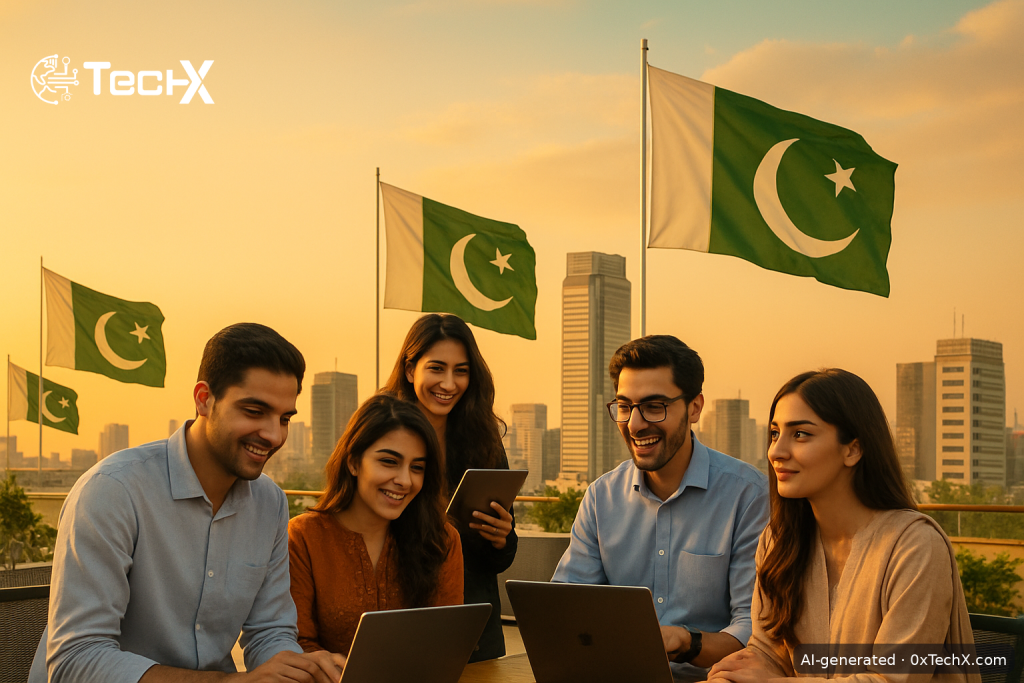
Disclaimer: This article has been compiled from information publicly available on the internet and from published sources. The featured image is AI generated and is for illustration only. If you notice anything that needs correction, please contact us.