
Part 13 of 14 in our Independence Day series.
A Nation Born from Sacrifice
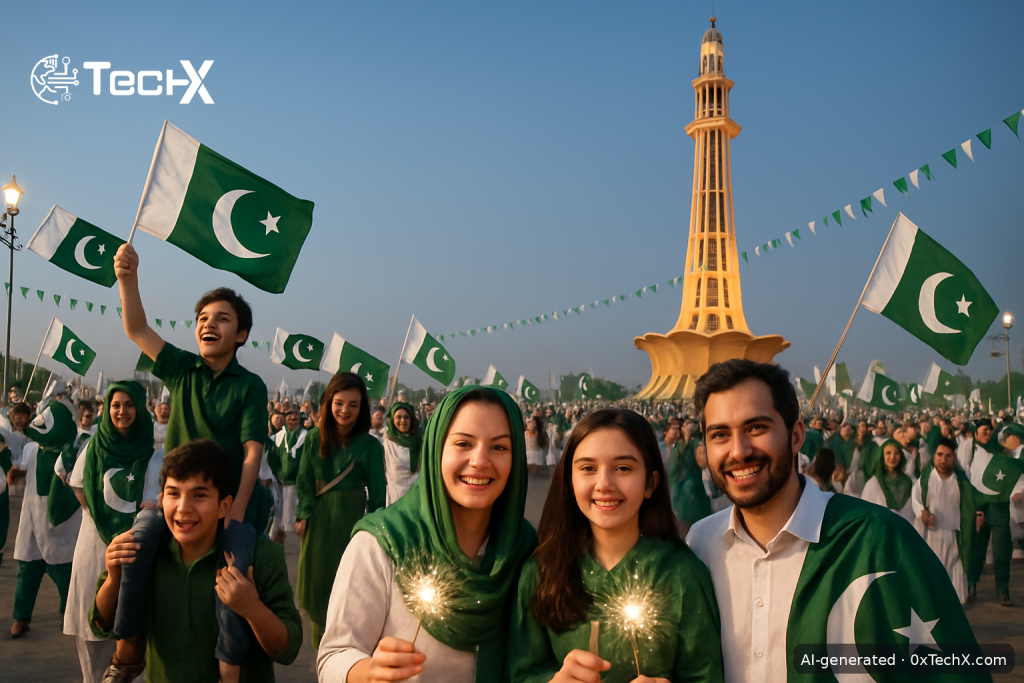
Every year on August 14, all of Pakistan comes alive with green and white. Flags flutter from rooftops, children paint their faces in the colours of the nation, and the air rings with joyful cries of Pakistan Zindabad. This is Pakistan Independence Day, the birthday of a country that came into being through immense courage, sacrifice, and an unshakeable dream.
The story of Pakistan’s creation begins with the long struggle for a separate homeland. The demand for a separate homeland for Muslims of the Indian subcontinent was based on the principle of safeguarding their religious, cultural, and political rights. The Lahore Resolution of 1940, also known as the Pakistan Resolution, was a pivotal moment in this struggle, formally articulating the demand for an independent state. Under the tireless leadership of Quaid-e-Azam Muhammad Ali Jinnah and the All-India Muslim League, that dream finally became reality.
On August 14, 1947, Pakistan emerged as a sovereign nation, and the first Governor-General, Muhammad Ali Jinnah, took the oath of office in Karachi. Pakistan chose to celebrate its independence on August 14, 1947, as the transfer of power took place during the day in Karachi. The new national flag, green with a white vertical stripe and a crescent and star, was raised, streets were decorated, processions held, and slogans of “Pakistan Zindabad” filled the air.
How We Celebrate Youm-e-Azadi
The day is officially recognised by the government of Pakistan and commemorated annually with great enthusiasm and patriotism. The main Independence Day ceremony is held in Islamabad and features a full military parade. Pakistani cadets including the Navy, Military, and Air Force salute the tomb of the father of the nation, Muhammad Ali Jinnah, while students illuminate candles at midnight to bring hope for the future. From the mountains of Khyber Pakhtunkhwa to the beaches of Karachi, this is a day that truly unites every Pakistani.
A Country That Kept Moving Forward
Pakistan’s journey since 1947 has not always been easy, but what stands out is the nation’s remarkable spirit of survival and progress. Pakistan’s journey since independence has been a testament to resilience and creativity, with the nation blessed with legendary icons across various distinctive fields, including science, culture, art, and academia. On this Pakistan Independence Day, let us look at some of the achievements that every Pakistani has the right to be proud of.
Nobel Prize Glory: Dr. Abdus Salam
One of the greatest individual achievements in Pakistan’s history belongs to the world of science. Pakistan’s excellence in physics is epitomised by Dr. Abdus Salam, Nobel Laureate (1979), for his groundbreaking work on electroweak unification, a cornerstone of the Standard Model. A son of the soil from Jhang, Dr. Salam showed the world that Pakistani minds can compete at the very highest level. His legacy continues to inspire generations of young scientists across the country.
Reaching for the Stars: Pakistan’s Space Programme
Not many people know that Pakistan was among Asia’s earliest entrants into the space age. Pakistan launched its first satellite, Badr-1, on 16 July 1990. But the milestones did not stop there. In a historic achievement that made the entire nation proud, on 3 May 2024, Pakistan achieved a historic milestone by sending its first lunar orbiter, iCube-Qamar (iCube-Q), into the Moon’s orbit. The lunar orbiter was designed by the Institute of Space Technology (IST) Islamabad, with objectives including capturing detailed images of the Moon’s surface and testing emerging technologies such as nanosatellite-level communication systems. With this mission, Pakistan became the sixth country in the world to send a research orbiter to the Moon, joining a select group of nations that have achieved this milestone.
The momentum has continued. In 2025, Pakistan has made significant progress in making the key objectives of its Space Vision 2040 a reality. In January 2025, within just one week of each other, Pakistan launched two earth-observation satellites: PAUSAT-1 and PRSC-EO1. Pakistan achieved another major milestone on 31 July 2025 by launching its latest remote sensing satellite, PRSS-2. The sky is truly no longer the limit.
On the Global Stage: Culture and Cinema
Pakistan has also made its mark far beyond science and technology. In 2012, Sharmeen Obaid-Chinoy became the first Pakistani to ever win an Oscar at the 84th Academy Awards, with her documentary Saving Face winning Best Documentary (Short Subject). She went on to win a second Oscar, cementing Pakistan’s presence in world cinema. From literature to music, Pakistani artists and creators have carried the nation’s name with pride across the globe.
The IT Revolution: Pakistan’s Brightest New Chapter
If there is one achievement that truly signals the Pakistan of tomorrow, it is the extraordinary rise of the country’s technology and IT sector. This is the story that defines modern, dynamic Pakistan, and it is a story worth shouting from the rooftops.
Pakistan’s IT exports reached an all-time high of $3.8 billion in the financial year 2024-25, marking an 18% increase from $3.2 billion the previous year, according to data released by the State Bank of Pakistan. The IT and IT-enabled services sector is now the third-largest foreign exchange earner after textiles and rice, accounting for 45% of total services exports. And the growth is accelerating: with $2.24 billion already earned in the first half of FY26, the trajectory suggests that the $5 billion milestone is no longer aspirational but increasingly attainable.
Pakistan’s tech reputation has also gone global. Pakistan was honoured with the prestigious title of Tech Destination of the Year at GITEX Global 2024, a testament to the incredible strides made by Pakistan’s IT industry on the world stage. The IT and Telecom Minister has said that Pakistan is well on its way to achieve $15 billion in IT exports by 2030. Young Pakistani developers, freelancers, and startup founders are building products used by people all over the world, and they are doing it right here at home.
CPEC and Economic Connectivity
On the infrastructure front, Pakistan has taken bold steps to connect itself with the world. Pakistan and China announced their intention to develop the $46 billion China, Pakistan Economic Corridor (CPEC), which forms part of China’s ambitious One Belt, One Road initiative. CPEC has brought investment in roads, energy, and ports, opening up new possibilities for trade and development for millions of Pakistanis.
The Spirit That Never Quits
Every generation of Pakistanis has faced its challenges, and every generation has found a way to keep the nation moving forward. From the farmers of Punjab who feed the nation, to the engineers of Karachi’s tech hubs, to the students burning midnight oil in every corner of the country, the story of Pakistan is a story of people who refuse to give up.
This Pakistan Independence Day, as we celebrate 78 years of freedom, we honour not just the founders who made Pakistan possible, but every ordinary Pakistani who builds this country day by day. The best chapter of Pakistan’s story is still being written, and it will be written by the young, talented, determined generation of today.
Frequently Asked Questions about Pakistan Independence Day
When is Pakistan Independence Day celebrated?
Independence Day in Pakistan is celebrated annually on August 14. It commemorates the end of British rule in 1947 and the creation of Pakistan as an independent homeland for Muslims of the Indian subcontinent.
Who led the movement for Pakistan’s independence?
Pakistan emerged as a sovereign nation in 1947, free from British colonial rule, under the leadership of Quaid-e-Azam Muhammad Ali Jinnah. The All-India Muslim League, led by Jinnah, championed the cause of a separate homeland with great determination and political skill. Poet of the East Allama Iqbal had earlier given the idea of a Muslim state its philosophical and spiritual vision.
What are some of Pakistan’s biggest scientific achievements since independence?
Pakistan’s scientific journey has produced remarkable milestones. Dr. Abdus Salam won the Nobel Prize in Physics in 1979. Pakistan became the sixth country in the world to send a research orbiter to the Moon with the iCube-Qamar mission in 2024. In January 2025, Pakistan launched two earth-observation satellites, PAUSAT-1 and PRSC-EO1, within just one week of each other.
How is Pakistan’s tech sector performing today?
Pakistan’s IT and IT-enabled services exports hit an all-time high of $3.8 billion in fiscal year 2024-25, higher by 18% from the previous year. With $2.24 billion already earned in the first half of FY26, the $5 billion milestone is no longer aspirational but increasingly attainable. Pakistan’s young, growing tech workforce is the engine powering this growth.
Pakistan Zindabad, Long Live Pakistan!
- How the Demand for Pakistan Began, The Story Behind Independence Day
- How Pakistan Won Its Independence on 14 August 1947
- Part 3: Pakistan Independence Day Heroes of the Independence Movement
- Part 4: The Partition, the Migration, and the Birth of a Nation
- Part 5: The Green Flag and the Anthem That Gave Pakistan Its Voice
- Part 6: Quaid-e-Azam’s Dream for Pakistan and What It Means for Us Today
- Part 7: Pakistan Independence Day Stories of Sacrifice from the 1947 Migration
- Part 8: How Pakistan Went from Telegraphs to 5G and AI in 79 Years
- Part 9: Pakistan Independence Day and How Tech Startups Are Building the Nation’s Future
- Part 10: How Young Pakistanis Are Carrying the Dream of Independence Day Forward Through Tech
- Part 11: How Pakistanis Celebrate Independence Day Every 14 August
- Part 12: Pakistan Independence Day Messages and Quotes and What They Really Mean
Disclaimer: This article has been compiled from information publicly available on the internet and from published sources. The featured image is AI generated and is for illustration only. If you notice anything that needs correction, please contact us.