
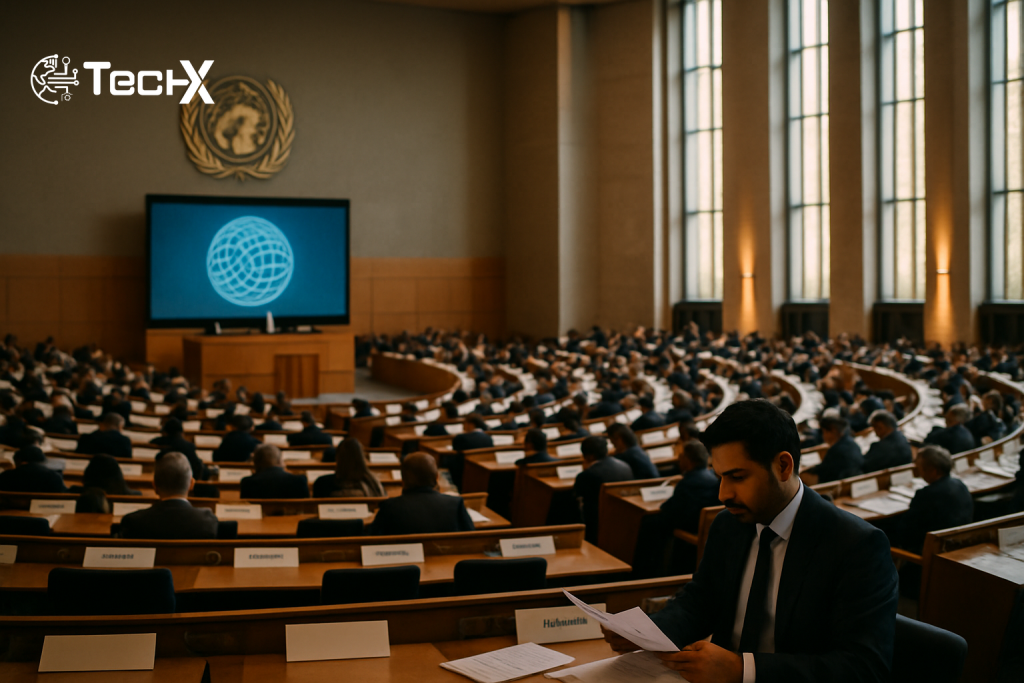
The UN AI governance dialogue is finally here. On July 6 and 7, 2026, Geneva hosts the first-ever Global Dialogue on Artificial Intelligence Governance, a landmark meeting where every UN member state sits at the same table to decide how the world should manage AI. For Pakistan, and for dozens of other developing nations, this is not just a diplomatic formality, it is a chance to shape rules that will affect jobs, security, and economic growth for years to come.
What Is the UN AI Governance Dialogue?
The AI Dialogue is the world’s first international platform convened by the UN General Assembly where all governments and stakeholders sit at the same table to have the meaningful conversation on AI the world needs. It brings together all 193 United Nations Member States alongside the private sector, civil society, academia, and the technical community to exchange best practices and build common approaches to AI governance.
In August 2025, the United Nations established two pathbreaking mechanisms for global cooperation on AI: the Independent International Scientific Panel on Artificial Intelligence and the Global Dialogue on Artificial Intelligence Governance. Think of the Panel as the science arm and the Dialogue as the policy arm. Together they are meant to turn shared principles into real action.
The Dialogue is committed to in the Global Digital Compact and established by General Assembly resolution A/RES/79/325, a concrete outcome of the Pact for the Future, moving from principles to practice. Six months of consultations across the UN system laid the groundwork, with governments, civil society, the private sector, and individuals from every UN regional group contributing more than 1,500 written submissions.
The AI Dialogue takes place in Geneva alongside the World Summit on the Information Society (WSIS) Forum 2026 and ITU’s AI for Good Global Summit. A second session of the UN AI governance dialogue is planned for New York in May 2027.
Why This Dialogue Matters Right Now
AI is moving extremely fast, and the science is alarming. The scientific panel warns that agentic AI, where AI agents complete complex tasks with minimal human involvement, is going even further, with the difficulty of tasks these systems can handle roughly doubling every few months. These are not chatbots answering simple questions. These are systems that can browse the web, write code, and take actions in the real world with very little human input.
As AI grows more autonomous, the panel flags growing risks, including AI being used to generate sexual abuse material and explicit deepfakes, with women and children disproportionately targeted. On the cybersecurity side, AI amplifies existing cyber threats, machine learning can automate vulnerability discovery, and AI-generated phishing messages are increasingly sophisticated and harder to detect.
The bigger structural problem is that existing rules simply do not cover these new risks. Current frontier safety policies, including the NIST AI RMF, ISO/IEC 42001, and the EU AI Act, contain no references to agentic AI systems at all. The world is deploying powerful autonomous AI tools without a single binding international standard to govern them. That is the gap this Geneva meeting must begin to close.
You can read more about how this fits into Pakistan’s own regulatory picture in our earlier piece on the AI governance commission and Pakistan’s fractured tech rulebook.
The Digital Divide Problem
The Global Dialogue on AI Governance exists to ensure that governance reflects the priorities of all nations, not just the most technologically advanced, and that the benefits of AI are shared by all. That sentence matters a lot for countries like Pakistan.
Countries were mostly united in calling for cooperation on multilateral AI governance, particularly to address the digital divide between the Global North and South. But there is tension. The risk is a world of incompatible AI rules, evaluation standards, safety approaches, and accountability regimes, a world with predictable consequences: widening inequality, weaker oversight, and greater market failures.
China aligned itself closely with developing countries, pushing for all nations to have a seat at the table, warning that AI governance should not become a game of the club of wealthy nations. This is a view that Pakistan, along with much of the Global South, shares.
Pakistan’s Stake in the UN AI Governance Dialogue
Pakistan is not a bystander in this conversation. In July 2025, the federal cabinet approved the National AI Policy 2025. That policy signals real ambition. Internationally, Pakistan plans to seek bilateral and multilateral agreements with AI-leading nations, participate in global AI forums, and align Pakistan’s AI regulations and standards with international best practices to ensure interoperability, data privacy, and security.
But there are honest gaps to acknowledge. With AI capabilities concentrated in a handful of global powers, countries like Pakistan risk leaving critical infrastructure, public services, and sensitive data subject to foreign systems and influence. Pakistan’s current AI capacity is centered in a single AI-optimized data center in Karachi with roughly 3,000 GPUs, a start, but far below the scale needed to achieve true AI sovereignty.
On the human side, the numbers are promising. In partnership with the University of Oxford, UNESCO launched a global course on AI and Digital Transformation in Government in 2025, which has already attracted more than 19,000 enrolments worldwide, with Pakistan leading globally and contributing over 1,000 participants. That hunger for AI knowledge is real and should be backed by the kind of technology transfer commitments that the Geneva dialogue can unlock.
Pakistan’s National AI Policy 2025, published by the Ministry of IT and Telecom, lays out the country’s vision for ethical and responsible AI. The Geneva platform is where Pakistan can push for international standards that actually fit this vision, rather than rules written entirely by richer nations with very different priorities.
What Developing Nations Should Push For
The UN AI governance dialogue is not a one-way lecture. Every member state has a voice. Here are the key positions Pakistan and other developing nations should press for at Geneva and beyond.
- Binding rules on agentic AI. Autonomous AI agents need specific international standards, not vague principles. Developing nations should push for clear accountability rules so that when an AI agent causes harm, there is a defined legal chain of responsibility.
- Technology transfer and compute access. AI without computing power is like a factory without electricity. The UN General Assembly encourages states, as well as the private sector and financial institutions, to support developing countries through voluntary contributions made public in the interest of full transparency. Pakistan should push for this to become a concrete commitment, not just an encouragement.
- Language and cultural inclusion. Speakers at the UN have pressed for stronger representation of linguistic and cultural diversity, noting that today’s leading AI models underperform for many non-English languages and reflect narrow cultural assumptions. Urdu, Sindhi, and Pashto speakers deserve AI tools that actually work for them.
- Biosecurity and cyber safeguards. The Geneva agenda covers risks from AI being misused in cyber attacks and biosecurity threats. The UN General Assembly has adopted a resolution urging inclusive and equitable AI governance that bridges the digital divide, while countries in the Global South have warned that unchecked deployment risks deepening inequalities. Developing nations must ensure these safeguards are designed to protect all countries, not just those with advanced defence budgets.
- A fair seat at the table going forward. The Global Dialogue on AI Governance meets again in New York in 2027. Pakistan should use Geneva to build coalitions with other Global South nations so that by 2027, developing countries are not just present but are actually shaping the outcomes.
What Comes Next
The panel’s findings will feed into the UN AI governance dialogue, where member states will debate coordinated international approaches to managing the technology. This is not the end of the process, it is the beginning. Rules agreed in Geneva will form the base for everything that follows: national laws, trade agreements, and investment decisions.
Pakistan has already shown it is serious about AI. The policy is in place, the talent is there, and the global appetite to engage developing nations is real. Geneva is the moment to convert that into actual influence over global rules, rules that will shape the country’s digital future whether Pakistan helps write them or not.
Frequently Asked Questions
What is the UN AI governance dialogue in Geneva?
It is the first session of the Global Dialogue on Artificial Intelligence Governance, held on July 6-7, 2026, at Palexpo in Geneva. It was established by the UN General Assembly and brings together all 193 member states to discuss global AI rules, safety, and the digital divide.
What is agentic AI and why is it a concern?
Agentic AI refers to AI systems that can plan and carry out complex tasks on their own, with very little human input. They can browse the internet, write code, and take real-world actions. The concern is that existing safety rules were not written with these systems in mind, leaving a major governance gap.
Why does Pakistan care about global AI governance?
Pakistan has a National AI Policy and growing tech ambitions. But without fair representation in global rule-making, the rules will be written by richer, more technologically advanced nations. Those rules will still apply to Pakistani companies, data, and citizens. Having a voice now means having fairer rules later.
What happens after the Geneva dialogue?
A second session of the Global Dialogue on AI Governance is planned for New York in May 2027. The findings and agreements from Geneva will feed into that session and into national AI policies, international standards, and trade agreements worldwide.