
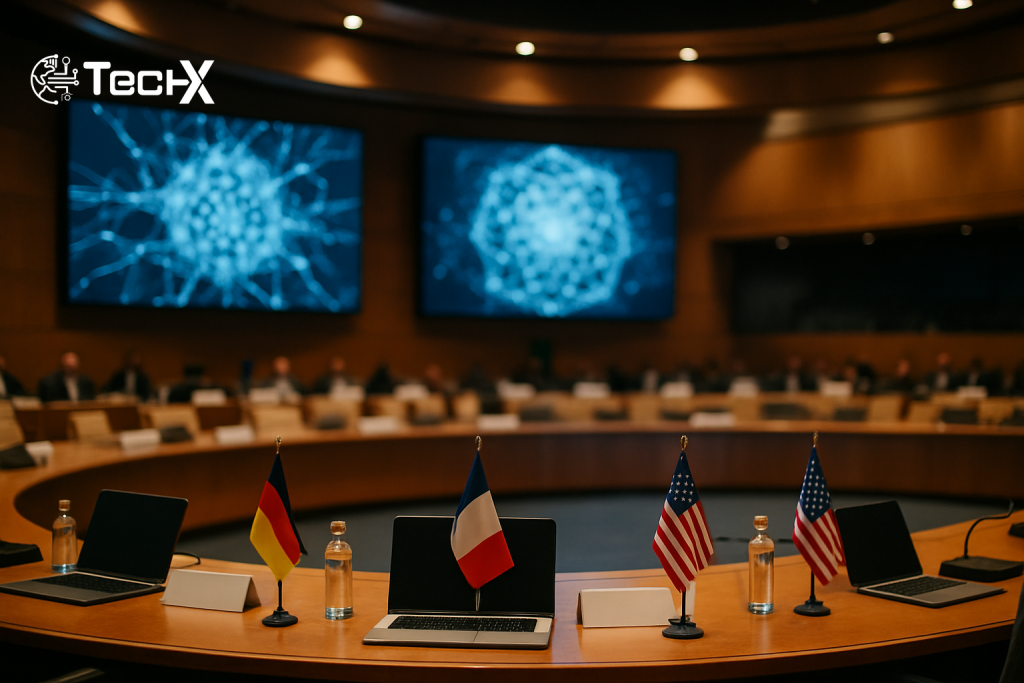
The new AI governance commission launched by the UN and the International Telecommunication Union (ITU) on July 1, 2026, is the biggest attempt yet to bring order to a world of clashing AI rules, and its first meeting on July 8 in Geneva matters far beyond Europe. For Pakistan’s growing tech sector, the decisions shaped in that room could soon touch everything from software export contracts to how local developers build AI-powered products.
What is the AI governance commission and who is in it?
The United Nations and ITU announced the AI for Good Global Commission, putting Nvidia founder Jensen Huang, Amazon CEO Andy Jassy, Microsoft President Brad Smith, and Salesforce CEO Marc Benioff in the same room as heads of state from Rwanda, Estonia, Saudi Arabia, Singapore, and Nigeria.
It will be co-chaired by Salesforce CEO Marc Benioff and Rwandan President Paul Kagame. Other members include ITU Secretary-General Doreen Bogdan-Martin, Estonian President Alar Karis, Anthropic co-founder Jack Clark, and Cohere co-founder Aidan Gomez.
The group will hold its first meeting during the ITU’s AI for Good Global Summit, just after the UN’s Global Dialogue on AI Governance on July 6 and 7. That summit itself runs from July 7 to 10 at Palexpo in Geneva.
Benioff’s framing is that the commission will bring together ‘the people who build AI, deploy it, shape policy, and represent communities.’ That is a rare mix, and it is exactly why this body is worth watching closely.
Why the world needs a single AI governance commission in the first place
Right now, AI regulation is a mess. There is no single global rulebook. Instead, every major power has written its own, and the rules do not match.
The regulatory landscape has crystallised into three distinct approaches, each reflecting the economic priorities and strategic interests of the world’s major AI powers. The EU AI Act, the United States’ sector-specific approach, and China’s state-directed regulatory framework are shaping how AI is developed and deployed globally.
The EU AI Act, which entered into force in August 2024, phases in its most consequential provisions on 2 August 2026, when high-risk AI system obligations become enforceable. Penalties reach EUR 35 million or 7 percent of global turnover for prohibited practices violations.
The US has moved in the opposite direction. President Trump signed an executive order in December 2025 establishing a policy to sustain US global AI dominance through a minimally burdensome national policy framework.
China is one of the earliest countries to enact specific legislation for particular AI applications. Unlike the EU’s ‘one regulation covering all AI’ comprehensive approach, China has adopted a ‘sector-by-sector, batch-by-batch’ regulatory strategy.
This gap between three very different systems is painful for any company that sells across borders. An AI module deemed ‘limited-risk’ in the US could be reclassified as ‘high-risk’ under the EU’s AI Act or even be prohibited for use on certain populations in China, making cross-border contract indemnities nearly impossible to draft.
What this means for Pakistan’s developers and IT exporters
Pakistan’s tech sector is growing fast. The country earns close to $5 billion a year from IT exports, and a growing share of that work now involves AI-powered products and services. But most of Pakistan’s IT earnings still come from outsourcing, meaning local developers build things for clients in the US, EU, and Gulf. That makes global AI rules a direct business issue, not just a policy one.
Here is the problem. When you build for a US client, you follow US rules. When you build for a European client, you need to meet EU AI Act requirements. When your product touches Chinese users, you face a third set of rules entirely. For organisations building AI products for global markets, the regulatory divergence creates significant compliance challenges. A product that meets EU requirements may not satisfy Chinese content regulations, and a system designed for US market flexibility may need substantial modification for EU deployment.
Compliance costs will pressure smaller AI providers, and market consolidation is a realistic possibility as governance requirements create barriers to entry. For Pakistani startups and small software houses, this is a serious warning. The cost of staying compliant in multiple markets could eat into thin margins.
There is also the question of the EU AI Act’s reach. The Act applies to any AI system serving EU citizens, regardless of where the developer is based, giving it extraterritorial reach similar to GDPR. So a Pakistani freelancer or agency building an AI tool for a European client is already inside the EU’s regulatory scope, whether they know it or not.
World governments are miles apart on how AI should be regulated, even as many countries agree that democratic values should govern the technology. It will be a challenge for this group to reach cohesive, concrete goals that manage to transcend politics and calls for digital sovereignty. This is exactly why the new AI governance commission meeting in Geneva is so important for developing countries like Pakistan that have no seat at the big table.
What Pakistan’s policymakers should watch for
Pakistan does not yet have a national AI policy with legal teeth. That is both a risk and an opportunity. On the risk side, Pakistani companies building AI tools may find themselves locked out of regulated markets if they do not plan ahead. On the opportunity side, Pakistan has room to shape a framework that works for its own developers and exporters.
The UN Global Dialogue on AI Governance has identified seven thematic areas including safe, secure, and trustworthy AI; AI capacity-building; interoperability of governance approaches; protection of human rights; and transparency and accountability. Pakistan’s government and tech bodies should be tracking all seven of these, because each one will eventually touch local law.
ITU Secretary-General Doreen Bogdan-Martin said: ‘As artificial intelligence moves from strategy to real-world deployment, countries need the skills, solutions, and international standards for AI to work for everyone.’ That message applies directly to Pakistan. Without building AI skills and a local policy framework, Pakistani developers will keep reacting to rules made elsewhere.
The ITU is the standards body that historically negotiated the plumbing of the global network. If the July 8 session produces workstreams that feed into ITU processes, the norms discussed there could quietly become the interoperability and safety defaults that platform teams eventually inherit. In plain terms: what gets decided in Geneva this week may end up in the compliance checklist every Pakistani software house has to follow in a year or two.
The AI for Good Summit is the flagship platform for showcasing and helping scale up AI applications in areas from healthcare and education to food security, particularly in developing countries. Pakistan fits squarely in that category and has a genuine interest in making sure the rules that emerge are fair to smaller economies.
The ITU, which organises this summit, has active study groups on AI standards that any Pakistani tech company or regulator can monitor and contribute to. Engaging now, before binding rules are set, is far smarter than reading the final text when it is too late to change anything.
The bottom line for Pakistan’s tech sector
The new AI governance commission is not just a photo opportunity for powerful CEOs. The commission may have the most luck with its goal of bringing AI to people who lack internet access, which is 2.2 billion people worldwide, per the ITU’s figures. That goal aligns well with Pakistan’s connectivity and digital inclusion challenges.
But the bigger story for local developers, exporters, and policymakers is this: the age of building AI products without caring about rules is ending fast. The era of debating whether AI needs regulation is over. According to the OECD, 72 countries have adopted some form of AI policy, though most have not yet translated these into legally binding law. Pakistan is in that majority for now. What Geneva produces in July may be the push that changes that.
Frequently Asked Questions
What is the UN-ITU AI governance commission?
It is a new body launched on July 1, 2026, by the United Nations and the ITU. It brings together top tech CEOs, heads of state, and policymakers to build shared approaches to AI regulation. Its first meeting is on July 8 in Geneva. Salesforce CEO Marc Benioff and Rwandan President Paul Kagame co-chair it.
How does the EU AI Act affect Pakistani developers?
The EU AI Act applies to any AI system used by people in the EU, no matter where the developer is based. So if a Pakistani company or freelancer builds an AI tool for a European client, EU rules apply. High-risk AI systems face strict documentation, testing, and oversight requirements, with fines of up to 7 percent of global turnover.
Does Pakistan have its own AI regulation?
Not yet as a binding law. Pakistan currently lacks a national AI policy with legal force. This means Pakistani developers must follow the rules of whichever country their client or end user is in. A clear local framework would help companies plan and compete more confidently in global markets.
Why does the Geneva AI summit matter for developing countries like Pakistan?
Because the standards and norms agreed upon at forums like the ITU’s AI for Good Global Summit often become the default rules that companies worldwide must follow. Countries that do not engage early risk having rules imposed on them that do not fit their context. Pakistan has a stake in pushing for AI governance that supports capacity-building and fair access for smaller economies.