
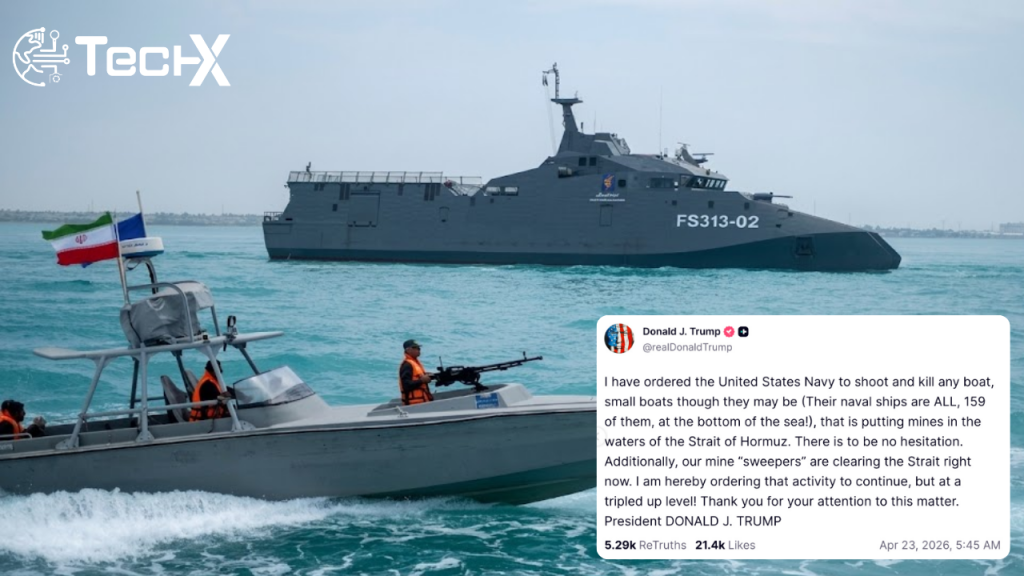
n a major escalation of maritime tensions, President Donald Trump has officially ordered the U.S. Navy to “shoot and kill” any Iranian small boats caught planting sea mines in the Strait of Hormuz. This directive, issued on April 23, 2026, marks a shift to a zero-tolerance policy against Iranian interference in international waters. The President stated that there should be “no hesitation” in using lethal force to eliminate threats to global shipping lanes.
Enforcement of the Total Naval Blockade
This aggressive order is a key component of the total U.S. Naval Blockade of Iran that began earlier this month. The U.S. military has been authorized to stop, search, and seize any vessel attempting to enter or exit Iranian ports. By cutting off Iran’s ability to export oil and import goods, the administration aims to exert “maximum pressure” to stop what it describes as Iran’s maritime terrorism and regional aggression.
Seizure of the M/V Touska and Majestic X
The effectiveness of the blockade was recently demonstrated through the seizure of several high-profile vessels. The M/V Touska, an Iranian-flagged cargo ship, was disabled and captured by the USS Spruance after it refused to comply with the blockade. Similarly, the Majestic X was intercepted in the Indian Ocean for allegedly smuggling Iranian oil. These operations signal that the U.S. Navy is prepared to use kinetic force to maintain control over the strategic waterways.
Combatting Iranian Choke Point Tactics
Iran’s strategy of using small, fast-attack boats to lay mines in the narrow Strait of Hormuz has been a primary target of the new U.S. directives. These mines are designed to “choke” the waterway, creating a massive risk for commercial oil tankers and cargo ships. President Trump has ordered the Navy to triple its mine-sweeping efforts while simultaneously destroying the IRGC vessels responsible for deploying these explosive devices.
Global Economic Impact and Oil Prices
The maritime conflict has sent shockwaves through the global economy, pushing oil prices toward the $100 per barrel mark. Because nearly 20% of the world’s oil supply passes through the Strait of Hormuz, the threat of Iranian mines and the subsequent U.S. military response have created significant market volatility. The U.S. administration argues that clearing the mines and securing the strait is essential to stabilizing global energy prices.
Three Aircraft Carriers Enforcing the Truce
To ensure these orders are followed and to deter a larger regional war, the United States has deployed a massive naval force to the region. With three aircraft carriers the USS Abraham Lincoln, USS Harry S. Truman, and the recently arrived USS George H.W. Bush now on station, the U.S. has unprecedented firepower in the area. This presence is intended to back up the diplomatic efforts in Lebanon while ensuring that Iran cannot disrupt the fragile peace in the Middle East.