
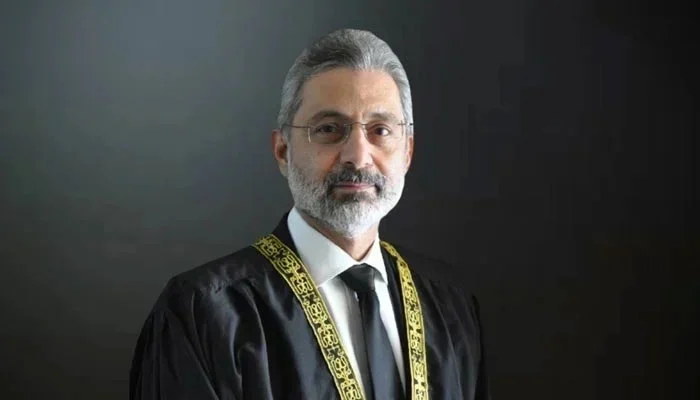
According to a senior judge on the Supreme Court, Justice Qazi Faez Isa, Article 184(3) of the Constitution only serves the public interest and the upholding of fundamental rights.
The Golden Jubilee of the Constitution of Pakistan was celebrated yesterday, and Justice Isa spoke at the event. He said, “The clause of Article 184(3) was added in the Constitution for the oppressed but was used extensively for both good and bad reasons and one should be vigilant while using it.”
According to him, the supreme court has the power to act suo motu in accordance with the provisions of Article 184(3) of the Constitution.

“My friends are of the view that the suo motu powers can only be exercised by the chief justice of Pakistan,” he added.
In order to remedy himself, Justice Isa requested the provision that created the Chief Justice Master of Rules.
Justice Qazi Faez Isa Remarks on Article 184(3)
In accordance with Article 184(3), all judges, including the Chief Justice of Pakistan (CJP), must unify, he continued.
Every case, whether criminal or civil, has at least one right to appeal, according to the senior-most judge, however this is not true under Article 184-3. “Whenever there is injustice, it doesn’t last long,” Justice Isa said.
The justice stated that “the country did not split all of a sudden as the seeds of [bifurcation] were sown” in reference to East Pakistan’s secession. He claimed that an incorrect judicial ruling was the primary cause of Pakistan’s partition.
Justice Isa stated, “The Constitution has not been presented in the way it deserves to be,” adding that the Constitution should be understood in all interpretations.
According to him, the goal of creating Pakistan was to give Muslims a place to live without being oppressed and to do as they pleased.
He claimed that although the largest Muslim state in the world had been established, the work was just partially completed. Justice Isa said that the “legislative assembly worked for seven years”.
“When the Constitution reached the brink of completion, Ghulam Muhammad, a civil servant, stumbled on the Constitution,” he said.
Justice Isa lamented the lack of elections for the 1956 legislative assembly, which was in session for just two years.
“A civil servant concluded that he was a wise man and there came the martial law of 1958,” the justice said, adding that this “wise man” formed the 1962 Constitution on his own and ended the democracy.
“According to the civil servant, the people are not conscious, have no intelligence, so there should be a filter. This wise man introduced basic democracy for the filter,” Justice Isa said.
According to this fundamental kind of democracy, 80,000 elected delegates should elect the president and work with him to rule the populace.
According to the senior puisne judge, Justice Munir sowed the seeds for Pakistan’s secession.
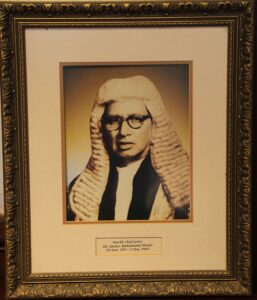

“This poisonous seed grew and in December 1971 the country was divided into two parts,” Justice Isa said. He claimed that activities taken today will have an impact years and centuries from now.
To read our blog on “Notices issued by SC to AGP & others on delay in elections,” click here.