
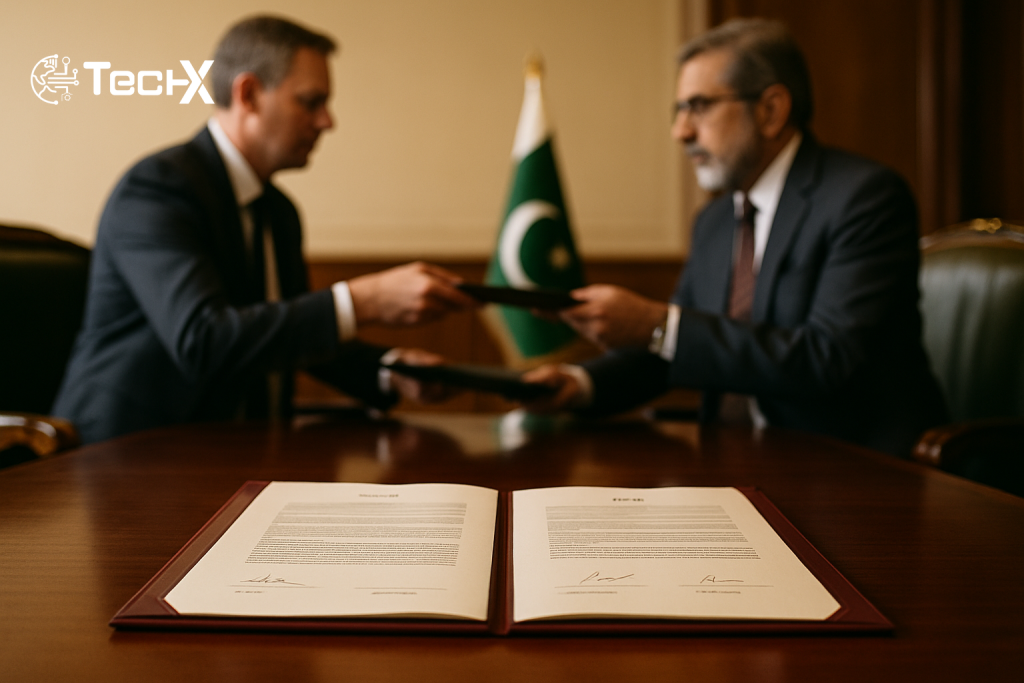
The Pakistan WLF crypto deal signed in January 2026 turned out to be far more than a tech agreement about moving money across borders. A detailed Al Jazeera investigation published on July 3, 2026 reveals that what Pakistan really bought was something rarer and harder to price: direct access to the Trump White House at one of the most tense moments in South Asian history.
What the Pakistan WLF Crypto Deal Actually Involved
Pakistan’s Ministry of Finance signed a memorandum of understanding with SC Financial Technologies, an affiliate of World Liberty Financial, to explore the use of its dollar-pegged USD1 stablecoin for cross-border payments. A stablecoin is a digital coin tied to a fixed value, usually the US dollar, designed to move money over the internet without going through traditional banks.
Prime Minister Shehbaz Sharif and army chief Field Marshal Asim Munir were both present as the firm’s executives, including Trump adviser Steve Witkoff’s son Zach, were welcomed to Islamabad. Witkoff Jr signed the agreement with Pakistan’s Finance Minister Muhammad Aurangzeb.
The MoU is not a legally binding document, but rather a statement of serious intent agreed voluntarily by equal partners. In simple words, it was a handshake on paper, not a signed contract.
The Trump family receives 75% of net proceeds when WLF sells tokens, as well as a cut of stablecoin profits. The firm earns interest on the reserves backing each coin, meaning wider use of USD1 generates income for its owners, including the Trump family.
Trump’s $500M Disclosure Puts Pakistan WLF Crypto Deal in a New Light
President Donald Trump recorded a staggering $2.2 billion in total income during his first year back in office, according to his 2025 annual financial disclosure. The 927-page financial report, released by the US Office of Government Ethics on 30 June 2026, details a massive $1.4 billion influx from cryptocurrency ventures.
More than $500 million came from the cryptocurrency venture World Liberty Financial, which was co-founded by Trump family members, while Trump-branded meme coin sales generated more than $600 million.
This is why the Pakistan WLF crypto deal suddenly looks different in hindsight. When the MoU was signed, WLF was already a fast-growing money machine for the Trump family. The prospect of a president’s family firm holding a federal bank charter has intensified scrutiny from ethics watchdogs and congressional Democrats, who argue the crypto income creates unprecedented conflicts of interest.
Foreign actors and corporate interests have been buying access and favors from the President and his administration by funneling money into the Trump family’s cryptocurrency ventures and making large, politically motivated donations. The White House, however, has firmly denied all of this. “Neither the President nor his family has ever engaged, or will ever engage, in conflicts of interest,” White House spokesperson Anna Kelly said.
What Pakistan Actually Got From the Deal
Here is the key question: did Pakistan get anything real? Analysts say yes, but not what the press release suggested.
Analysts say Pakistan has achieved something no less valuable than the half-a-billion dollars earned by Trump from World Liberty Financial: it has given Islamabad rare access to the Trump administration.
The World Liberty Financial delegation first arrived in Islamabad in April last year, days after a deadly attack by armed fighters in Indian-administered Kashmir’s Pahalgam pushed India and Pakistan towards renewed tensions. In June last year, Pakistan nominated Trump for the Nobel Peace Prize, crediting his ‘stellar statesmanship’ for helping defuse the May standoff with India.
Trump also hosted Munir for lunch at the White House in June 2025, marking the first time a US president had received a Pakistani army chief who was not also head of state.
In March 2026, Bilal Bin Saqib told Bloomberg that the crypto push had opened doors and rebuilt trust with Washington.
Karachi-based economist Khurram Husain was more blunt. “The MoU was nothing more than an instrument of access. It had no real policy basis,” he said. “Access was the calculation, and it paid off spectacularly. The tangible gains for Islamabad were getting good access to the Trump White House, which was then added to by the diplomacy in the context of the Iran war.”
What About the USD1 Stablecoin Technology Itself?
On the actual crypto side, the picture is less rosy. Unless Pakistan’s trading partners accept USD1 directly, the central bank would still need to convert the token back into dollars before it could be used, potentially adding friction rather than removing it.
A senior banking executive who spoke on condition of anonymity told Al Jazeera that the MoU is “exploratory, technical dialogue and knowledge-sharing, with no commitment to deploy any particular stablecoin.”
Licensing, bank onboarding, a pilot and eventual scaling would realistically take months, he said. For ordinary Pakistani workers who send money home from the Gulf or the UK, the practical difference could still be a long way off.
Where PVARA’s Crypto Roadmap Stands Today
Separate from the diplomatic drama, Pakistan has been building real crypto infrastructure. You can read more about how PVARA is pushing for global crypto rules and Pakistan’s growing role at international forums.
The Virtual Assets Act, passed in March 2026, created a permanent regulator, the Pakistan Virtual Assets Regulatory Authority (PVARA), with powers to license firms and impose prison sentences of up to five years for operating without approval.
In April 2026, the State Bank cleared banks to open accounts for licensed crypto firms. But PVARA is still only accepting preliminary applications, with full licensing rules yet to be published. Binance and HTX, two global exchanges, have been granted no-objection certificates and are registered but are not yet authorised to operate.
Pakistan is already one of the world’s largest crypto markets. According to the Chainalysis crypto adoption index, the country ranked third globally last year, behind India and the United States, with much of the informal crypto activity believed to flow through Tether’s USDT, the world’s largest stablecoin.
In other words, millions of Pakistanis are already using crypto every day, mostly outside the formal system. The Pakistan WLF crypto deal, whatever its diplomatic value, did help push the government to build the rules that ordinary users badly need.
What This Means for Pakistan’s Crypto Users
For the average Pakistani who holds crypto, sends remittances, or works as a freelancer, the bigger story is regulation, not geopolitics. Here is what to watch:
- Full licensing rules from PVARA are still not published. Until they are, no exchange can fully operate in Pakistan legally.
- Bank accounts for crypto firms are now allowed after the April 2026 State Bank circular, which is a big step forward.
- USD1 stablecoin is not yet integrated into any Pakistan payment system. The MoU is still exploratory.
- Conflict-of-interest questions in the US Congress around WLF could affect WLF’s own growth plans, which would indirectly affect any Pakistan pilot.
Pakistan’s initial approvals for global exchanges were granted in under five months, significantly faster than timelines typically seen in other jurisdictions, which shows the government is serious about moving quickly.
Frequently Asked Questions
What is the Pakistan WLF crypto deal?
It is a memorandum of understanding signed in January 2026 between Pakistan’s Ministry of Finance and SC Financial Technologies, an affiliate of World Liberty Financial (WLF), the Trump family-backed crypto firm. The MoU covers exploring the use of WLF’s USD1 stablecoin for cross-border payments. It is not legally binding.
How much did Trump earn from World Liberty Financial?
Trump reported more than $500 million in income from token sales by World Liberty Financial, a cryptocurrency company backed by the president and his family, and around $65 million from equity sales in the firm that controls World Liberty Financial.
Is there a conflict of interest in the Pakistan deal?
Critics argue that World Liberty’s global expansion blurs the line between public policy and private profit, especially as the firm remains majority-owned by Trump-linked entities. The White House has denied any conflict of interest. The deal is also under scrutiny as part of a broader Congressional review of Trump’s crypto earnings.
What has Pakistan actually built for crypto regulation so far?
Pakistan passed the Virtual Assets Act in March 2026, giving PVARA permanent legal authority. The State Bank allowed licensed crypto firms to open bank accounts in April 2026. Binance and HTX have received preliminary no-objection certificates. However, full operating licenses have not yet been issued, and complete licensing rules are still pending publication by PVARA.