
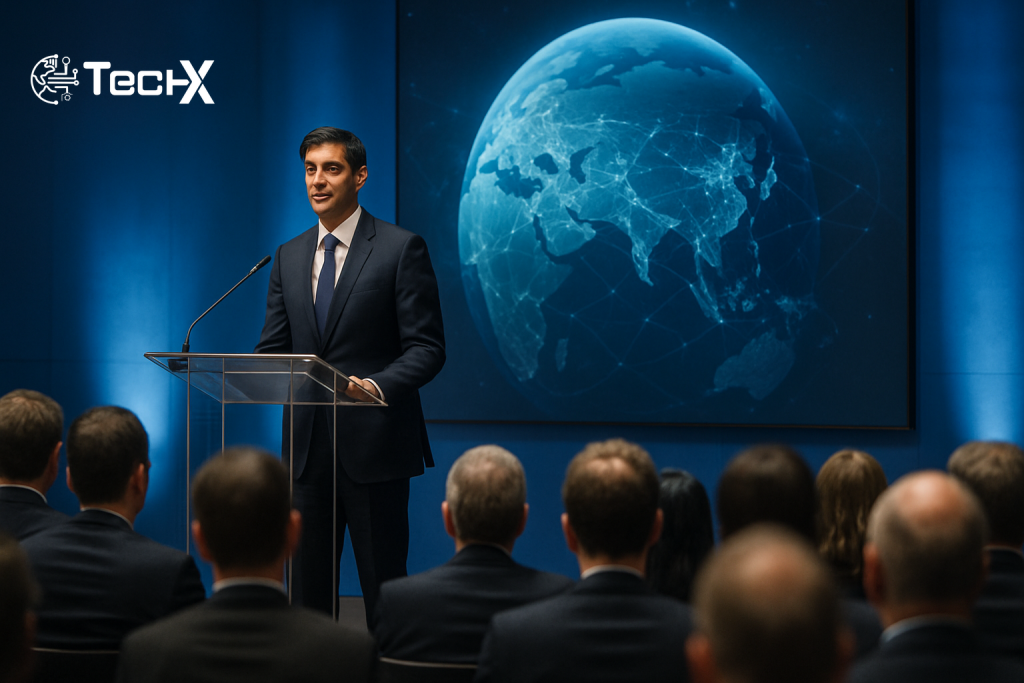
PVARA global crypto rules became a serious talking point on the world stage this week, as Pakistan’s top digital asset regulator stood before central bankers and financial policymakers in Zurich and said his country will no longer sit on the sidelines of international standard-setting. Speaking at the Point Zero Forum in Zurich, where policymakers, central bankers, regulators and financial industry leaders gathered to discuss tokenised money and virtual assets, PVARA Chairman and Minister of State Bilal Bin Saqib said Pakistan is pursuing a ‘Pakistan-first’ approach to digital finance.
What Did Bilal Bin Saqib Say in Zurich?
He urged developing economies to take an active role in setting global standards for digital assets rather than relying solely on frameworks developed by advanced economies. The message was direct: countries like Pakistan have millions of active crypto users and they deserve a seat at the table where the rules are written.
Bin Saqib said the world is witnessing a fundamental shift in the way money is created, transferred, and regulated, driven by the rapid rise of digital assets, tokenised money, stablecoins, and central bank digital currencies (CBDCs).
“The rules governing money are being rewritten, and Pakistan will help write them,” he said, adding that money is rapidly evolving into software and that traditional financial systems based on national borders are changing.
According to him, governments should prioritise regulating the infrastructure supporting digital assets instead of attempting to restrict their expansion.
The Point Zero Forum is the annual policy-technology gathering co-organised by the Global Finance and Technology Network and Switzerland’s State Secretariat for International Finance. The three-day forum, themed ‘A financial system rewired: trust, compliance and protocols in a shifting world’, brought together over 2,000 bankers, regulators, policymakers and industry leaders.
Pakistan’s Case for PVARA Global Crypto Rules Leadership
Why should Pakistan have a voice in shaping global crypto policy? The numbers back up the claim. According to Chainalysis’s 2025 Global Crypto Adoption Index, Pakistan ranks third globally in grassroots crypto adoption, behind only India and the United States. Contributing factors include a young, mobile-first population, one of the world’s largest freelance economies, over $38 billion in annual remittances, and the growing use of stablecoins as a hedge against inflation.
In 2025, around 40 million Pakistani citizens were already trading digital assets with zero rules, zero protection, and zero benefit flowing back to the state. That reality made regulation not just useful, but urgent.
Beyond the main stage, Bin Saqib did not just give speeches. He joined invitation-only meetings involving central bankers and financial leaders from Singapore, Japan, the Philippines, the Gulf and Europe, as well as major international banks and digital asset institutions. Those discussions focused on how developing economies could benefit from dollar-denominated tokenised money without giving up monetary sovereignty, payment system control or visibility over financial flows.
From Gray Market to Licensed VASP Ecosystem
The Zurich push is happening alongside a major change at home. Pakistan has moved fast to build a formal crypto ecosystem from scratch.
Pakistan’s Virtual Assets Act 2026 introduces the country’s first comprehensive legal framework for overseeing virtual assets and the businesses that operate in this space. PVARA is the dedicated authority responsible for licensing, supervising, and regulating virtual assets and virtual asset service providers (VASPs) operating in the country.
All virtual asset service providers, including cryptocurrency exchanges, wallet operators, token issuers, custodians, and investment platforms, must obtain a formal licence before offering services in Pakistan.
The State Bank lifted banking restrictions that had remained in place for nearly eight years. Banks can now provide services to PVARA-licensed VASPs and their customers, provided they comply with strict Anti-Money Laundering (AML) and Countering the Financing of Terrorism (CFT) requirements. However, banks are still not allowed to directly hold, trade or invest in cryptocurrencies.
PVARA has started issuing No Objection Certificates (NOCs) to international cryptocurrency exchanges, including Binance and HTX. This is the first step toward full licensing and signals that global exchanges can now operate legally in Pakistan.
The New Budget Crypto Tax Proposals
Alongside regulation, Pakistan is also building a tax framework. The 2026-27 federal budget proposes bringing digital assets more explicitly into the tax framework, with discussions on tax rates ranging from 10% to 30%, subject to amendments to the Income Tax Ordinance.
The capital gains tax rate on trading is proposed to be fixed at 15 to 30 percent on annual net income levels, covering spot and futures trading of assets like Bitcoin and Ethereum. Continuous income from crypto mining or proof-of-stake activity would be treated as regular business income and taxed under individual and corporate income tax rates.
Pakistan’s move to formalise digital asset regulation aligns with broader economic reforms under its IMF programme, which requires Islamabad to strengthen financial controls, improve transparency, and manage risks linked to emerging technologies.
By aligning with CARF and FATF’s Virtual Asset Service Provider criteria, Pakistan aims to plug major gaps in its tax net. The plan would require local exchanges to register, report transaction data, implement KYC and AML protocols, and integrate into the national tax database.
For Pakistani traders, this is a real change. The days of buying and selling crypto with no records and no tax filings are ending. Pakistan’s crypto market is transitioning from a regulatory gray area to a fully regulated ecosystem, where licensed VASPs have access to banking services while regulators continue to emphasise consumer protection and alignment with international standards, including FATF recommendations.
Pakistan’s broader digital finance goals connect to its IT sector growth. The country is also working on frameworks for expanding IT exports and formalising digital earnings, of which crypto and Web3 are becoming a growing part.
Why This Matters for Ordinary Pakistanis
For everyday users, the shift is straightforward. If you are trading crypto in Pakistan today, you are moving from an unregulated space to one with clear rules, licensed platforms, and tax obligations. That brings both benefits and responsibilities.
The benefit: your funds will have more legal protection. Exchanges operating under a PVARA licence must follow consumer protection rules, keep records, and meet security standards. The responsibility: your gains will now be taxable and reportable to the FBR.
For freelancers and remittance users who rely on stablecoins, the new banking rules mean you may soon be able to convert digital assets through a proper bank channel rather than informal routes. That is a big change from where things stood just two years ago.
Pakistan’s voice in the PVARA global crypto rules debate is growing stronger, backed by real user numbers, new legislation, and a regulator willing to show up at global forums and make the case.
Frequently Asked Questions
What is the Point Zero Forum and why did Pakistan attend?
The Point Zero Forum is an annual policy and technology gathering organised by the Global Finance and Technology Network and the State Secretariat for International Finance of Switzerland, in collaboration with the BIS Innovation Hub, the Monetary Authority of Singapore and the Swiss National Bank. Pakistan attended to push for developing nations to have a role in setting global digital asset standards.
What is PVARA and what does it do?
PVARA is the dedicated authority responsible for licensing, supervising, and regulating virtual assets and virtual asset service providers (VASPs) operating in Pakistan. It was created by the Virtual Assets Act 2026 and is now the main regulator for all crypto exchanges and digital asset businesses in the country.
What are the proposed crypto tax rates in Pakistan’s new budget?
The 2026-27 federal budget proposes bringing digital assets more explicitly into the tax framework, with discussions on tax rates ranging from 10% to 30%, subject to amendments to the Income Tax Ordinance. Mining and staking income would be treated as business income and taxed at standard income tax rates.
Can Pakistani banks now work with crypto exchanges?
Banks can now provide services to PVARA-licensed VASPs and their customers, provided they comply with strict AML and CFT requirements. However, banks are still not allowed to directly hold, trade or invest in cryptocurrencies.