
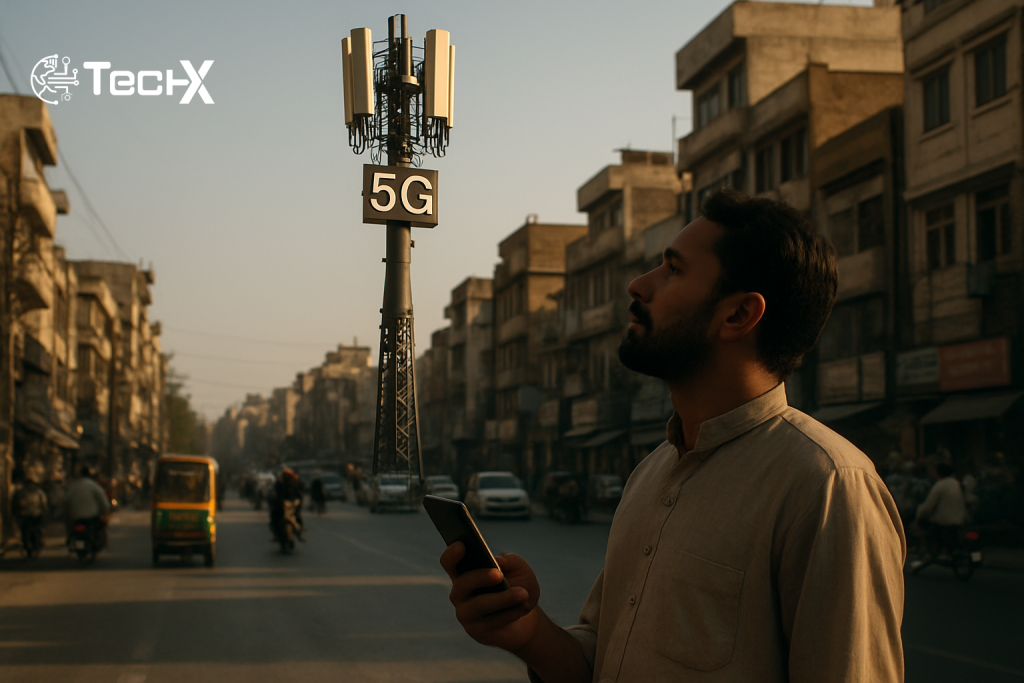
The Ericsson Mobility Report 2026 has confirmed a landmark moment for the global telecom industry: 5G subscriptions have crossed the three billion mark for the first time. For Pakistan, which only recently completed its 5G spectrum auction, this milestone puts into sharp focus just how much ground the country needs to cover as the rest of the world accelerates ahead.
Ericsson Mobility Report 2026: The 3.1 Billion Headline
The 162 million new 5G subscriptions added globally during the first quarter of 2026 brought the total past the three billion mark, to 3.1 billion subscriptions. That is a substantial jump in a single quarter, and it signals that 5G is no longer an early-adopter technology, it is going mainstream at speed.
This figure is expected to grow rapidly and is forecast to more than double, reaching 6.4 billion, by the end of 2031. To put that in context, two-thirds of all mobile subscriptions are expected to be 5G at the end of 2031.
Some 390 service providers have launched commercial 5G services to date, more than 90 of which have launched 5G Standalone (SA). The number of 5G SA commercial offerings based on network slicing, which allows operators to guarantee quality of service for specific use cases, is also rising fast. The number of commercial differentiated connectivity service offerings based on 5G SA network slicing continued to grow, increasing from 65 in the November 2025 report to 84 across all regions in the new June edition, indicating that services based on differentiated connectivity are moving from early adoption to mainstream commercialisation.
Traffic Data: A Network Under Pressure From AI
Network data traffic, for both mobile and Fixed Wireless Access (FWA), grew 22 percent year-on-year for the first quarter of 2026 compared to the same period in 2025, exceeding expectations. One of the more striking trends the Ericsson Mobility Report 2026 highlights is a shift in how networks are being used.
Changing user behaviour is reflected in the June 2026 network traffic statistics: uplink traffic is growing faster than downlink for most service providers, in some instances significantly faster. The main current drivers are smartphone communication and collaboration apps, the sharing of user-generated content, and cloud storage. AI is amplifying this shift further. Ericsson scenario modelling suggests additional AI traffic could result in uplink traffic being three times higher or more in 2031 compared to 2025.
By the end of 2025, 5G networks carried 48 percent of all mobile data traffic worldwide, and Ericsson expects that figure to reach 85 percent by 2031. For operators and enterprises alike, this means 5G infrastructure is no longer optional, it is the foundation on which AI-driven services will run.
Which Regions Are Leading, and Where Does That Leave Pakistan?
Western Europe, North America, North East Asia and the Gulf Cooperation Council (GCC) countries are forecast to have 5G mobile subscription adoption close to, or above, 90 percent by the end of 2031. South Asia, including Pakistan, is a very different story at this stage.
Pakistan only held its 5G spectrum auction in March 2026. The planned commercial rollout follows the government’s 5G spectrum auction held in March, in which spectrum worth $507 million was sold to support faster and better-quality mobile internet services. Jazz, Zong, and Ufone all received 5G licences following the conclusion of the country’s 5G spectrum auction. Veon-owned Jazz and China Mobile-owned Zong wasted no time in launching 5G services, with Jazz rolling out across around 180 sites, including Islamabad and all provincial capitals such as Rawalpindi, Lahore, Karachi, Peshawar, Quetta, Multan, and Faisalabad.
Zong commercially launched 5G services in more than 16 cities, including Islamabad, Rawalpindi, Karachi, Lahore, Peshawar, and Quetta, and announced plans to deploy and upgrade more than 1,000 5G sites nationwide in 2026. The Ministry of Information Technology and Telecommunication submitted a formal four-phase 5G rollout plan to the National Assembly in May 2026, targeting a minimum 5G data rate of 50 Mbps rising to a 100 Mbps end-state. Digital Foreign Direct Investment commitments exceeding $700 million have already been secured to back this ecosystem.
However, real challenges remain on the ground. Industry officials say only 5 percent of handsets currently available in Pakistan are 5G-enabled, describing this as a major challenge for operators preparing to launch the service. Ministry officials have also confirmed that 5G services will not initially be available to iPhone users in Pakistan, with Apple expected to enable the 5G option for Pakistani users in 2027 after assessing the size of the market. For a deeper look at the handset side of this challenge, see our earlier article on Pakistan’s 5G handset barrier and upgrade costs in 2026.
Analysts note that while 5G promises faster internet and new applications in areas such as industry, health and education, its success will depend on infrastructure readiness, affordability and consumer adoption in a price-sensitive market. You can also read about the quality considerations facing local 5G infrastructure in our piece on Pakistan’s 5G local assembly quality gap.
What the 6G Timeline Means for Pakistan
The Ericsson Mobility Report 2026 also looks ahead to the next generation. The first implementable 6G specifications are expected to be finalised by the end of 2028 or early 2029, with the first commercial 6G services expected to follow around 2030. As with 5G launches, the US, China, Japan, South Korea and the GCC countries are expected to be early adopters. For Pakistan, this reinforces the urgency of executing its current 5G rollout effectively. Countries that take too long to mature their 5G ecosystems risk entering the 6G era without the infrastructure, developer base, or enterprise adoption needed to benefit from the next wave of connectivity. The Pakistan Telecommunication Authority (PTA) and operators now have a relatively narrow window to scale 5G meaningfully before the global conversation shifts to 6G standards. You can read the full report directly from Ericsson’s official Mobility Report page.
Frequently Asked Questions
What is the Ericsson Mobility Report 2026 and what did it find?
The Ericsson Mobility Report is a biannual industry forecast published by Swedish telecom giant Ericsson. The June 2026 edition found that global 5G subscriptions reached 3.1 billion in Q1 2026, with 390 commercial 5G launches worldwide and network data traffic growing 22 percent year-on-year.
How many 5G subscriptions are there globally in 2026?
The 162 million new 5G subscriptions added globally during the first quarter of 2026 brought the total past the three billion mark, to 3.1 billion subscriptions. This number is forecast to reach 6.4 billion by 2031.
Has Pakistan launched 5G yet?
Yes, in a limited way. Pakistan conducted its 5G spectrum auction in March 2026. Jazz launched its 5G service across around 180 sites covering Islamabad and all provincial capitals, while Zong commercially launched 5G in more than 16 cities including Islamabad, Rawalpindi, Karachi, Lahore, Peshawar, and Quetta. A broader commercial rollout is being planned in phases through the rest of 2026.
When will 5G become the dominant mobile technology globally?
Globally, 5G is anticipated to overtake 4G as the dominant mobile access technology by subscription by the end of 2027, nine years after launch. For Pakistan, given it is only beginning its rollout in 2026, 5G dominance locally will take considerably longer to achieve.