
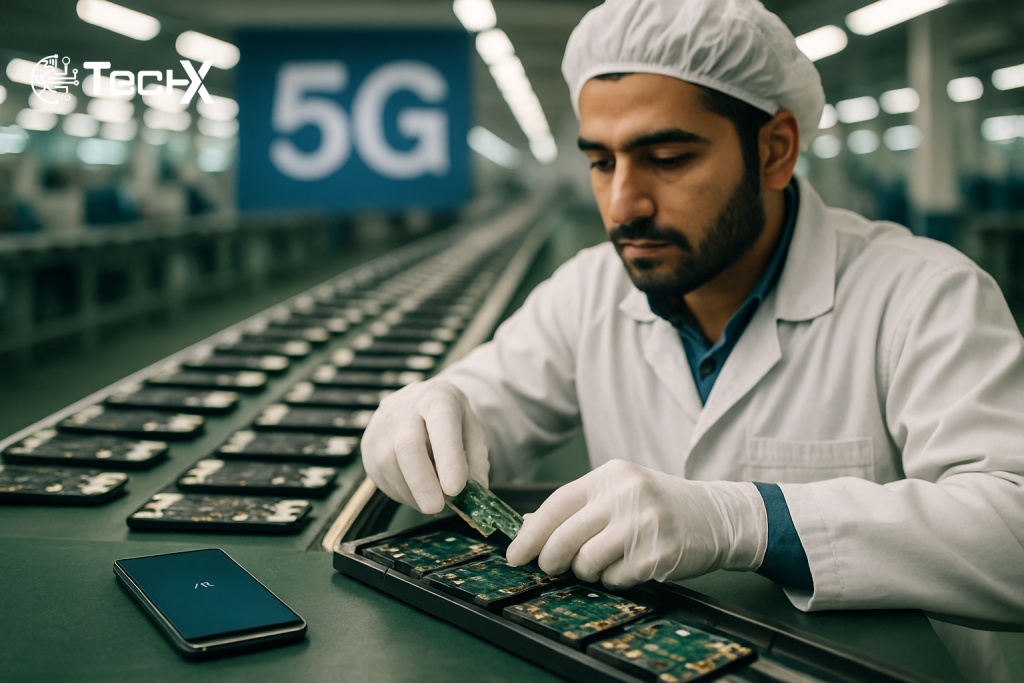
Pakistan’s 5G local assembly produced 11.17 million handsets in the first five months of 2026, meeting roughly 86% of the country’s total mobile device demand, a remarkable industrial achievement. Yet buried inside that headline figure is a number that tells a very different story: during May 2026 alone, local manufacturers assembled just 101,005 5G-enabled mobile handsets. In a country that just held its first-ever 5G spectrum auction, that gap between sheer volume and next-gen readiness deserves a closer look.
Pakistan 5G Local Assembly in Numbers: What PTA Data Actually Shows
Pakistan’s domestic plants produced and assembled 11.17 million mobile handsets during the first five months of 2026, significantly exceeding the 1.91 million units imported commercially during the same period. Of those locally assembled devices, 4.92 million were smartphones and 6.25 million were 2G feature phones.
Read that last part again: more than half of everything Pakistan assembled locally was a basic 2G feature phone. That single fact explains why the 5G numbers look so small by comparison.
Local manufacturers assembled 101,005 5G-enabled smartphones in May 2026, compared with 553,079 5G-enabled devices assembled during the whole of 2025, reflecting ongoing efforts to expand the availability of next-generation mobile technology in Pakistan.
So year-to-date, 5G handsets are on pace to represent a small fraction of total output. The assembly lines are running hot, but they are largely running for the mass-market segment, not the next-generation one.
Who Is Assembling Phones in Pakistan Right Now?
Pakistan’s mobile phone manufacturing and assembly sector continued its robust growth trajectory during the first five months of 2026, with VGO TEL emerging as the country’s leading handset assembler, having produced 1.71 million mobile phones between January and May 2026.
Infinix ranked second with 1.08 million units assembled during the period. TECNO followed with 770,000 units, narrowly ahead of Itel, which produced 760,000 handsets. Samsung secured fifth place with 720,000 units, while Vivo assembled 670,000 devices.
Notice a pattern: the top assemblers by volume, VGO TEL, Infinix, TECNO, Itel, are all brands known for affordable, entry-level and mid-range devices. Pakistani consumers are highly price-sensitive, making budget-friendly devices the top-selling items. Local assembly policy has responded to that reality, and the output reflects it.
Why Volume Growth Is Not Translating Into 5G Readiness
There are three structural reasons why Pakistan’s impressive assembly numbers are not producing a 5G-ready consumer base.
1. The Price Barrier Is Real
Many smartphones currently assembled or sold in Pakistan already support key 5G frequency bands expected to be deployed locally. However, such devices are largely positioned in the mid- to high-price segment, starting at around Rs 75,000. For a country where the bulk of handset demand sits comfortably under Rs 30,000, that is a significant ceiling.
Industry experts note that prices of 5G-enabled handsets could be higher than those of existing models by Rs 5,000 to Rs 15,000, while in some cases the price difference may range between Rs 20,000 and Rs 30,000. That premium, stacked on top of an already expensive base price, puts 5G handsets beyond the reach of most everyday buyers.
2. Hardware Cannot Be Updated With Software
There is no shortcut here. 5G cannot be enabled through software updates alone. It requires specific hardware, including 5G-capable chipsets, antennas, and RF components. Every 4G phone being assembled and sold today is permanently locked out of 5G networks, regardless of future software patches. Consumers buying budget handsets in 2026 will need to replace their device entirely when they eventually want to access 5G speeds.
3. Feature Phones Still Dominate the Mix
According to data from the Pakistan Telecommunication Authority (PTA), smartphones now account for 72.3% of all mobile devices operating on Pakistan’s cellular network, while 27.7% remain 2G devices. More than a quarter of the entire installed base cannot even access 4G, let alone 5G. Local assembly is partly serving replacement demand for that 2G base, and the replacement device is often another affordable feature phone or entry-level 4G handset, not a 5G-capable one.
Pakistan’s 5G Network Is Ready, But the Devices Are Not Keeping Up
On the network side, Pakistan moved decisively in 2026. The federal government raised $507 million in the much-awaited 5G spectrum auction, selling 480 MHz of spectrum against a target of 597 MHz, with three telecom operators securing frequencies to roll out next-generation mobile services.
Jazz, Zong and Ufone secured spectrum licenses to expand mobile broadband capacity and prepare for 5G deployment in Pakistan. 5G services will initially be launched in Islamabad and provincial capitals, marking Pakistan’s entry into the list of countries offering next-generation mobile services.
The infrastructure is being built. The spectrum has been allocated. But without affordable 5G handsets in consumers’ hands, most Pakistanis will be watching 5G from the sidelines, even as the towers go live around them. You can read more about how the handset cost challenge plays out for ordinary buyers in our detailed look at the Pakistan 5G handset barrier and upgrade costs in 2026.
What the Industry Says About the Path Forward
Industry experts note that while handset manufacturers are largely prepared, the full benefits of 5G will depend on timely spectrum allocation, a phased network rollout, and consumer affordability.
Manufacturers will roll out new or upgraded 5G models while continuing to offer 4G devices for price-sensitive consumers. This dual strategy is designed to ensure inclusion and consumer choice during the transition period, with production volumes aligned to network rollout timelines and market demand.
Initial adoption is expected to come from early users in major urban centres such as Lahore, Karachi, and Islamabad, where 5G coverage is expected to be introduced first. Broader adoption will follow once consumers clearly experience faster speeds and lower latency, and when affordable 5G devices and financing options become widely available.
The mobile manufacturing sector in Pakistan has expanded significantly in recent years following regulatory reforms, particularly the introduction of the Mobile Device Manufacturing Policy and the Device Identification, Registration and Blocking System (DIRBS). These frameworks encouraged global brands, including Samsung, Xiaomi, Vivo, Oppo, Infinix, and Tecno, to establish or expand local assembly operations.
The next logical step for policymakers is to extend similar incentives specifically toward 5G-capable component sourcing, so that assembling a 5G phone locally becomes as cost-competitive as assembling a 4G one. Until that happens, Pakistan 5G local assembly will keep setting volume records while the 5G-ready proportion of output remains a small slice of the pie.
Frequently Asked Questions
How many phones did Pakistan locally assemble in the first five months of 2026?
Pakistan’s domestic plants produced and assembled 11.17 million mobile handsets during the first five months of 2026, significantly exceeding the 1.91 million units imported commercially during the same period.
How many of those locally assembled phones were 5G-capable?
Local manufacturers assembled 101,005 5G-enabled smartphones in May 2026 alone. For context, locally assembled mobile phones included 4.92 million smartphones and 6.25 million 2G feature phones across the January-May period, meaning the overwhelming majority of output was non-5G.
Why are 5G phones so expensive in Pakistan?
5G cannot be enabled through software updates alone, it requires specific hardware, including 5G-capable chipsets, antennas, and RF components. The price premium for a 5G-enabled handset over an equivalent 4G model can range from Rs 5,000 to Rs 30,000 depending on the segment, which is a significant barrier in Pakistan’s price-sensitive market.
When will 5G services actually be available in Pakistan?
Authorities expect the newly assigned spectrum to improve existing 4G services within four to five months, while commercial 5G launches in major cities could begin within six months of the March 2026 auction. The PTA has approved a structured, phased rollout beginning with metropolitan areas such as Islamabad, Karachi, and Lahore, before gradual expansion to additional cities and commercial hubs.