
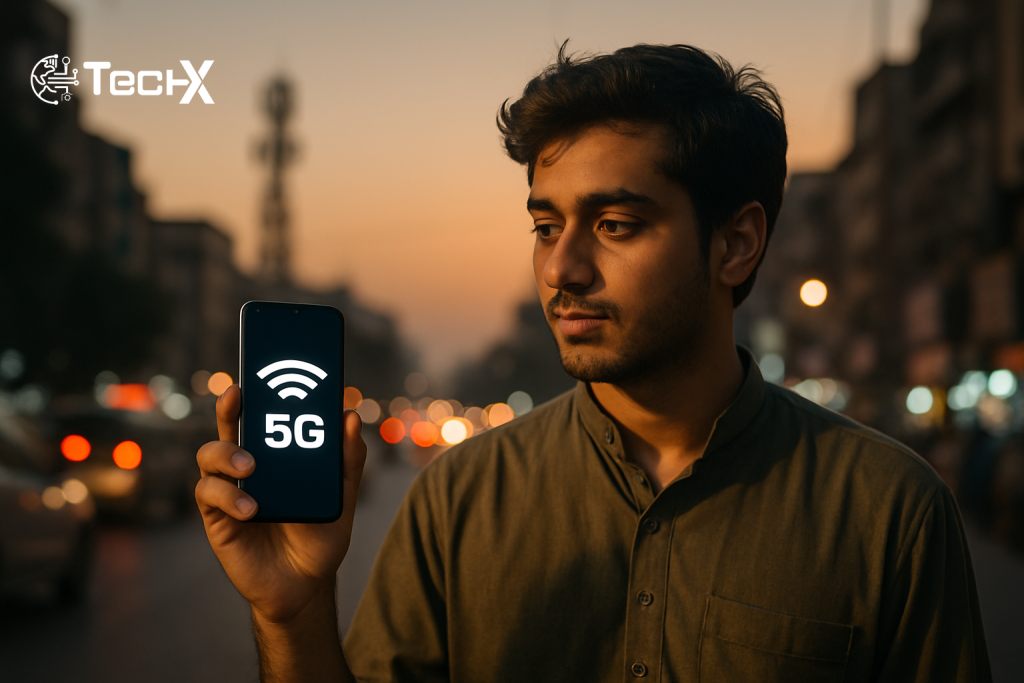
The Pakistan 5G handset problem is the country’s biggest barrier to the next generation of mobile connectivity. Pakistan’s networks are live, the licences have been signed, and towers are being switched on across major cities, yet fewer than 2% of mobile users in the country actually own a phone capable of using them. Understanding why this gap exists, what it will cost to close it, and how long that will realistically take is the most important 5G conversation Pakistan needs to be having right now.
Pakistan 5G Is Officially Live, Here’s What Happened
On 20 March 2026, Jazz, Zong, and Ufone formally received their 5G licences from the Pakistan Telecommunication Authority (PTA). Two of the three wasted no time. Jazz activated 5G across around 180 sites, covering Islamabad, all provincial capitals, and major urban hubs including Rawalpindi, Lahore, Karachi, Peshawar, Quetta, Multan, and Faisalabad. Zong went live in more than 16 cities under the same rollout push. Ufone received its licence but did not immediately launch commercial services, citing equipment imports still in transit.
Zong has committed to deploy and upgrade over 1,000 5G sites across Pakistan before the end of 2026. The spectrum auction that preceded these licences raised $507 million from selling 480 MHz across multiple bands, a substantial investment by any regional comparison. Pakistan’s IT Minister noted that 480 MHz of spectrum had been added to the system, compared with just 274 MHz previously, which should significantly improve speeds across the board.
For context on coverage, you can read more about the PTA’s 5G speed targets and quality-of-service benchmarks that operators are required to meet as the rollout progresses.
The Pakistan 5G Handset Problem in Numbers
Here is the central challenge: Pakistan has roughly 194 million active cellular mobile connections. The country’s total mobile and fixed phone subscriber base has crossed 207 million. Yet according to pre-launch analysis, fewer than 2% of mobile users carry a 5G-enabled handset. That means, conservatively, fewer than four million people in a country with over 200 million subscribers could even attempt to connect to the new network today.
The wider handset picture is mixed. Smartphone penetration is rising, Pakistan’s Economic Survey data puts smartphone usage at 71.6% of the population, and local mobile phone manufacturing has scaled rapidly, with 161.6 million devices produced domestically by March 2026. But the overwhelming majority of those locally assembled phones are budget 4G handsets. 5G-compatible devices, where they exist, are mostly imported and carry price tags that place them out of reach for the average Pakistani consumer.
Mobile broadband penetration sits between 57% and 60%, with around 148 million subscribers on 3G or 4G. More than 40% of mobile users still rely on feature phones. The Pakistan 5G handset gap sits at the very top of this pyramid, a small, urban, relatively affluent segment that happens to have upgraded recently to a newer flagship or upper-mid-range device.
What Does a 5G Phone Cost in Pakistan Right Now?
This is where the numbers get uncomfortable. Entry-level PTA-approved 5G handsets in Pakistan currently start at around PKR 57,000, and that is for the most basic options available in the market. Mid-range 5G devices from brands like Samsung, Xiaomi, or Realme typically fall in the PKR 70,000 to PKR 95,000 bracket. Premium and flagship 5G phones, iPhones, Samsung Galaxy S-series, and high-end Vivo models, can cross PKR 300,000 with ease.
To put that in perspective: Pakistan’s per-capita income means PKR 57,000, 70,000 represents a very significant financial commitment for most households, especially when a capable 4G phone can be purchased for PKR 30,000, 45,000. The premium for 5G connectivity is roughly PKR 10,000, 20,000 above the equivalent 4G model in the same product line, a meaningful gap in a price-sensitive market.
Import duties and taxes compound the issue. Taxes and duties on mobile devices in Pakistan can reach as high as 40%, according to industry analysis. These charges are baked into the retail prices above, meaning the underlying handset cost before local levies is often considerably lower than what consumers pay at the counter.
The Software Patch Problem: Even 5G Phones May Not Work Yet
There is an additional complication that even the minority who own 5G-capable phones need to be aware of. At the time of Pakistan’s 5G launch, major manufacturers including Apple and Samsung had not yet released the necessary network patches for their devices to connect to Pakistan’s specific 5G frequencies. This means that even users who own a fully 5G-capable phone from one of these brands, and who live within a covered area, may not be able to access 5G speeds until their handset receives a software update enabling the relevant bands.
This is not a permanent problem, but it illustrates that a Pakistan 5G handset being technically capable of 5G and a handset being operationally ready for Pakistan’s 5G are not always the same thing. Operators are required by the PTA to publish updated lists of compatible devices and covered areas on their official websites, which is the most reliable way for users to verify their specific model.
When Will Mass-Market 5G Phones Realistically Arrive?
The honest answer is: not immediately, but the direction is clear. PTA officials have themselves indicated that stabilising the 5G network nationwide could take approximately two years from the launch date. Network coverage and handset affordability tend to move together, as coverage expands, manufacturers gain the confidence to push 5G devices harder into lower price brackets.
The local manufacturing sector is a key variable. Pakistan’s domestic mobile assembly industry has grown significantly, and if government policy incentivises the local production of 5G-capable chipset-based handsets, entry prices could fall faster than import-only dynamics would allow. The question is whether policy frameworks will be updated quickly enough to encourage this.
Monthly mobile data usage hit a record 9.71 GB per subscriber in March 2026, up from 8.4 GB in FY2024. That appetite for data is real and growing. As that demand intensifies and 4G networks become more congested, the commercial pressure on both operators and handset manufacturers to make 5G accessible at lower price points will only increase. A realistic estimate for meaningful mass-market 5G handset penetration, say, 15, 20% of subscribers, is 2028 at the earliest, assuming steady economic conditions and continued network investment.
Also worth noting: the Zong 5G customer facilitation desk at Karachi Airport is an early sign that operators are actively working to educate consumers about device compatibility and getting them connected, a necessary step given how few subscribers currently understand what their phone can and cannot do on the new network.
Frequently Asked Questions
Is 5G actually live in Pakistan right now?
Yes. Jazz and Zong launched commercial 5G services in March 2026 following a spectrum auction earlier that month. Jazz is live across around 180 sites in major cities and provincial capitals. Zong is live in over 16 cities. Ufone holds a licence but had not launched commercial services at the time of writing. Coverage is currently concentrated in urban centres.
Why does the Pakistan 5G handset percentage remain so low?
The primary reasons are price and market composition. Over 40% of Pakistan’s mobile users still use feature phones, and the vast majority of smartphones in the market are 4G devices assembled locally at affordable price points. 5G-capable handsets require newer, more expensive chipsets and are almost entirely imported, pushing their cost above what most consumers are willing or able to spend. Taxes and import duties add significantly to retail prices.
What is the cheapest 5G phone available in Pakistan?
As of mid-2026, PTA-approved 5G handsets in Pakistan start at roughly PKR 57,000. The average price across all 5G devices listed in the market is substantially higher. Prices fluctuate with the rupee-dollar exchange rate, import duties, and brand promotional cycles, so it is always worth checking current listings before buying.
Will 5G coverage reach smaller cities and rural areas soon?
Not in the near term. Early deployment is focused on Karachi, Lahore, Islamabad, Rawalpindi, Faisalabad, Multan, Peshawar, and Quetta. The PTA has explicitly acknowledged that rural and remote regions risk being left behind due to high infrastructure costs. Officials estimate that fully stabilising the 5G network nationwide could take around two years, and rural 5G coverage beyond major towns is unlikely before that timeline at the earliest.