
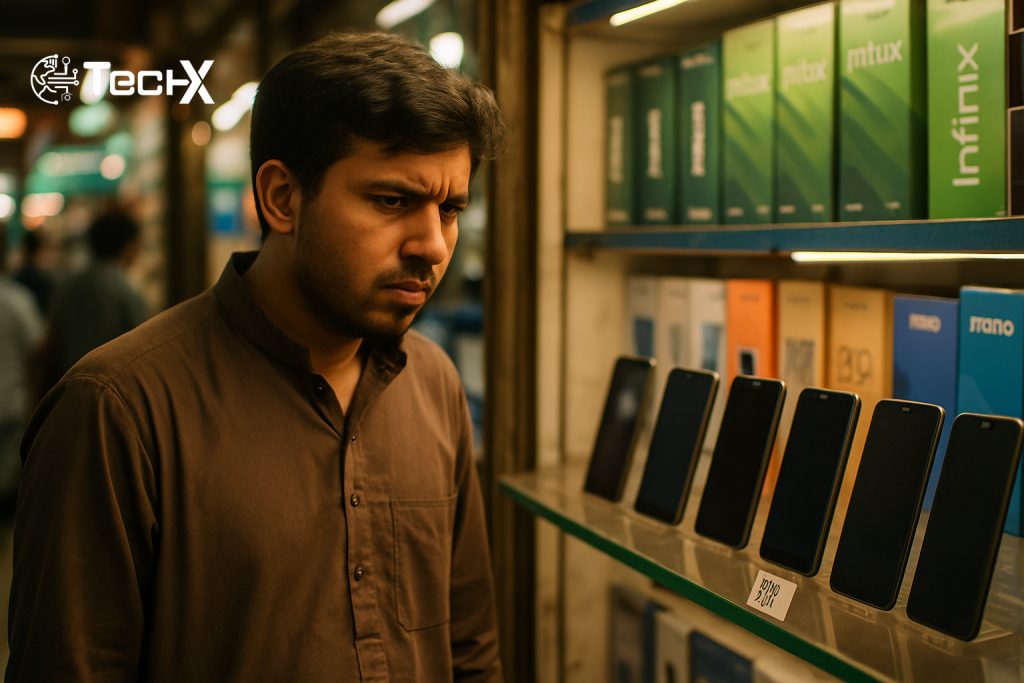
Budget phone prices in Pakistan are rising in 2026 for a reason that has nothing to do with rupee depreciation or import taxes. A structural shift in global memory chip manufacturing, driven entirely by the artificial intelligence boom, is squeezing the very components that make affordable smartphones possible. The result is bad news for the millions of Pakistanis who rely on sub-Rs 30,000 devices as their primary connection to the internet, banking apps, and digital services.
Why AI Data Centres Are Threatening Budget Phone Prices in Pakistan
The three companies that manufacture almost all the world’s DRAM memory, Samsung, SK Hynix, and Micron, are facing an extraordinary demand surge from hyperscalers like Google, Microsoft, Meta, and Amazon. These companies are building AI data centres at a pace never seen before, and each AI server requires enormous quantities of a specialised chip called High-Bandwidth Memory, or HBM.
The problem is a manufacturing reality with direct consequences for Pakistani phone buyers. 1GB of HBM consumes four times the wafer capacity of standard DRAM, while GDDR7 requires 1.7 times. This multiplier effect is enormous at scale. When factoring in the equivalent wafer usage of high-speed memory like HBM and GDDR7, AI could effectively consume nearly 20% of global DRAM supply by end-2026.
The voracious demand for HBM by hyperscalers has forced the three biggest memory manufacturers to pivot their limited cleanroom space and capital expenditure towards higher-margin enterprise-grade components. This is a zero-sum game: every wafer allocated to an HBM stack for an Nvidia GPU is a wafer denied to the LPDDR5X module of a mid-range smartphone.
This is not a temporary bottleneck. Unlike the 2020-2023 global chip shortage, which stemmed primarily from pandemic-related supply chain disruptions, this shortage is driven by a structural reallocation of manufacturing capacity toward high-margin products for AI data centre infrastructure. According to a 2026 Kearney analysis, the shortage is expected to last at least until 2030.
The Direct Impact on Budget Phone Prices in Pakistan
The numbers are stark. According to Counterpoint Research, mobile DRAM prices have risen close to 70% since early 2025. NAND flash, which handles storage, has nearly doubled in the same window.
Entry-level phones are hardest hit because of how their costs are structured. Budget phones under $200 are the most exposed because memory makes up 25 to 30% of their entire bill of materials. There is almost no margin left to absorb a 70% input cost increase. For context, $200 is roughly Rs 55,000 at current exchange rates, meaning a huge portion of Pakistan’s active smartphone segment sits squarely in this danger zone.
The very cheapest devices face an even bleaker outlook. IDC warns that entry-level phones under $100 will effectively disappear this year, and that the average smartphone will cost $523, the highest price on record. A $100 phone translates to approximately Rs 27,000 to Rs 28,000 at today’s rates. That is precisely the segment that brands like Infinix, Tecno, Redmi A-series, and itel have traditionally dominated in Pakistan.
Between Q1 2025 and Q1 2026, LPDDR4 memory prices, the standard in budget Android phones, rose 250%. Legacy DRAM (DDR4, LPDDR4) is entering accelerated end-of-life, and spot pricing is now rising faster than some leading-edge parts due to reduced output. This directly affects the affordable Xiaomi, Samsung Galaxy A-series, Tecno, and Infinix devices that Pakistani consumers search for every day.
You can read more about how the global memory supercycle is affecting RAM and storage pricing in the region in our earlier coverage of Micron RAM prices in Pakistan and the 2027 AI memory supercycle, and how SK Hynix’s strategic moves are shaping RAM and SSD prices for Pakistani buyers.
Pakistan’s Budget Segment: The Specific Risks
The sub-PKR 30,000 category remains critical for digital inclusion in Pakistan. These are not luxury purchases; they are gateway devices that determine whether someone can access online education, digital payments, or remote work opportunities.
Pakistan’s budget smartphone ecosystem is dominated by Chinese brands competing on very thin margins. Budget Android brands operating on thin margins, like Transsion (parent of Infinix and Tecno), Oppo, Vivo, and Xiaomi, are hit hardest. Memory makes up a larger share of their manufacturing costs, and they have less room to absorb price spikes.
Manufacturers are now facing a difficult choice. Unable to sustain margins amid soaring memory costs, manufacturers are deploying aggressive mitigation strategies. Some brands are downgrading camera modules, displays, and audio components, while others are reverting base models to 4GB DRAM configurations, a spec level not seen since 2020. Pakistani buyers at the Rs 20,000 to Rs 35,000 price point may soon find that phones in this range offer noticeably worse hardware than what was available just two years ago.
These price rises will be significantly higher at the low end of the market, where margins are extremely tight, and OEMs will have to pass the cost to end users. Regardless of the severity of the scenario, longer replacement cycles are likely in markets with rising costs causing lower purchasing power. This is a realistic concern for Pakistan, where many users already hold onto phones for three to four years.
No Quick Relief in Sight
A leaked SK Hynix internal analysis forecasts PC DRAM supply trailing demand until at least late 2028, and general industry consensus is that meaningful relief for DDR5 and LPDDR5 supply at prices suitable for consumer products will not come until 2028 or 2029 at the earliest.
Unlike previous memory shortages, which were typically caused by natural disasters, production accidents, or coordinated supply cuts, the 2026 shortage is being driven by a genuine surge in demand from the AI sector that shows no signs of abating. Building new fab capacity takes four to five years and billions of dollars in capital expenditure, which means there is no short-term fix.
For Pakistani consumers, this is a practical reality to plan around. Replacing an ageing device sooner rather than later, before further price increases hit, is something buyers across price segments should consider. The budget phone prices Pakistan shoppers are accustomed to seeing will not return to earlier levels for several years.
Frequently Asked Questions
Why are budget phone prices in Pakistan rising in 2026?
The core reason is a global memory chip shortage caused by AI data centres consuming a growing share of DRAM wafer capacity. As manufacturers prioritise high-margin HBM chips for AI servers, less supply remains for the LPDDR memory used in affordable smartphones, pushing up costs that brands pass on to buyers.
Which smartphones in Pakistan are most affected by the memory shortage?
Entry-level and budget devices in the Rs 15,000 to Rs 55,000 range are most at risk. Brands like Infinix, Tecno, Redmi, and Xiaomi that compete heavily in sub-Rs 35,000 segments face the tightest margins and the least ability to absorb rising memory costs without raising prices or cutting specifications.
Will sub-Rs 30,000 smartphones disappear from Pakistan’s market?
IDC has warned that sub-$100 phones (approximately Rs 27,000 to Rs 28,000) risk disappearing globally in 2026. For Pakistan, the more likely outcome is that phones in this range will survive but with noticeably downgraded specifications, such as less RAM, slower storage, or weaker cameras, compared to current offerings.
When will smartphone memory prices come down in Pakistan?
Industry analysts, including those at SK Hynix and IDC, do not expect meaningful relief in LPDDR and consumer DRAM supply until 2028 at the earliest. New fabrication capacity takes years to build, and AI demand shows no signs of slowing, meaning elevated budget phone prices in Pakistan are likely to persist through at least 2027.