
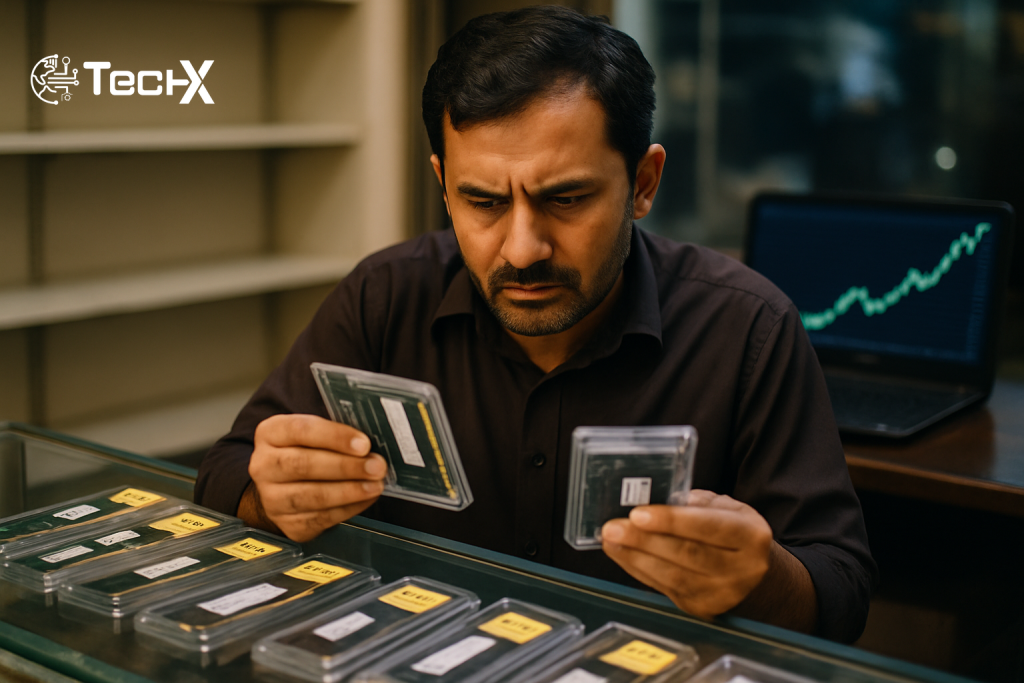
The SK Hynix Nasdaq listing is one of the biggest financial events in the global semiconductor industry in years, and its consequences will be felt in computer markets from Seoul to Karachi. South Korea’s SK Hynix, the world’s second-largest memory chipmaker and the dominant supplier of high-bandwidth memory (HBM) to AI giants, formally filed with the US Securities and Exchange Commission on June 24, 2026 to list American depositary shares (ADS) on the Nasdaq stock exchange. The company aims to raise around $29 billion, making it one of the largest technology listings in recent memory. For Pakistani hardware buyers, IT importers, and startups, this milestone carries serious implications worth understanding.
What Exactly Is the SK Hynix Nasdaq Listing?
SK Hynix, the world’s second largest memory chipmaker, plans to raise around $29 billion on the Nasdaq by issuing American depositary receipts (ADRs), according to the firm’s regulatory filing. The company plans to issue 17.79 million new shares at a value of 45.45 trillion won, and expects to start trading on July 10, though the dates are tentative and subject to change.
The firm says the ADR listing will expand its investor base, and stated it expects to “elevate our status as a global company by broadening our touchpoints in the United States, the epicenter of AI technological innovation.” Its market capitalisation now stands at roughly $1.2 trillion, a milestone that pushed it past Samsung Electronics this week to claim the top spot among South Korean listed companies, with its stock gaining more than 300% this year alone.
SK Hynix and NVIDIA: The AI Memory Partnership Behind the Numbers
The listing is not happening in a vacuum. SK Hynix has cemented itself as the critical link between AI computing and physical hardware. The South Korean chipmaker is the main supplier of high-bandwidth memory to Nvidia, and has lined up Citigroup, JPMorgan, Goldman Sachs and Bank of America to manage the offering.
Nvidia and SK Hynix signed a multi-year co-development deal for next-generation AI memory, covering HBM4 and the Vera Rubin platform, with SK Hynix holding an estimated 60 to 70% of HBM4 volume for Vera Rubin, cementing its lead over Samsung and Micron. SK Hynix holds about 60% of the HBM market share overall, according to Counterpoint Research. This lock-in between the world’s two most powerful AI infrastructure companies means that the bulk of SK Hynix’s production capacity will remain focused on premium AI memory, not the consumer-grade chips that end up in Pakistani laptops and smartphones.
As AI factories scale globally, this strategic partnership enables memory supply to keep pace with NVIDIA’s infrastructure roadmap, and SK Hynix will diversify into new markets including AI infrastructure, personal AI, and physical AI, co-developing memory for NVIDIA Vera Rubin AI supercomputers and RTX Spark-powered PCs.
SK Hynix Nasdaq Listing and the Global Memory Shortage Explained
The core problem for ordinary consumers and businesses is structural, not temporary. A global computer memory supply shortage began in 2025 due to supply constraints and rapid price escalation in DRAM and NAND flash memory, driven by a structural reallocation of manufacturing capacity toward high-margin products for AI data center infrastructure, creating scarcity of computer memory in consumer and enterprise PC markets.
The voracious demand for HBM by hyperscalers such as Microsoft, Google, Meta and Amazon has forced the three biggest memory manufacturers, Samsung Electronics, SK Hynix, and Micron Technology, to pivot their limited cleanroom space and capital expenditure towards higher-margin enterprise-grade components. This is a zero-sum game: every wafer allocated to an HBM stack for an Nvidia GPU is a wafer denied to the LPDDR5X module of a mid-range smartphone or the SSD of a consumer laptop.
The numbers illustrate just how severe this has become. Consumer memory and storage prices surged significantly during the second quarter of 2026, with some components recording increases of more than 100%, as global supply shortages continue to impact the electronics industry. A 96Gb LPDDR5X chip jumped by approximately 89%, while 256GB UFS 3.1 storage, commonly used in smartphones, surged by 103%. Market forecasts suggest the supply shortage could persist until 2028, meaning consumers may continue to face elevated prices for memory, storage, and devices that rely on these components.
What This Means for Pakistan’s Hardware Market
Pakistan imports 100% of its RAM and SSD components, which means every global price movement hits local markets with extra force. In Pakistan, the global crisis gets amplified. Since RAM is 100% imported, every rise in the USD to PKR exchange rate increases the cost significantly, and a 1 to 2% fluctuation in the dollar often translates into a disproportionate increase in retail price, especially when retailers expect future shortages.
Pakistani IT importers and hardware resellers are already navigating a difficult environment. Suppliers are actively managing scarcity, not racing to solve it. Micron, SK Hynix, and Samsung are preventing panic buying by locking in customers with allocation-only frameworks that favour hyperscalers and large OEMs. Smaller buyers are critically disadvantaged. This means Pakistani importers, who are typically smaller buyers without long-term supply contracts, face the back of the queue when allocating stock.
The ripple effect on assembled PCs, laptops, and smartphones sold in Pakistan is direct. Lenovo, Dell, HP, Acer, and ASUS have already warned of 15 to 20% PC price increases for 2026 due to DRAM and NAND shortages, and some reports note it could climb up to 30% as component shortages worsen. Those price hikes will be passed on to Pakistani buyers in rupee terms.
For Pakistani tech startups building AI products or cloud infrastructure locally, the timing of the SK Hynix Nasdaq listing is a signal that premium AI memory will remain expensive and tightly controlled. Pakistan’s own growing AI ambitions, including platforms like Telenor Pakistan’s sovereign AI cloud GPU platform, depend on international supply chains where SK Hynix holds enormous sway.
What Pakistani Buyers and IT Importers Should Do Now
- Buy sooner rather than later. Prices are expected to continue climbing through the remainder of 2026, with the peak expected in Q3 to Q4 2026, and prices are unlikely to decrease before mid-2027.
- Audit current hardware carefully. For PC users, upgrading RAM and storage in existing devices may be more cost-effective than buying entirely new systems, assuming your device supports component upgrades. However, even aftermarket memory modules have seen significant price increases.
- Watch out for spec downgrades. Some manufacturers are responding to the shortage by offering less RAM or storage in their mid-range devices while maintaining the same model names. A 2026 mid-range smartphone might come with 6GB of RAM where the 2025 version offered 8GB. These specification downgrades may not be prominently advertised, so checking detailed specs before purchasing is important.
- Budget for higher server costs. Gartner has reported that memory price increases pushed server costs up by more than 125% in the first half of 2026. Businesses planning server or data centre refreshes in Pakistan should factor this into their 2026 and 2027 budgets.
- Explore the refurbished market. The refurbished market is seeing significant demand growth as consumers seek lower-priced options.
When Will Prices Come Down?
According to a 2026 Kearney PERLab analysis, the shortage is expected to last at least until 2030. However, not everyone agrees that the peak will be permanent. While the memory supercycle continues, cautious perspectives regarding price, supply, and geopolitical risks coexist. Some market researchers suggest that HBM prices could enter a correction phase after 2026 due to intensified competition and expanded production capacity. The SK Hynix Nasdaq listing itself is partly aimed at funding new fabrication capacity, but new fabrication capacity from major suppliers will not reach volume production until 2027 at the earliest.
For now, the SK Hynix Nasdaq listing is a clear signal to Pakistan’s tech ecosystem: the AI memory supercycle is not slowing down, and the companies driving it are deepening their investment in that direction. Pakistani hardware buyers, startup founders, and IT procurement managers need to plan their hardware spend with this reality in mind. Those who anticipate the crunch will be far better positioned than those who wait and hope prices return to 2023 levels any time soon. For Pakistani IT businesses looking at the bigger picture of tech sector listings and investment signals at the PSX, the SK Hynix story also offers a broader lesson: global chip companies are treating AI infrastructure as a multi-year structural bet, not a short-term trend.
Frequently Asked Questions
What is the SK Hynix Nasdaq listing and why does it matter?
On June 24, South Korean chipmaker SK Hynix announced it has formally filed with the US Securities and Exchange Commission to list American depositary shares on the Nasdaq stock exchange. It matters because SK Hynix controls the majority of HBM supply used in AI hardware globally, and its strategic direction directly affects the supply and price of all consumer memory.
Will RAM and SSD prices go up in Pakistan because of this?
Yes, and they already have. Industry analysts attribute the shortage to memory manufacturers shifting production toward higher-margin products such as HBM, server DRAM, and enterprise SSDs, which are experiencing strong demand from AI data centres, cloud computing providers, and enterprise customers, reducing the production capacity available for consumer-grade memory and storage products. Since Pakistan imports all its memory components, local prices will continue to reflect global spikes, amplified by rupee depreciation.
How long will the memory shortage last?
HBM capacity is projected to remain tight through at least 2028, and some forecasts extend the constraint to 2030. New fab capacity will not meaningfully arrive until 2027, so relief before that point is unlikely.
What should Pakistani IT startups and businesses do right now?
Businesses should lock in hardware purchases sooner, review specifications carefully to avoid spec-downgraded devices, and build memory cost increases into their project and procurement budgets for the rest of 2026 and 2027. Those planning AI or cloud infrastructure should expect that global supply agreements favour large Western hyperscalers, leaving Pakistani buyers to pay market rates for whatever inventory filters through.