
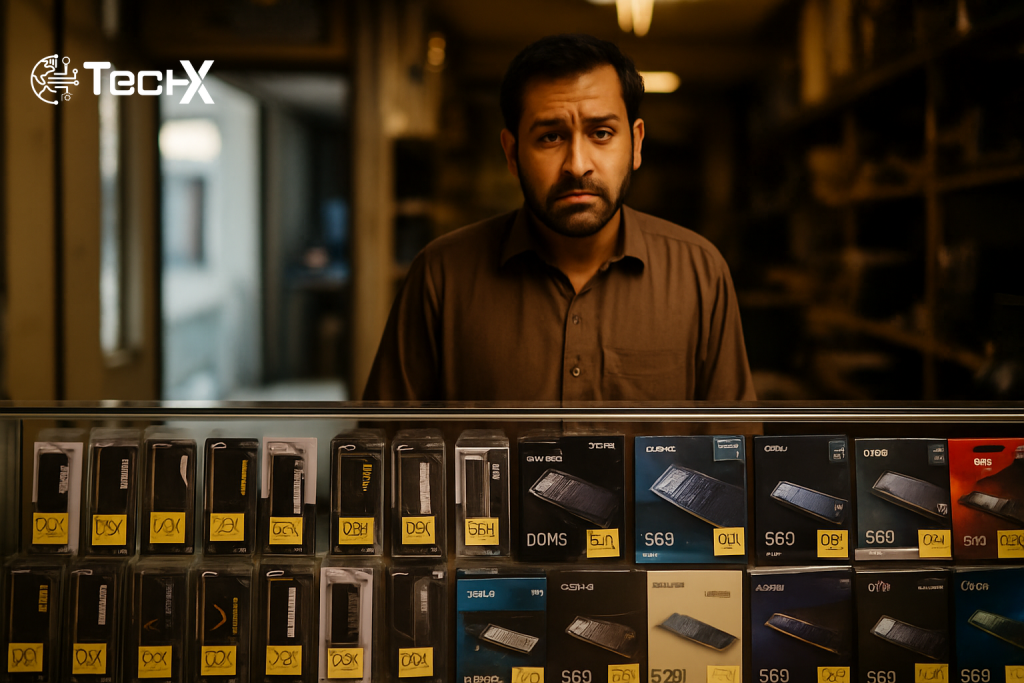
Micron RAM prices Pakistan are heading into a prolonged period of strain, and a single set of earnings numbers released this week explains exactly why. Micron Technology, the American memory giant, just posted a historic quarter that sent shockwaves through the global semiconductor industry, and the aftershocks will be felt in Hafeez Centre, Saddar market, and every IT import office across the country.
Micron’s Record Numbers: What Just Happened?
Micron delivered $41.46 billion in Q3 revenue and $25.11 in non-GAAP EPS, numbers that left Wall Street stunned. Analysts had anticipated EPS of $20.39 and revenue of $35.1 billion, making this one of the biggest earnings beats in the chipmaker’s history.
Micron delivered record revenue in fiscal Q3, driven by all-time-high DRAM revenue including nearly 50% sequential growth in HBM revenue, with data center revenue more than doubling year-over-year and reaching a quarterly record.
Data center revenue exceeded $25 billion in fiscal Q3, representing an annualized run rate of over $100 billion. That is not a chip company anymore, at least not in the old sense. Micron is now an AI infrastructure company, and that shift is precisely what will keep Micron RAM prices Pakistan elevated for years to come.
The company also announced it has signed 16 strategic customer agreements designed to lock in supply over several years. These deals include take-or-pay commitments, meaning customers commit to buying set volumes or paying anyway, and fourteen of them represent about $100 billion of minimum contracted revenue, with $22 billion of cash deposits and related commitments.
Why Supply Will Stay Tight: The AI Memory Supercycle
This is not a normal demand spike. DRAM and NAND industry demand continues to significantly exceed industry supply, and Micron expects tight conditions to persist beyond calendar 2027 as a result of AI-driven demand across all segments coupled with structural supply constraints.
The core problem is how manufacturers are allocating their limited silicon wafer capacity. The voracious demand for HBM by hyperscalers such as Microsoft, Google, Meta, and Amazon has forced the three biggest memory manufacturers to pivot their limited cleanroom space towards higher margin enterprise-grade components. This is a zero-sum game: every wafer allocated to an HBM stack for an Nvidia GPU is a wafer denied to the LPDDR5X module of a mid-range smartphone or the SSD of a consumer laptop.
The financial logic behind this pivot is stark. A single HBM3E module sells for roughly $60 to $100, compared to approximately $5 to $10 for a comparable amount of conventional DDR5 DRAM. Manufacturers will always chase the higher-margin product, and AI data centres are that product right now.
Micron’s entire HBM output for 2026 is locked up under fixed-price contracts, and the company estimates it can only satisfy somewhere between 50% and 67% of key customer demand over the medium term. That gap is the engine behind sustained pricing pressure across all memory categories.
Micron forecasts the HBM total addressable market will grow at a compound annual rate of about 40% through calendar 2028, rising from roughly $35 billion in 2025 to around $100 billion in 2028. NAND demand for AI workloads tends to follow HBM growth, suggesting the current upcycle could run from 2024 through 2028.
Micron RAM Prices Pakistan: The Direct Impact on Consumers and Importers
Pakistan is almost entirely dependent on imported hardware. Pakistan’s desktop PC market is shaped by import dependency, USD/PKR exchange rate sensitivity, and fragmented local distribution, with over 95% of new desktops sold in Pakistan imported as complete systems or assembled locally using imported components.
Globally, demand for RAM and SSDs is rising significantly due to installation in AI-based data centres. As a result, the prices of RAM and SSDs surged by 100% and 500% in 2025 and are expected to remain on an upward trend in 2026. Those numbers translate directly into higher rupee prices on every laptop, PC, and standalone memory upgrade sold at local markets.
The second half of 2025 and the beginning of 2026 have already seen some big bumps in laptop pricing. Before the price pandemic hit, most Pakistanis, instead of upgrading their laptops, used to upgrade different components like RAM capacity or storage capacity to save a few bucks. That affordable upgrade path is now largely gone, because the standalone RAM and SSD modules they would buy are caught in the same global supply squeeze.
Since importers settle invoices in USD, every 1 PKR depreciation against the dollar increases landed cost, often by 2 to 4% overnight. As of early 2026, the interbank USD/PKR rate has been pushing mid-tier laptop prices up by thousands of rupees on average. When global DRAM prices rise in dollar terms and the rupee simultaneously weakens, Pakistani buyers absorb a compounded hit.
The broader picture from IDC is equally sobering. What began as an AI infrastructure boom has now rippled outward, with tightening memory supply, inflating prices, and reshaping product and pricing strategies across both consumer and enterprise devices. The smartphone and PC markets are bracing for a period of higher costs, altered product roadmaps, and slower volume growth.
Pakistani IT importers and assemblers face an additional layer of difficulty. Many SSD form factors are already fully allocated into 2026, and suppliers will increasingly decline to support older nodes or offer only limited sample quantities. This means importers ordering stock for the second half of 2026 may struggle to secure adequate volumes at predictable prices, adding planning risk to already tight margins. Pakistan’s own infrastructure ambitions, including the country’s first sovereign AI cloud platform, will also require memory-intensive hardware that is growing more expensive by the quarter.
When Could Prices Ease?
Memory prices are likely to remain elevated through 2027 to 2028, with partial normalisation a realistic possibility only when new fabrication facilities reach volume production. An oversupply scenario in 2028 to 2029 remains a realistic possibility if AI demand moderates as capacity expands.
For consumers and enterprises alike, this signals the end of an era of cheap, abundant memory and storage, at least in the medium term.
There is also a structural dimension that makes this cycle different from previous ones. Micron, SK Hynix, and Samsung together control more than 95% of the global memory market. That level of consolidation creates a natural floor under pricing that did not exist during earlier cycles when a dozen smaller players would race to add capacity and crater margins.
For Pakistani consumers, the practical advice from the State Bank of Pakistan‘s own import cost guidance remains relevant: budget for USD-denominated hardware purchases to cost more whenever the rupee comes under pressure, and expect that pressure to persist as long as global memory tightness continues.
Industry voices within Pakistan are also calling for a structural response. P@SHA Senior Vice Chairman Muhammad Umair Nizam has said the government should develop a comprehensive hardware development policy to enhance local production of computers, laptops, tablets, and related systems. Without local manufacturing capacity, Pakistan will remain a price-taker in a market where AI demand is setting the terms.
What Pakistani IT Buyers Should Do Now
Given that Micron RAM prices Pakistan will stay elevated, here are some practical considerations for buyers and importers:
- Buy sooner rather than later. Channels are building inventory in advance to mitigate the impact of further price increases in the months ahead. Waiting is unlikely to bring lower prices before 2028.
- Prioritise DDR5 over DDR4. By late 2025, the DDR4 price premium had spiked so much that DDR5 and DDR4 now cost roughly the same, making the newer standard the better long-term investment.
- Importers should lock in volumes early. Spot market allocations are becoming unreliable as suppliers are increasingly seeking hard orders or binding commitments to support allocation.
- Account for dual currency risk. Both global DRAM prices in USD and the PKR/USD exchange rate are working against Pakistani buyers simultaneously.
Frequently Asked Questions
Why are RAM and SSD prices rising in Pakistan in 2026?
Companies such as Samsung and Micron have shifted focus toward high-margin AI chips due to rising demand for data centres. This shift reduces the supply of DRAM and NAND memory used in everyday devices, causing memory prices to rise sharply and increasing manufacturing costs for smartphones and laptops. Pakistan’s near-total import dependency amplifies this global trend.
What did Micron’s Q3 2026 earnings reveal about memory supply?
DRAM and NAND industry demand continues to significantly exceed industry supply, and Micron expects tight conditions to persist beyond calendar 2027 as a result of AI-driven demand across all segments coupled with structural supply constraints. The record $41.5 billion quarterly revenue was built on exactly this tightness.
Will RAM prices in Pakistan ever go back to 2023 levels?
It is unlikely in the near term. Memory prices are likely to remain elevated through 2027 to 2028, with partial normalisation a realistic possibility only when new fabrication facilities reach volume production. Any price relief for Pakistani consumers is a 2028 story at the earliest, not 2026 or 2027.
How does the global memory shortage affect Pakistan’s IT sector specifically?
Rising costs of imported devices will increase expenditure of public and private sector entities and add significantly to the import bill. This is likely to affect the spending capacity of individuals and businesses across Pakistan, and may even slow down digital adoption across the country. For an economy trying to grow its IT exports and digital infrastructure, that is a serious challenge.