
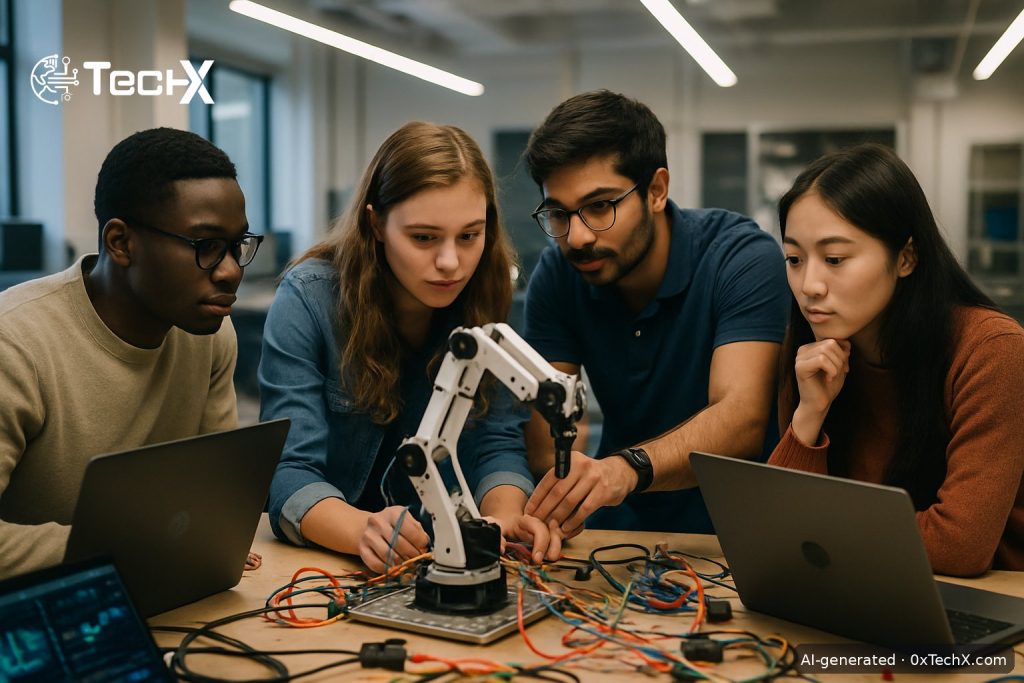
Pakistani robotics data startup World Context brought the World Context UC Berkeley hackathon to life in September 2026, pulling together 13 teams of students and researchers to build AI-powered robotics projects using data collected from factory floors in Pakistan. It is an early but concrete sign that Pakistan’s tech talent is finding a place inside the global robotics supply chain.
What Is World Context and What Does It Do?
World Context is a Pakistani startup founded in January 2026. It records how workers perform physical tasks in factories and other real-world settings and converts those recordings into datasets used to train robots. In simple terms, it films Pakistani factory workers doing their jobs, then sells that footage as training data to companies building robots in the United States and elsewhere.
This type of data is called human demonstration data. The hackathon highlighted the growing importance of human demonstration data in robotics. Recording how people perform tasks in real-world environments gives developers examples of physical tasks, helping them build and train systems designed to operate in the physical world.
The startup had already been building momentum before the Berkeley event. In August 2026, World Context, a startup building a data supply chain between local factory floors and the US robotics industry, partnered with Multinet Pakistan to support the infrastructure behind its growing library of real-world visual data. CEO Sherdil Ali Khan has spoken openly about his goal to position Pakistan inside what he calls the “superintelligence supply chain”, the full stack of compute, data, models and applications that power intelligent systems.
The World Context UC Berkeley Hackathon in Detail
World Context hosted its first hackathon at the University of California, Berkeley, bringing together 13 teams to build projects using the company’s datasets as part of an effort to expand artificial intelligence and technology ties between Pakistan and the United States.
UC Berkeley was chosen for the first hackathon because of its strengths in robotics and engineering and the opportunity to work directly with its students and researchers. That is a deliberate choice: Berkeley has one of the strongest robotics research programmes in the world, and placing a Pakistani company’s data at the centre of a Berkeley event sends a clear signal about where World Context wants to sit in the global AI ecosystem.
The event was held in partnership with student organisation Blockchain at Berkeley and was sponsored by Google Gemini, ElevenLabs, The Hackathon Company, Lovable, Praxis Robotics and UC Berkeley Startup. Getting Google Gemini as a sponsor for what is essentially a Pakistani startup’s first event on American soil is a notable achievement on its own.
Tracks, Winners and Prize Money
Participants competed across hardware, software and visualisation tracks using datasets supplied by World Context, with a total of $4,500 in cash prizes awarded.
- Hardware track: Sortbot, a project focused on building robots capable of sorting different types of objects, won the hardware track.
- Software track: Reconstructors, which focused on reconstructing World Context data in the physical world, won the software track.
- Visualisation track: A simulation produced by the same team (Reconstructors) won the visualisation track.
The projects developed during the event showed students were able to use the company’s human demonstration datasets in ways World Context itself had not anticipated. That kind of open-ended discovery is exactly what a good hackathon is meant to produce.
Why This Matters for Pakistan
Pakistan’s manufacturing sector is large and largely untapped as a source of AI training data. Manufacturing accounts for 14.8 percent of employment in Pakistan and 20.7 percent of urban employment, according to the Pakistan Labour Force Survey 2024-25. That is a huge pool of real-world work activity that World Context is now turning into a product the global robotics industry needs.
At the same time, Pakistan’s tech ambitions are growing fast. In FY2025-26, Pakistan’s ICT exports reached an impressive $4.6 billion, driven largely by a government-led strategy designed to scale the sector and incentivize local IT firms. The United States and Pakistan have also reaffirmed their commitment to expanding cooperation in technology, startups, research and innovation. World Context is arriving at exactly the right moment in that relationship.
The broader startup picture is also encouraging. As noted in our coverage of how investors view Pakistan’s startup ecosystem, Pakistan needs more than one breakout company to prove its tech sector can sustain global ambitions. A robotics data firm opening doors at one of America’s top engineering universities is a meaningful step in that direction.
What Comes Next for World Context
World Context aims to explore closer collaboration with other top universities and said large-scale visual datasets will remain important to robotics development. The company said it planned to work with universities on similar events in the future as it explores closer collaboration with academic institutions.
This is the piece most coverage of this story has glossed over: the Berkeley event is not a one-off. It is meant to be the first node in a network of university partnerships that keeps Pakistani-collected data flowing into American and global robotics labs. If World Context can repeat this model at other top engineering schools, it builds a durable bridge between Pakistan’s factory workforce and the robots being built to work alongside them.
For Pakistan’s young engineers and data scientists, that pipeline could eventually mean jobs, research collaborations, and a reason to build careers at home rather than abroad. The University of California, Berkeley is just the start.
Frequently Asked Questions
What is World Context?
World Context is a Pakistani robotics data startup founded in January 2026. It films workers doing physical tasks in Pakistani factories and turns those recordings into datasets that companies use to train robots. Its CEO is Sherdil Ali Khan.
What happened at the World Context UC Berkeley hackathon?
World Context hosted its first hackathon at UC Berkeley, where 13 teams built AI and robotics projects using the company’s factory datasets. The event covered hardware, software and visualisation tracks, and awarded $4,500 in total cash prizes. Sortbot won the hardware track and Reconstructors won both the software and visualisation tracks.
Who sponsored the hackathon?
The event was held in partnership with Blockchain at Berkeley and sponsored by Google Gemini, ElevenLabs, The Hackathon Company, Lovable, Praxis Robotics and UC Berkeley Startup.
Why does this matter for Pakistan’s tech sector?
It shows a Pakistani startup can put its technology at the centre of a top US university event and attract big-name sponsors. It also points to a new kind of tech export for Pakistan, not just code or services, but real-world AI training data gathered from Pakistan’s large manufacturing workforce. The company plans to run similar events at more universities, which could build a lasting Pakistan-US robotics collaboration.