
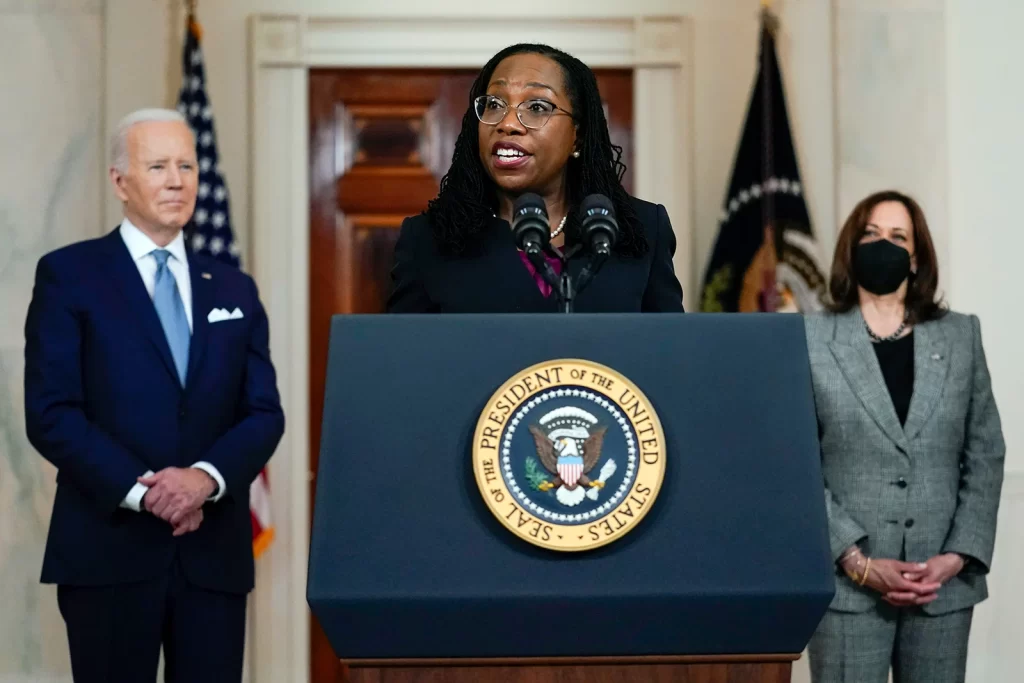
Ketanji Brown Jackson was approved by the US Senate on Thursday as the first Black woman to serve on the Supreme Court, marking a watershed moment for the country and a success for President Joe Biden, who fulfilled a campaign promise to diversify the federal judiciary.
The vote to approve the 51-year-old federal appellate judge to a lifetime appointment to the nation’s highest court was 53-47, with three Republicans — Susan Collins, Lisa Murkowski, and Mitt Romney — joining Biden’s fellow Democrats.
As Jackson overcame Republican resistance in a Supreme Court confirmation process that remained extremely politicized, a simple majority was required.
Jackson will replace the 83-year-old Breyer on a court with an increasingly assertive 6-3 conservative majority.
Breyer is scheduled to serve until the end of the court’s current term, which is generally in late June, following which Jackson will be properly sworn in. Jackson worked as a Supreme Court clerk for Breyer early in her career.
In the debate preceding the vote, Democrat Raphael Warnock, one of the Senate’s three Black members, said, “I’m the father of a young Black girl. I know how much it means for Judge Jackson to have navigated the double jeopardy of racism and sexism to now stand in the glory of this moment. Seeing Judge Jackson ascend to the Supreme Court reflects the promise of progress on which our democracy rests. What a great day it is in America.”
All but three of the 115 persons who have served on the Supreme Court since its inception in 1789 have been white. It has had two African-American justices, both men: Clarence Thomas, who was appointed in 1991 and is still serving, and Thurgood Marshall, who retired in 1991 and died in 1993.
Justice in the Present Sonia Sotomayor is the only Hispanic to have served on the court. Jackson is expected to become the sixth female justice in history.
Nominations to the Supreme Court by the president have become a flashpoint in American politics.
The court has significant sway over American policy on contentious subjects such as abortion, guns, voting rules, LGBT rights, religious liberty, the death penalty, and race-based policies.
To read our blog on “Tesla is being sued by the state of California for allegedly discriminating against black employees,” click here.