
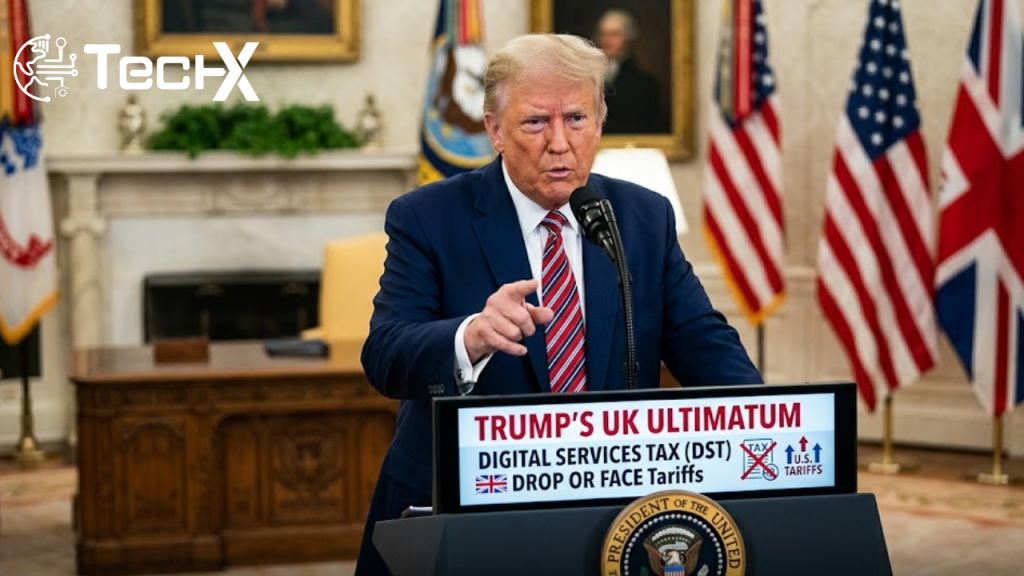
In a significant escalation of transatlantic trade tensions, U.S. President Donald Trump has issued a stern warning to the United Kingdom, demanding the immediate repeal of the Digital Services Tax (DST). Speaking from the Oval Office on April 24, 2026, the President asserted that the tax unfairly targets American technology giants including Google, Amazon, Meta, and Apple and warned of “heavy, reciprocal tariffs” on British exports if the policy remains in place.
The Core of the Conflict: Digital Services Tax (DST)
The dispute centers on a tax framework implemented by the UK that levies a fee on the revenues of large search engines, social media platforms, and online marketplaces derived from British users. President Trump has characterized this tax as a “direct assault” on American innovation.
-
The U.S. Perspective: The administration views the DST as a discriminatory measure specifically designed to extract wealth from U.S.-based companies.
-
The UK Defense: The British government maintains that the tax ensures multinational tech firms pay their fair share of taxes relative to the economic activity they generate within the UK.
A Threat of Reciprocal Tariffs
President Trump was explicit in his warning, suggesting that the United States is prepared to engage in a full-scale trade confrontation. He emphasized that the U.S. would not sit idly by while American companies are “taxed into submission” by foreign governments.
-
Reciprocity: Trump stated that the tariffs on British goods would be “at least equal” to the revenue lost by American companies due to the DST.
-
Targeted Sectors: While specific products were not named, trade experts suggest that high-value British exports such as Scotch whisky, luxury automobiles, and high-end textiles could be the first to face these retaliatory duties.
Impact on the 2025 Trade Agreement
This sudden friction threatens to destabilize the trade progress made between the two nations following the May 2025 Trade Framework. Although that agreement aimed to lower barriers, the issue of digital taxation was left unresolved, and it has now become the primary flashpoint in the “Special Relationship.”
-
Uncertainty for Businesses: The threat of a tariff war has already sent ripples through the markets, with British exporters and American tech firms bracing for a potential disruption in cross-border commerce.
-
Stalled Negotiations: Further talks regarding expanded market access are now reportedly on hold until the tax dispute is settled.
Diplomacy Amidst High Stakes Tensions
The timing of the threat is particularly sensitive as it precedes the highly anticipated state visit of King Charles III and Queen Camilla to the United States next week. While President Trump expressed personal respect for the British Monarch, he was quick to separate personal diplomacy from economic policy.
-
The King’s Visit: Trump noted that while the visit is an “important symbol of friendship,” it would not influence his decision to protect American economic interests.
-
Global Precedent: The U.S. administration is also using this threat as a warning to other European nations currently considering similar digital taxes, signaling that Washington is moving toward a more protectionist and “America First” trade stance in 2026.
The Road Ahead: Escalation or Compromise?
The international community is now watching closely to see if the UK government will blink under the pressure of potential tariffs. While Prime Minister’s Office at 10 Downing Street has expressed a desire for a “dialogue-based solution,” the White House seems determined to force a total withdrawal of the tax. If a compromise is not reached within the coming weeks, the world could witness a significant shift in trade dynamics between the two oldest allies, potentially leading to increased prices for consumers on both sides of the Atlantic.