
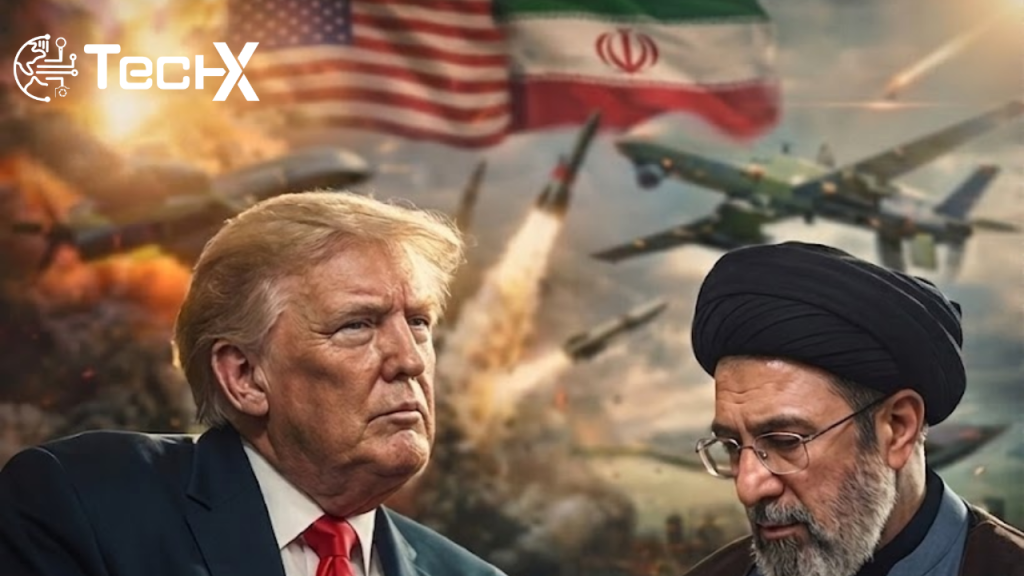
During a press briefing at the Oval Office on Thursday, April 23, 2026, President Donald Trump categorically ruled out the use of nuclear weapons in any ongoing or future conflict with Iran. When asked by a reporter if he would consider a nuclear option to end the hostilities, the President dismissed the inquiry as a “stupid question.” He emphasized that nuclear weapons are a catastrophic force that should ideally never be used by any nation, reaffirming his preference for conventional military might.
Success of Operation Epic Fury
The President justified his stance by stating that American forces have already achieved significant strategic goals using conventional weaponry. According to Trump, the ongoing military campaign—dubbed “Operation Epic Fury”—has been devastatingly effective.
-
Target Neutralization: Trump claimed that approximately 78% of Iran’s high-value military targets have already been destroyed.
-
Infrastructure Collapse: He asserted that the Iranian Navy is largely at the bottom of the sea and their Air Force has been “decimated,” rendering their defensive and offensive capabilities nearly non-existent.
Economic Blockade and the Strait of Hormuz
A key pillar of the President’s strategy remains the economic strangulation of the Iranian regime. He confirmed that the United States maintains total control over the Strait of Hormuz, a vital artery for global oil transit.
-
Financial Pressure: Trump noted that by keeping the Strait closed to Iranian exports, the regime is losing an estimated $500 million per day.
-
Strategic Patience: He stated that he is in “no rush” to reach a settlement, suggesting that time is on America’s side while Iran’s economy continues to spiral.
Humanitarian Intervention and Diplomatic Signals
In a surprising turn, President Trump revealed that a personal request from his administration led to a stay of execution for eight young women in Iran.
-
Moral Victory: He claimed that four of the women are set for immediate release, while the other four will serve an additional month in prison.
-
The Ultimatum: While acknowledging this as a positive sign, Trump reiterated his core demands: a permanent end to Iran’s nuclear program and the total cessation of funding for proxy groups like Hezbollah.
The Path to an Everlasting Deal
President Trump made it clear that the ultimate goal is not a temporary ceasefire but a permanent, “everlasting” agreement that ensures Iran never obtains a nuclear weapon. He warned that if the Iranian leadership does not come to the negotiating table soon, the U.S. military is “locked and loaded” to eliminate the remaining 22% of identified military targets.
Global Implications and Energy Security
The President’s remarks have sent a dual message to the world: a reassurance that the U.S. will not escalate to nuclear warfare, but a firm warning that it will continue to dominate the global energy corridor. By maintaining a naval blockade, the U.S. is effectively dictating the terms of the regional energy market, forcing allies and adversaries alike to look toward Washington for stability in the Persian Gulf.