
China launched three astronauts on a six-month mission on Sunday to monitor a critical phase of the space station’s development, with the last modules set to launch in the following months.
When finished by the end of the year, the space station would mark a key milestone in China’s three decades long human space program, which was officially approved in 1992 and code-named “Project 921.” It will also mark the beginning of China’s permanent presence in space.
The completion of the structure, which accounts for nearly a fifth of the mass of the International Space Station (ISS), is a source of pride for ordinary Chinese people and marks the end of President Xi Jinping’s ten years as the ruling Communist Party’s leader.
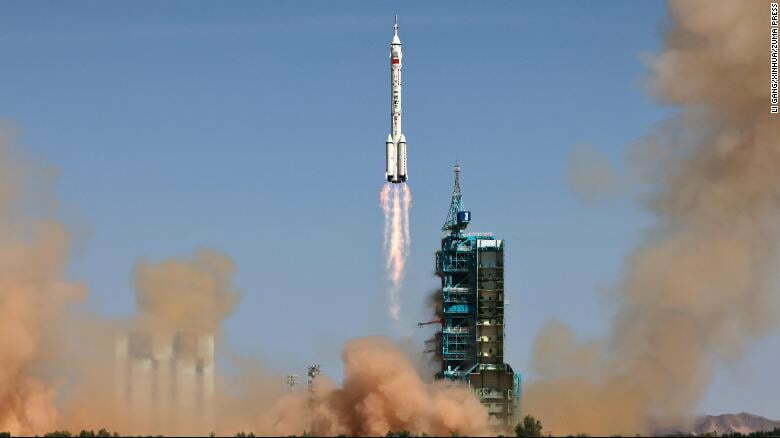
A Long March-2F rocket, which launched China’s first crewed spaceflight on the Shenzhou-5 mission in 2003, took off from the Jiuquan Satellite Launch Center in the Gobi Desert in northwest China at 10:44 a.m. (0244 GMT) with the spacecraft Shenzhou-14, or “Divine Vessel,” and its three astronauts, according to a live broadcast on state television.
“I watched the launch of Shenzhou-5 when I was a primary student, and now we have Shenzhou-14,” Zanna Zhang, a social media developer, told Reuters.
“Of course, I’m super excited, and I’m so proud as a Chinese. We’re one step closer to becoming a space superpower,” the 25-year-old said.
The first and largest of the three modules, Tianhe, which will house visiting astronauts, was launched in April of last year. In July and October, respectively, the lab modules Wentian and Mengtian will be released.
Chen Dong, 43, and companions Liu Yang, 43, and Cai Xuzhe, 46, all from China’s second astronaut cohort, will live and operate on the space station for around 180 days before returning to Earth in December when the Shenzhou-15 crew arrives.
To read our blog on “Four astronauts leave the ISS for a return journey to earth,” click here.