
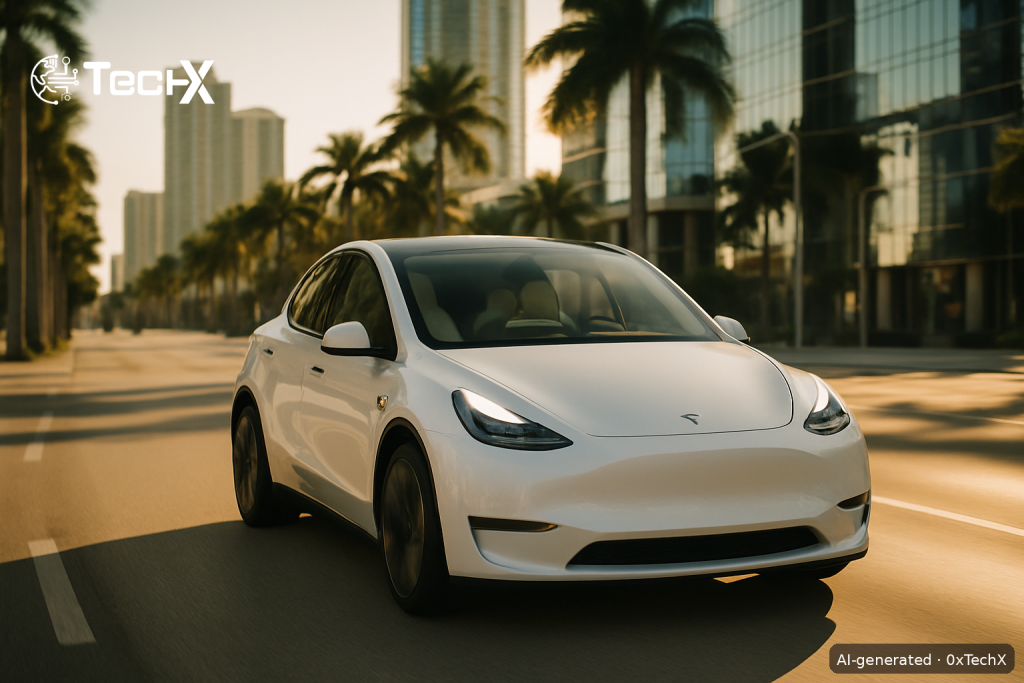
The Tesla robotaxi driverless era took a clear step forward on July 3, 2026, when Tesla put fully unsupervised Model Y cars on the streets of Miami with nobody in the front seat and no human watching from the back. This is not a small update to an existing pilot. It is the first time Tesla has entered a brand-new city with zero human oversight from the very first ride.
What Happened in Miami on July 3
Tesla launched fully driverless robotaxi service in Miami on July 3, skipping the human-monitored phase it used in every prior market and marking the company’s first time offering unsupervised rides in a brand-new city from day one.
The Miami rides are fully unsupervised from day one, no safety driver, no human in the front seat, a detail confirmed within hours of the announcement by Ashok Elluswamy, Tesla’s VP of AI Software, on X. Riders need the dedicated Robotaxi app on iOS or Android and should expect a waitlist.
The Miami launch makes Florida the third state, after Texas and California, to host Tesla’s robotaxi network. The service operates in a geofenced zone of roughly 10 to 14 square miles covering West Miami, Doral and Coral Gables, deliberately excluding downtown, Miami Beach and the airport.
This is a big deal because of how different it is from the rollout in other cities. When commercial operations began in Austin in June 2025, every vehicle carried a human safety monitor in the passenger seat for months before Tesla removed them. Dallas and Houston followed a similar phased approach. Miami skipped that transition entirely, going driverless immediately.
How Tesla Robotaxi Driverless Tech Actually Works
Tesla does not use the expensive sensors that most competitors rely on. Tesla’s approach relies on a camera-only sensor system, which is markedly cheaper to deploy than the lidar-and-radar suites used by rivals including Alphabet’s Waymo and Amazon’s Zoox, giving Tesla a cost advantage that supports faster geographic expansion.
The software behind the cars is called Full Self-Driving (FSD), Tesla’s AI-based driving system. Large-scale robotaxi expansions are slated to wait for the release of Full Self-Driving version 15, expected later this year or early next year, which will feature 10 times as many parameters as current builds.
The current fleet is composed entirely of Model Y vehicles, but the long-term objective is a transition to a custom robotaxi. The purpose-built Tesla Cybercab has begun public-road testing in Austin without a steering wheel, pedals, or any manual driving controls. Once that model debuts, it is expected to deploy directly into active Robotaxi markets and quickly surpass the Model Y in total numbers.
Is the Tesla Robotaxi Driverless Service Safe?
This is the question that matters most, and the honest answer is: we do not fully know yet. There is no disclosed Miami fleet size, no per-mile safety data for any of the unsupervised cities, and no independent certification behind the monitor removal.
The camera-only system also faces a real test in Florida’s weather. Florida’s sudden tropical downpours, intense sun glare and high humidity present driving conditions Tesla’s robotaxi network has not previously encountered at commercial scale. In March, the National Highway Traffic Safety Administration (NHTSA) escalated a probe into Tesla’s Full Self-Driving system to an engineering analysis after finding the camera-only system “fails to detect and/or warn the driver appropriately under degraded visibility conditions such as glare and airborne obscurants.”
Tesla’s Robotaxi network now spans four cities, but its authorized fleet in Texas stood at 42 vehicles as of Texas DMV filings, compared to Waymo’s 577 registered driverless vehicles in the same state. Tracking data put the actively operating unsupervised count in Texas at roughly 20 vehicles as of late May 2026.
The small fleet size matters. A 20-car service across a major metro is still more of a real-world test than a true transport network. Tesla knows this, and the Miami launch should be read the same way: a beachhead, not a finished product.
What This Means for Global AV Regulation
The Miami launch highlights a big gap in how driverless vehicles are regulated. Florida does not require a state-specific permit for autonomous vehicles, a regulatory environment that made it an attractive venue for Tesla’s expansion and helped the company reach unsupervised operation there ahead of competitors.
The US still lacks a single national law for autonomous vehicles. Instead, there is a messy mix of regulations. The United States has what is known as a self-certification regime. NHTSA creates specific standards and automakers self-certify. But if there is no standard specific to a given technology, there is nothing to self-certify, and NHTSA does not have specific standards for the performance of many advanced driver assistance systems.
This gap is exactly why Tesla can move fast. Taking out the human monitor raises the stakes on every ride, and regulators are watching. CEO Elon Musk said on an April earnings call that Tesla aims to offer unsupervised robotaxi service across a dozen US states by the end of 2026.
Elsewhere, the race is on. Both Tesla and Waymo now hold announced or active positions in the same Miami metro, which makes it the first market where the two robotaxi playbooks will compete for the same passengers on the same streets.
What Pakistan Can Learn From the Tesla Robotaxi Driverless Story
Pakistan does not have autonomous vehicles on public roads, and it will be years before that is a realistic conversation. But the broader EV transport picture is very much alive here.
The Government of Pakistan officially launched the National Electric Vehicle (NEV) Policy 2025-30. One of the major targets under the policy is to ensure that 30% of all new vehicles sold in Pakistan by 2030 are electric. This transition is projected to save 2.07 billion litres of fuel annually, amounting to nearly $1 billion in foreign exchange savings.
Ride-hailing companies and taxi service providers in Islamabad will be encouraged to implement projects for the use of new energy vehicles. That is a modest start, but it is a start. Electric rickshaws and bikes are already growing fast on Pakistani roads, and the subsidy programme is pushing that further. A quarter of all electric bike and rickshaw subsidies are reserved for women, helping them buy e-bikes at 25 to 30% below market rates, and this initiative also supports women-led delivery and ride-hailing ventures.
What the Miami story shows Pakistan’s planners is that the jump from basic EV adoption to autonomous ride-hailing is not small. It takes years of real-world data, a clear legal framework for liability, and a regulator willing to define rules before vehicles go out, not after. Pakistan’s NEV policy does not yet include an autonomous vehicle chapter, and that is the gap worth noting. Getting EV basics right now, including charging infrastructure and local manufacturing, is what will make the next stage possible later. For more context on how Chinese EV makers are shaping global and regional trends, see our coverage of BYD crossing 17 million NEVs, which shows the scale of competition Pakistani planners need to account for.
The Tesla robotaxi driverless model is a glimpse of where transport technology is heading. Pakistan has a decade, probably more, before anything like it lands here. But the regulatory and infrastructure decisions made today will determine whether the country is ready when it does.
Frequently Asked Questions
When did Tesla launch driverless robotaxi rides in Miami?
Tesla launched fully unsupervised robotaxi rides in Miami on July 3, its first city outside Texas and its first with no safety monitor from day one.
How do riders book a Tesla robotaxi in Miami?
Riders can hail a car through Tesla’s dedicated Robotaxi app on iOS or Android, though the company has told users to expect a waitlist, consistent with rollout patterns in its earlier markets.
Does Tesla publish safety data for its driverless rides?
Tesla has not published safety data specific to its unsupervised operations in any market. This is one of the key concerns raised by independent analysts and regulators watching the programme.
Could autonomous ride-hailing ever come to Pakistan?
Not soon. Pakistan is still building the foundation: EV charging stations, local manufacturing capacity, and basic EV adoption incentives. The NEV Policy 2025-30 plans for 3,000 charging stations by 2030, including Level 3 fast chargers and Level 2 chargers. Autonomous vehicles require all of that infrastructure plus a legal and regulatory framework that does not yet exist in Pakistan. It is a long road, but Miami shows where that road could eventually lead.