
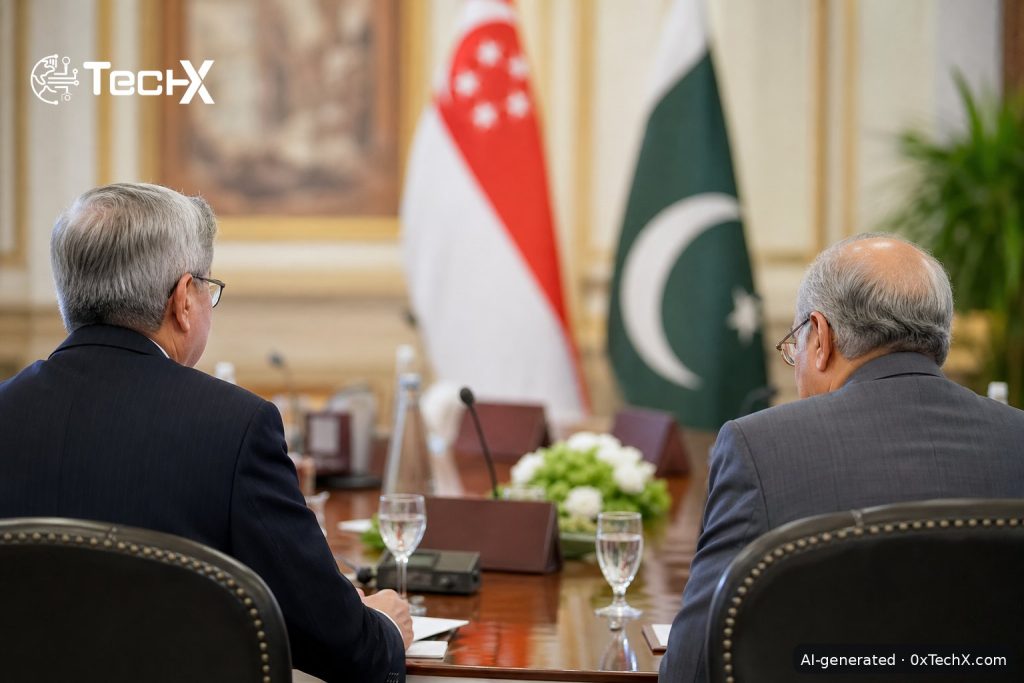
Singapore Pakistan fintech cooperation moved firmly onto the official agenda on 30 October 2026, when Singapore’s Foreign Minister Dr Vivian Balakrishnan visited Islamabad for high-level talks with Deputy Prime Minister and Foreign Minister Ishaq Dar. It was the first visit by Singapore’s foreign minister to Pakistan in more than two decades, and both sides pledged to boost trade and investment between their business communities.
A Visit Timed to Mark 60 Years of Ties
The two countries are marking 60 years of relations but have long struggled to match their political goodwill with actual trade, and earlier talks on a free trade agreement stalled without a deal. This visit was meant to change that story.
Dar acknowledged that the strength of Pakistan-Singapore diplomatic relations was not fully reflected in their economic ties, and said that economic diplomacy had been a priority since he joined the Foreign Office, expressing confidence that closer cooperation could take bilateral ties to a new level.
Despite excellent diplomatic relations, bilateral trade volumes remained below their potential and both sides agreed they need to increase substantially.
Singapore Pakistan Fintech and Digital Economy on the Table
The most significant moment for Pakistan’s tech sector came when both sides put the digital economy and fintech squarely in the priority list. The two sides discussed ways to increase bilateral trade and investment and expand cooperation in priority sectors, including the digital economy, financial technology (fintech), infrastructure development, logistics, small and medium-sized enterprises (SMEs) and services.
This is a notable signal. Singapore is one of the world’s leading fintech hubs, home to hundreds of financial technology companies and one of the most open regulatory environments for digital finance in Asia. Pakistan, on the other hand, has a rapidly growing but still underserved digital banking market. Pakistan’s digital banking sector has been developing slowly but surely, with the State Bank of Pakistan having approved five digital retail banks, and three now in operation. A closer tie with Singapore could bring capital, expertise, and partnerships to accelerate this.
The countries have explored cooperation in financial technology, the digital economy and food trade, with Pakistani companies already participating in the Singapore Fintech Festival, while officials have identified halal products as another potential area for commercial expansion.
For Pakistani startups and digital banks, this kind of government-level push matters. It creates a pathway for Singaporean venture capital and established fintech firms to look at Pakistan as a serious destination, rather than a frontier market to watch from a distance. You can read more about Pakistan’s own fintech growth on PSX in our coverage of the AdalFi IPO, which would make it the first fintech listed on the Pakistan Stock Exchange.
AI, Skills and Research in the Mix
The agenda went beyond money and markets. Dar said both sides discussed the scope for closer cooperation in education, research and innovation, including digital technologies and artificial intelligence, and agreed to deepen cooperation in human resource development, agriculture and climate domains.
Singapore’s FM Balakrishnan emphasised connecting SMEs across South Asia and Southeast Asia while exploring emerging sectors like carbon markets and credits, and both sides agreed to promote joint ventures across artificial intelligence, digital technologies, agriculture, and skills development.
Skills transfer is another angle worth watching. Both sides called for the early conclusion of cooperation arrangements between Singapore’s Institute of Technical Education and Pakistan’s National Vocational and Technical Training Commission (NAVTTC) on skills development. Pakistan has a large pool of young tech talent but limited access to world-class vocational and digital training. A link with Singapore’s institutions could open real doors for Pakistani workers and engineers.
Direct Flights and Business Connectivity
One practical outcome that could make a real difference for Pakistani businesses is the discussion on air links. The two leaders discussed the possible resumption of direct flights between Pakistan and Singapore to facilitate business travel and closer contact between their peoples. Right now, travelling between the two countries means a stopover, which adds cost and time for anyone trying to build cross-border business relationships. Direct flights would change that.
Pakistan Reopens Its Trade Office in Singapore
A concrete and immediate step was also announced. Dar said the reopening of Pakistan’s Trade and Investment Office at its High Commission in Singapore demonstrated Islamabad’s commitment to promoting stronger business-to-business ties. This office will be a direct point of contact for Singaporean investors and businesses looking at Pakistan, and for Pakistani exporters and startups trying to enter the Singapore market.
Dar also suggested that Pakistan’s Board of Investment could work with its Singaporean counterpart to identify investment opportunities and encourage business partnerships.
The ASEAN Angle Matters for Pakistan’s Tech Exports
There is a bigger strategic picture here too. Both sides discussed cooperation at multilateral forums and Pakistan’s enhanced engagement with ASEAN, particularly in the context of Singapore’s forthcoming chairmanship of the body in 2027.
ASEAN is a bloc of ten Southeast Asian economies with a combined GDP of around $3.6 trillion. Pakistan has been trying to deepen its links with the region as part of a broader push to grow exports and attract investment. Singapore holds the ASEAN chair in 2027, making it a useful partner for Islamabad to work with right now. Pakistan has sought closer engagement with the regional bloc as part of efforts to expand economic links with Southeast Asia.
For Pakistan’s tech and fintech sector, ASEAN connectivity means access to a market of 680 million people that is already comfortable with mobile payments, digital banking, and e-commerce. If Pakistani tech firms can use the Singapore bridge to enter that market, the opportunity is substantial. Pakistan’s government has also been pushing AI and digital projects hard, as seen in the PM Shehbaz November deadline for Alibaba AI projects, showing a consistent pattern of using bilateral ties to drive digital transformation.
What the MoU Actually Covers
The one formal agreement signed during the visit was on disaster management. The two sides exchanged a memorandum of understanding between Pakistan’s National Disaster Management Authority and the Singapore Civil Defence Force. This builds on a history of Singapore supporting Pakistan during crises. Singapore supported relief efforts following Pakistan’s devastating 2022 floods, while Pakistan has acknowledged donations from Singapore-based non-profit Temasek Foundation during the COVID-19 pandemic.
The fintech, digital economy, and AI cooperation remains at the discussion stage for now. No formal deals were signed on those fronts. But the direction is clear, and a high-level visit after more than two decades sends a signal that both governments are ready to move.
Frequently Asked Questions
What did Singapore and Pakistan agree on in the October 2026 Islamabad talks?
Both countries agreed to strengthen bilateral cooperation in trade, investment, the digital economy, fintech, AI, logistics, SMEs, skills development, and disaster management. They also discussed the possible return of direct flights and the reopening of Pakistan’s Trade and Investment Office in Singapore.
Why does Singapore matter for Pakistan’s fintech sector?
Singapore is Asia’s leading fintech hub, with a highly developed regulatory environment, strong venture capital presence, and deep connections across Southeast Asian markets. Closer ties give Pakistani fintech startups and digital banks better access to investment, partnerships, and a gateway into the broader ASEAN region of 680 million people.
What is the Pakistan Trade and Investment Office in Singapore?
It is an office within Pakistan’s High Commission in Singapore that serves as a formal channel for promoting business-to-business ties. It was recently reopened to signal Pakistan’s serious interest in building trade and investment links with Singapore and the wider Southeast Asian market.
How does Singapore’s ASEAN chairmanship in 2027 affect Pakistan?
Singapore will chair ASEAN in 2027, giving it extra influence over the bloc’s agenda. Pakistan is pushing for closer engagement with ASEAN as part of its export diversification strategy. Working closely with Singapore now positions Pakistan to benefit from that relationship when Singapore leads the bloc next year.