
Pakistan’s retail digital payments jumped 58% year-on-year in fiscal year 2025-26, with total retail transactions through formal banking channels hitting 14.3 billion, according to the State Bank of Pakistan’s Annual Payment Systems Review FY2025-26. The numbers confirm that Pakistan’s shift away from cash is no longer slow and steady, it is accelerating fast.
What the SBP FY26 Report Actually Shows
The headline figure is striking: retail digital payments grew from 9.1 billion transactions in FY25 to 14.3 billion in FY26. But there is an important detail buried inside the data that most coverage misses. While transaction volume jumped 58%, the total value of retail payments only grew by 10%, rising from Rs611.6 trillion to Rs672.7 trillion. That gap tells a clear story, Pakistanis are making far more transactions, but those transactions are mostly small, everyday payments, not large transfers. Think mobile top-ups, grocery payments, and utility bills, not property deals or wholesale transfers.
Digital channels now handle 13.2 billion of those 14.3 billion transactions, that is 92% of total retail payment volume, up from 88% in FY25. In real terms, Pakistan processed 5.2 billion more digital transactions this year than last, which is a remarkable shift in just twelve months.
Mobile Apps Are Running the Show
If one thing powered this surge in retail digital payments, it is the smartphone. Mobile phone-based payments accounted for more than 11.1 billion transactions during FY26, a rise of 79% from the previous year. These apps, offered by banks, branchless banking providers, and electronic money institutions (EMIs, or e-wallet companies), now sit at the centre of how most Pakistanis move money.
The user numbers back this up. Branchless banking mobile app users grew from 79.2 million to 99.1 million in FY26. Bank mobile app users rose from 24.1 million to 30.4 million, and e-money wallet users increased 37% to reach 7.9 million. Internet banking also recorded steady progress, handling around 300 million transactions, up 15% year-on-year.
Raast and Merchant Payments: The Next Big Push
SBP’s instant payment system, Raast, has become a backbone of the country’s digital finance ecosystem. By the third quarter of FY26 alone, Raast was processing 742 million transactions worth Rs23.27 trillion in a single quarter. Person-to-person (P2P) transfers and merchant payments (P2M) through Raast are both growing rapidly, with over 2.6 million merchants registered on the Raast P2M alias system by end of March 2026.
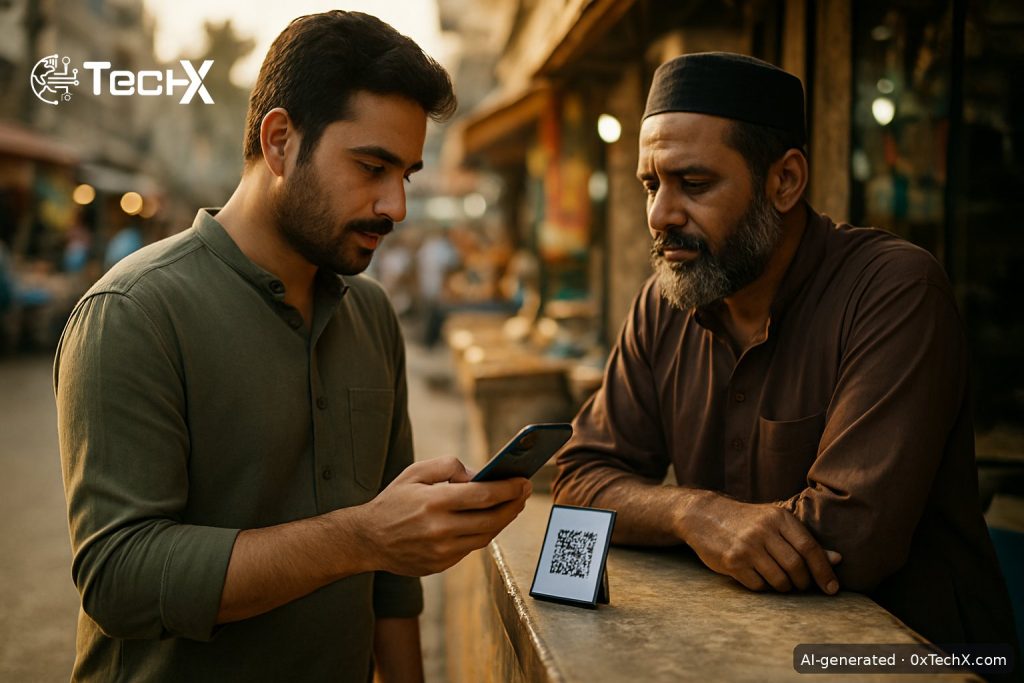
QR-based payments at physical shops are also growing fast. Transactions through QR merchants grew 41% quarter-on-quarter in Q3 FY26, with over 2.5 million micro-merchants now set up to accept QR and wallet-based payments. This is where the retail digital payments story gets most interesting for ordinary Pakistanis, paying at a corner shop with a phone, rather than cash, is becoming normal.
You can also read how SBP is upgrading the broader payment infrastructure in our article on the Pakistan Express Clearing System, which is modernising cheque processing alongside digital channels.
The Gap That Still Needs to Close
Here is the part the headline numbers do not show. Digital channels may handle 92% of payment volume, but they only account for about 38% of total payment value. Over-the-counter transactions through bank branches and branchless banking agents still account for roughly Rs415.7 trillion, or about 62% of all retail payment value in FY26. That means large-value transactions, business payments, property, wholesale trade, have not yet moved to digital channels in any meaningful way.
This is a real challenge for Pakistan’s broader digital economy goals. More Pakistanis than ever are tapping apps to pay for small things, but the big money still flows through counters. Closing that value gap is the real next chapter for fintech in Pakistan.
E-commerce is one area where digital is already winning. Account-based online payments now make up 96% of e-commerce transactions processed through banking channels, which is a near-complete shift. And point-of-sale (POS) terminals grew to 337,791 across 295,367 merchant locations, processing nearly 1.5 million card payments per day, compared to about 1 million per day in FY25. For more context on the broader digital payments trajectory, see our earlier report on Pakistan digital payments growth in 2026.
Why This Matters for Everyday Pakistanis
The 58% jump in retail digital payments is not just a statistic, it reflects a real change in daily habits. People are trusting their phones to pay bills, transfer money to family, and shop online. Banks and fintech companies are responding by expanding app features and lowering barriers to entry. The SBP’s own policies, including the push for Raast adoption and financial inclusion targets, have clearly helped accelerate this.
For businesses, especially small retailers and freelancers, this growth means more customers who prefer to pay digitally. For the government, it means more transactions are visible, trackable, and ultimately taxable, a key goal for broadening the formal economy.
Frequently Asked Questions
How much did Pakistan’s retail digital payments grow in FY26?
Pakistan’s retail payments through formal banking channels reached 14.3 billion transactions in FY26, a 58% increase in volume year-on-year. Digital channels accounted for 13.2 billion of those transactions, up 65% from FY25, with their share of total retail payments rising to 92%.
What is driving the growth in digital payments in Pakistan?
Mobile banking apps are the biggest driver. Mobile phone-based payments hit 11.1 billion transactions in FY26, up 79% from FY25. The expansion of Raast, growth in QR merchant acceptance, and a rising base of branchless banking users, now at 99.1 million, are all fuelling the shift.
Do digital channels handle most of the payment value too?
Not yet. While digital channels handle 92% of retail payment volume, they only account for about 38% of total retail payment value. Over-the-counter transactions at bank branches and branchless banking agents still dominate in value, making up roughly 62% of all retail payment value in FY26.
What is Raast and why is it important for Pakistan’s payment system?
Raast is the State Bank of Pakistan’s instant payment system. It allows real-time, low-cost transfers between individuals, merchants, and institutions. By Q3 FY26, Raast was handling 742 million transactions per quarter, and more than 2.6 million merchants had signed up to receive payments through the system.