
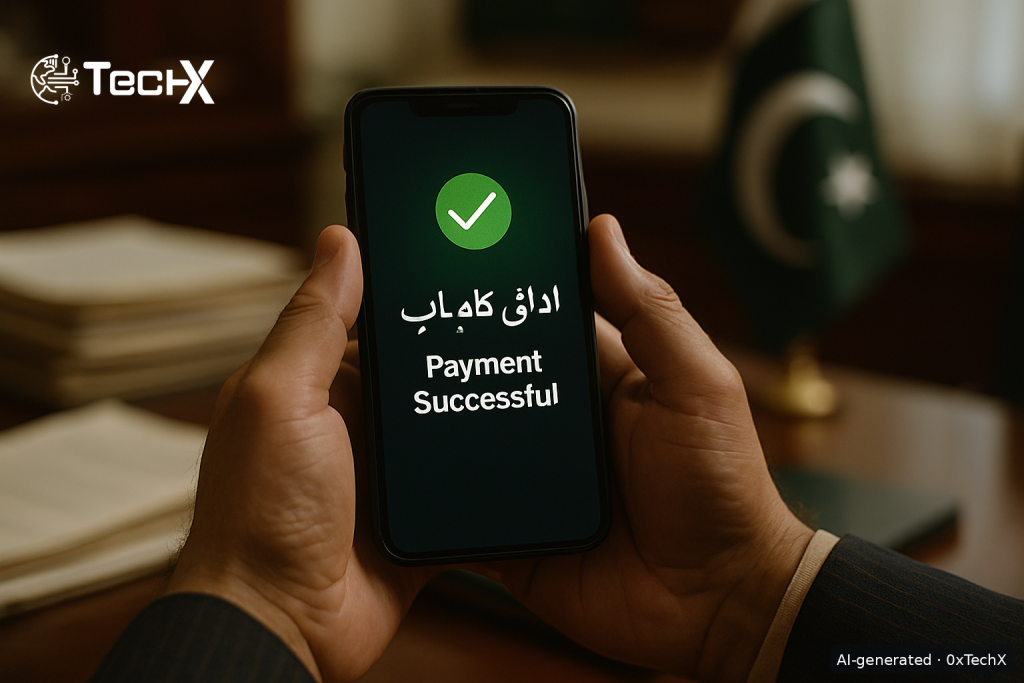
Government payments Raast migration is no longer a pilot project or a distant goal, the State Bank of Pakistan has confirmed it will route every federal salary, pension, supplier bill and welfare transfer through Raast before the close of fiscal year 2025-26. For Pakistan’s 48 million Raast users, that shift is about to make public money move faster, more transparently and with far less paperwork than ever before.
What SBP Actually Said
In October 2025, SBP Deputy Governor Saleem Ullah made the commitment public at the launch of a UN Better Than Cash Alliance study on merchant payments. “We have plans that with the close of this fiscal year we will be having all government payments go to Raast. We are working very aggressively,” he said. That statement covers the full range of government-to-person (G2P) disbursements: monthly salaries for federal employees, pension payouts, vendor invoices from government suppliers, and social safety-net transfers including programmes modelled on Ehsaas and BISP.
The SBP and the Controller General of Accounts Pakistan (CGAP) had already signed an MoU to digitise federal payroll through Raast. Under that agreement, payroll and pension data moves from CGAP’s systems to Raast through a secured interface. Raast then checks each beneficiary’s bank details in real time before the funds land in the account, so no money goes to the wrong person.
Why Government Payments Raast Integration Is a Big Deal
Pakistan still runs largely on cash. More than 85% of the country’s transactions are done in notes and coins, and the SBP estimates that Rs11.2 to Rs11.3 trillion sits outside the formal banking system. When the government pushes all its disbursements onto Raast, it forces a large chunk of that informal economy into a digital trail. The SBP has said that redirecting even Rs2.5 to Rs3 trillion of that cash back into banking channels would benefit banks, fintechs and the wider economy.
There is also a leakage problem. Cash-based government payments have historically been hard to track. Duplicate entries, ghost employees and delays in pension payouts are well-documented problems in Pakistan’s public finance system. A digital record on Raast creates an audit trail that cash never could.
How Fast Is Raast Growing?
The numbers behind Raast’s growth make the SBP’s confidence easier to understand. According to the SBP’s Financial Stability Review for 2025, Raast processed nearly Rs50 trillion in transactions last year across almost two billion transactions, and its user base reached 48 million individuals. To put the speed of adoption in perspective: the first Rs1 trillion in Raast transactions took 360 days to process, but today that same volume flows through the system every nine days.
The momentum continued into 2026. In just the January to March 2026 quarter, Raast processed 742.1 million transactions worth Rs23.3 trillion. Person-to-merchant (P2M) payments, which are still the weakest link in Raast adoption, jumped from 36.3 million to 55.9 million transactions in that same quarter, a sign that businesses are slowly coming on board too. Mobile banking and digital wallet registrations also crossed 132 million by end of March 2026, up 37% from a year earlier.
On the bulk payments side, which is the channel most relevant to government payroll, Raast Bulk processed over 9 million transactions worth PKR 2.6 trillion in Q2 FY26 alone, used heavily for salary and vendor disbursements by government departments and large corporate payers.
What Changes for Ordinary People
For a retired federal government employee, the most immediate change is simple: no more queuing at a bank branch on pension day. Payments will land directly in the account the moment the government processes the disbursement. The SBP has consistently flagged that pensioners who wait hours at bank counters to cash cheques will benefit the most from this shift.
For Ehsaas-style welfare recipients, a Raast-based transfer means the money arrives instantly and without any intermediary taking a cut. The SBP has specifically said it is working to bring social safety-net programmes including BISP onto the Raast rail. A digital transfer also gives recipients a record of the payment, which matters when disputes arise.
For government suppliers and vendors, instant settlement means they no longer need to wait for a cheque to clear or a bank to process a batch payment. That helps small businesses manage their cash flow, something that matters especially for the thousands of small vendors who supply government offices across Pakistan.
The Merchant Side Still Needs Work
Moving government disbursements onto Raast is the easier half of the equation. The harder challenge is getting everyday merchants to accept Raast payments from those same beneficiaries once the money lands in their accounts. Right now, merchant adoption remains low. To fix that, the government has committed Rs3.5 billion in subsidies covering September 2025 to June 2026, reimbursing merchants at 0.5% of each Raast QR-based transaction or Rs100, whichever is lower. The programme runs for three years in total.
The UN Better Than Cash Alliance, which co-authored the SBP-commissioned study, has recommended a 0.35% merchant discount rate floor to make the system commercially viable for banks and fintechs while keeping costs low for small retailers. Micro and small businesses still resist digital payments, partly because of thin margins, and partly because formal digital records make them visible to tax authorities. Those cultural and structural barriers will not disappear overnight, even with subsidies.
What This Means for Pakistan’s Digital Economy
Routing all government payments through Raast does something no promotional campaign can: it makes digital payments unavoidable for a large slice of the population. Millions of civil servants, pensioners and welfare recipients who might never have downloaded a banking app will now receive money through Raast by default. That creates a base of active digital payment users from which merchant adoption, e-commerce and broader financial inclusion can grow.
The Better Than Cash Alliance’s managing director has said Pakistan has everything it needs to go cashless within three years. The government payments Raast push is the structural move that makes that timeline credible, not because it solves every problem, but because it locks in the habit for the biggest single pool of payment recipients in the country.
For a deeper look at how Pakistan’s digital infrastructure is evolving, see our analysis of how PTA’s spectrum decisions are shaping Pakistan’s 5G rollout, the connectivity layer that makes mass digital payments possible in the first place.
Frequently Asked Questions
What is Raast and who runs it?
Raast is Pakistan’s first instant payment system, built and run by the State Bank of Pakistan (SBP). It settles payments between individuals, businesses and government entities in real time at no cost to the sender or receiver. It launched in 2021 and now has 48 million registered users.
Which government payments will move to Raast?
The SBP’s plan covers all federal government disbursements: salaries for civil servants, pension payments for retired employees, supplier and vendor invoices, and welfare transfers such as those under BISP and Ehsaas-style programmes. Provincial governments are expected to follow once the federal rollout is complete.
Do I need a new account to receive my salary or pension through Raast?
No. If your salary or pension already goes into a bank account, it will still go to the same account, just through the Raast rail instead of older payment channels. The system verifies your details with your bank in real time before releasing funds, so you do not need to do anything extra.
Is Raast free to use?
Yes. Person-to-person (P2P) transfers on Raast are free for individual users. The SBP has confirmed there are no plans to charge individual senders for P2P transactions. A merchant discount rate applies on person-to-merchant QR payments, but that cost is borne by the merchant, not the customer sending money.