
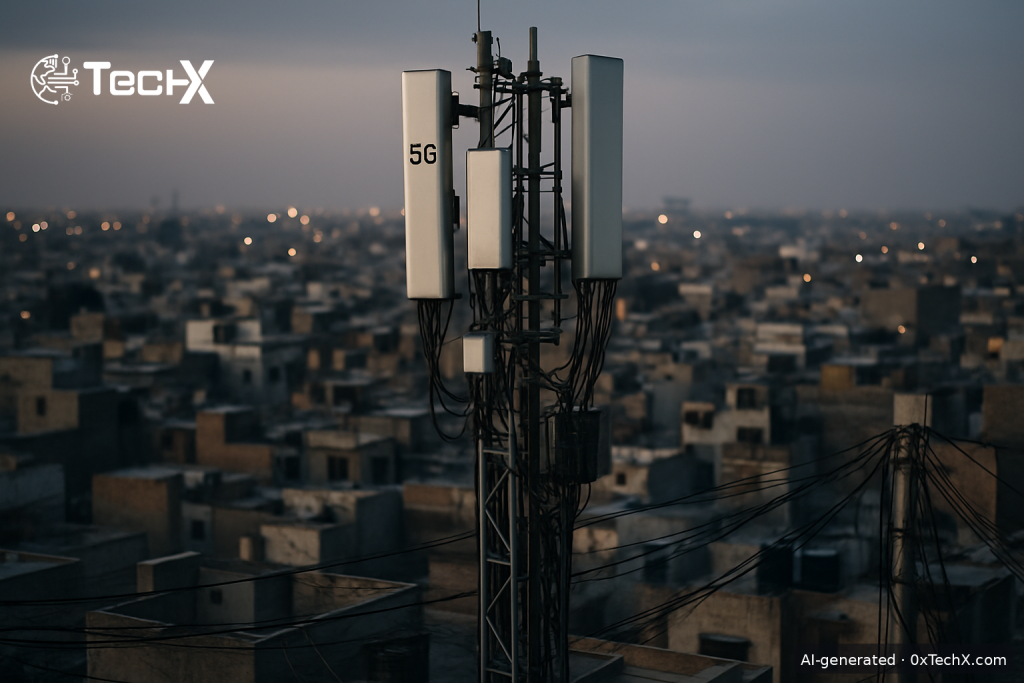
Pakistan’s 5G rollout is now live across 22 cities with 449 active tower sites, but only 17.9% of the country’s cell towers are connected to fibre backhaul. This gap is throttling real-world speeds even in Karachi, Lahore, and Islamabad, raising a fair question for consumers: is paying extra for a 5G package actually worth it right now?
Pakistan 5G Rollout by the Numbers
The Pakistan Telecommunication Authority (PTA) confirmed that 5G services are now available in 22 cities, with a total of 449 active tower sites across the country. Zong was the first operator to commercially launch, initially switching on service in more than 16 cities including Islamabad, Rawalpindi, Karachi, Lahore, Peshawar, and Quetta.
The Pakistan 5G rollout is using a Non-Standalone (NSA) method. This means operators are not building brand-new 5G infrastructure from scratch. Instead, Jazz, Zong, and Ufone are upgrading their existing 4G towers to carry 5G signals. It is a faster and cheaper way to launch, but it also means the network is only as strong as the backhaul behind each tower.
The site density gap is striking. Karachi, Pakistan’s biggest city and economic engine, has just 50 active 5G sites. Hyderabad, the second-largest city in Sindh, has only 3. Even within covered cities, you may get a solid 5G signal in one neighbourhood and nothing at all two streets away.
The Fibre Backhaul Problem Explained
Backhaul is the connection between a mobile tower and the core network. Think of it like a pipe: the 5G radio on top of the tower can push a huge amount of data, but if the pipe behind it is too narrow, the speed gets squeezed. Fibre-optic cable is the only backhaul technology wide enough to carry proper 5G traffic. Without it, a 5G tower effectively behaves like a faster version of 4G.
Pakistan’s telecom sector has a fibre coverage rate of just 17.9% across its roughly 58,000 cell sites. PTA’s own licence conditions for the Pakistan 5G rollout require operators to reach at least 20% fibre-to-site by 2028 in Phase I, rising to 35% by 2035. Most operators are not there yet.
- Jazz: 22% tower fibre coverage (the only operator to pass the Phase I target so far)
- Zong: 19% (just below the 20% Phase I mark)
- Telenor: 16% (needs a four-percentage-point jump)
- Ufone: 9% (would need to more than double its current level to comply)
The industry-wide average sits 2.1 percentage points below the first-phase benchmark. Without sufficient backhaul, towers can struggle to handle high traffic periods, making speeds unreliable even for people standing under a 5G-enabled mast.
Why Fibre Expansion Is So Hard in Pakistan
Pakistan has deployed over 234,000 kilometres of optical fibre cable in total, including long-haul and metro networks. But experts say this is still not dense enough to support a proper 5G backbone. The problem is not just money, it is also rules and paperwork.
IT Minister Shaza Fatima has publicly stated that fiberization is currently stalled because property owners often block infrastructure work, creating legal delays. The government is pushing a Right of Way (RoW) amendment through parliament to fix this, but the bill has sparked debate.
The cost of laying fibre in Pakistan is also unusually high. Pakistan charges operators between PKR 35 and PKR 60 per metre every year for right-of-way access. India, by comparison, charges a one-time fee of roughly one rupee per metre. That annual charge turns a capital investment into a permanent running cost, which discourages operators from expanding quickly. On top of that, connecting a single tower site to fibre can cost between $10,000 and $20,000, and there are tens of thousands of sites that still need the upgrade.
Difficult terrain, urban congestion, and a shortage of trained fibre-splicing engineers add further delays, especially in densely packed cities.
What This Means for Consumers in Karachi, Lahore, and Islamabad
Despite the excitement around the Pakistan 5G rollout, real-world internet speeds in the country’s biggest cities remain disappointing. Pakistan’s average internet speed stands at just 25 Mbps, placing the country 198th in global rankings. Users in Karachi and Lahore are reporting slow connectivity even in areas where the 5G signal icon appears on their phones. Islamabad, the capital, also continues to experience sluggish performance.
The situation is even worse outside major cities. In places like Azad Kashmir and Balochistan, reliable high-speed internet is still out of reach for most people.
So should you upgrade to a 5G package right now? The honest answer is: probably not yet, unless you are in a high-density urban area and specifically near one of the better-connected tower sites. Most current 5G service in Pakistan is NSA-based, meaning the experience is often not dramatically different from a good 4G connection. Buying a 5G-capable phone as a future investment makes sense since 4G devices will lose value as coverage improves. But paying a premium monthly rate for 5G data before the backhaul catches up may not deliver value for money. Also worth noting: mobile package prices in Pakistan have already risen by up to 33% following PTA approval, so consumers are already spending more on their connections.
What Needs to Happen Next
Experts say fibre coverage must reach at least 60% of cell sites to make 5G genuinely useful at scale. Getting there will need faster Right of Way approvals, lower annual access fees, and sustained investment from operators. The government has earmarked Rs35.7 billion for telecom operators under the Universal Service Fund (USF) to expand optical fibre in underserved regions, which is a start, but the total requirement runs far higher.
Zong has committed to deploying and upgrading over 1,000 5G sites nationwide in 2026. If operators hit their targets and the RoW legislation passes, real-world 5G speeds could improve noticeably within the next 12 to 18 months. For now, the Pakistan 5G rollout is real on paper but unfinished on the ground.
Frequently Asked Questions
Is 5G actually available in Pakistan right now?
Yes. The Pakistan 5G rollout is live across 22 cities with 449 active tower sites as confirmed by PTA. However, coverage within each city is patchy, and real-world speeds are limited by poor fibre backhaul infrastructure.
Why is my 5G connection slow in Karachi or Lahore?
Most 5G towers in Pakistan still use microwave or legacy backhaul instead of fibre. Only 17.9% of cell sites are fibre-connected. Without fibre behind a tower, the 5G radio cannot deliver the high speeds the technology promises.
Should I pay for a 5G package right now?
Unless you live very close to a well-connected 5G tower site in a major city, the speed difference over a good 4G connection will likely be small. Buying a 5G-capable phone as a long-term investment is reasonable, but upgrading your data plan purely for 5G speed may not deliver value yet.
When will Pakistan 5G speeds actually improve?
Meaningful improvement depends on operators raising fibre-to-site coverage toward 60% and the government clearing Right of Way hurdles. If investment accelerates, noticeable improvements could arrive in 12 to 18 months, with PTA’s Phase I target of 20% fibre coverage required by 2028.