
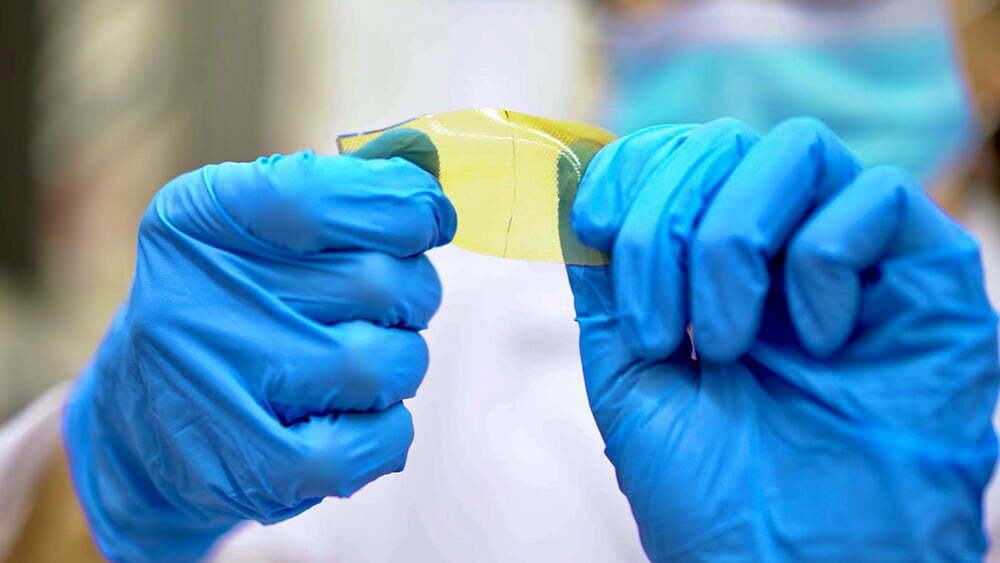
Researchers at the University of Cambridge have created self-healing, biodegradable 3D-printed materials that could be used to create realistic artificial hands as well as aid in other soft robotics applications.
According to a TechXplore report, the jelly-like materials created with salt are not only cost-effective, but they can also sense a variety of changes such as pressure, humidity, and temperature.
Furthermore, unlike previously developed self-healing robots, they can repair themselves partially at room temperature.
The paper’s first author, David Hardman of Cambridge’s Department of Engineering, stated, “Incorporating soft sensors into robotics allows us to get a lot more information from them, like how strain on our muscles allows our brains to get information about the state of our bodies.”
Hardman and his colleagues have been working on developing soft sensing and self-healing materials for robotic hands and arms as part of the EU-funded SHERO project, which is funded through the European Commission’s Future and Emerging Technologies (FET) program.
These materials can not only detect their own damage, but also take the necessary steps to temporarily repair themselves and resume work, effectively eliminating the need for human intervention.
Why Soft-sensing Tech is Useful
Previously, self-healing robots needed to be heated to heal, but these newly developed materials by Cambridge researchers can help heal robots at room temperature, making them more suitable for real-world applications.
The researchers discovered that printing sensors with sodium chloride (salt) instead of carbon ink resulted in a material with the exact properties they desired.
Because salt is soluble in the water-filled hydrogel, it creates a uniform channel for ion movement. This self-healing hydrogel bonds well with a variety of materials, making it suitable for use in other types of flexible and stretchable robotic devices.
The majority of research in the Bio-Inspired Robotics Laboratory, for example, is devoted to the development of artificial hands. Although this is a proof-of-concept material, if further developed, it could be incorporated into artificial skins as well as custom-made wearable and biodegradable sensors.
The self-healing materials are inexpensive and simple to create, either through 3D printing or casting. They outperform many existing alternatives in terms of long-term strength and stability without drying out, and they are entirely made of widely available, food-safe materials.
While most jelly-like sensing technologies are not long-lasting and require a lot of energy, soft sensing technologies have the potential to change the way we think about robotics.
To read our blog on “Apple patent describes a folding smartphone with a ‘self-healing’ display,” click here.