
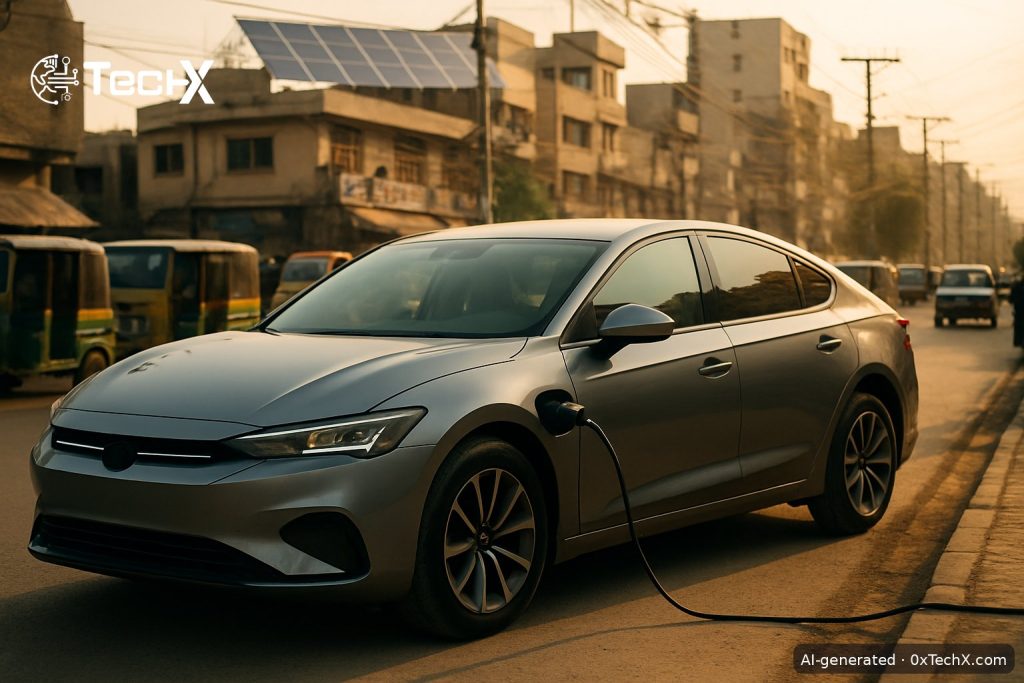
REEVs Pakistan fuel imports, this combination is now at the centre of a serious policy conversation. Industry analysts say that adding just 30,000 range-extended electric vehicles (REEVs) to Pakistani roads every year for five years could save Pakistan more than $1 billion in gross fuel imports. That figure is not a distant dream, REEV models are already landing in the market, with the XPENG L03 opening pre-bookings in July 2026 and the Changan Nevo Hunter officially launching in August 2026. The question is whether Pakistan’s policy framework can move fast enough to make it happen at scale.
Why Pakistan’s Fuel Bill Makes This Urgent
Pakistan’s dependence on imported oil is a serious economic weak point. Pakistan’s oil import bill reached $16.86 billion for the fiscal year 2025-26, a 5.76 percent annual increase in fuel imports. That figure was $1.58 billion higher than the IMF’s original benchmark estimate for the period. To put the REEV savings number in perspective: $1 billion is roughly 6 percent of that total annual bill, a meaningful dent from just one segment of the vehicle market.
Finance Minister Muhammad Aurangzeb confirmed in a written reply to the National Assembly that Pakistan spends nearly one-fourth of its import bill on petroleum products, with petroleum imports accounting for 22.2 percent of total imports during July-March FY2026. Nearly 80 percent of the country’s crude oil passes through the Strait of Hormuz, a chokepoint repeatedly under threat, and under normal conditions Pakistan holds only 10 days of crude reserves. That vulnerability makes the case for REEVs even stronger.
You can check the latest petrol prices at the pump and how they shift monthly in our petrol and diesel price update for October 2, 2026, a direct reminder of what consumers pay every time fuel costs rise.
What Exactly Is a REEV?
A REEV, or range-extended electric vehicle, is not a traditional hybrid. REEVs use electric motors for propulsion, while an onboard fuel-powered generator provides additional electricity when the battery needs support. Modern models can reportedly travel 150 to 180 kilometres on battery power alone, making home charging suitable for many daily journeys.
REEVs use electric motors to drive the wheels, while an on-board petrol engine works as a generator to support the battery when needed. This allows motorists to complete routine journeys on electricity and retain extra range for intercity travel. Think of it as a car that runs on electricity most of the time but carries its own backup power plant for long trips, solving the range anxiety problem that holds many people back from buying a pure EV.
REEVs Pakistan Fuel Imports, The Numbers Behind the Claim
The scenario envisages a fleet reaching 150,000 vehicles, cumulatively displacing 1.2 billion litres of petrol and avoiding around 2.7 million tonnes of operational carbon emissions compared with similar petrol vehicles. Analysts have also estimated that increasing annual REEV additions to 60,000 could broadly double the projected economic and environmental benefits under similar assumptions.
The broader case for EVs is not new in Pakistan’s academic circles. The economic case for electric mobility is highlighted in “Future on Wheels”, a policy viewpoint published by the Pakistan Institute of Development Economics (PIDE) in December 2024, whose authors noted that petroleum imports account for a significant share of Pakistan’s import bill and argued that accelerating EV adoption could reduce the economy’s exposure to volatile international oil prices and foreign-exchange pressures. The report stated that “with petroleum imports consuming 30% of Pakistan’s total import bill, the transition to EVs is a macroeconomic imperative.”
Which REEV Models Are Already in Pakistan?
This is where things get practical for Pakistani buyers. Several models are already here or in the pipeline:
- Changan Nevo Hunter: This REEV pickup officially launched in Pakistan on August 20, 2026, at Rs. 10.9 million. Its range-extended setup allows electric motors to handle propulsion while the petrol engine supports the electrical system as a generator.
- XPENG L03 REEV: The XPENG L03 REEV opened pre-bookings in Pakistan in July 2026. The REEV version combines a 37.25 kWh battery with a 1.5-litre petrol range extender, with a claimed electric range of 250 km and a combined figure of up to 1,150 km.
- Deepal S05: Master Changan officially announced its Pakistan price on October 31, 2025, making the S05 Deepal’s first range-extended model in the local market.
- Smaller options growing too: The transition extends beyond larger vehicles. Smaller electric cars, including the recently introduced Chery Q, are widening choices around the Rs. 4 million to Rs. 5.5 million segment, while several electric motorcycles are available below Rs. 300,000.
What About Savings for Individual Households?
The national savings figure is compelling, but what about the family running school runs and daily commutes? Some REEV owners charging largely through rooftop solar report monthly fuel savings of up to Rs. 65,000. Such savings vary with vehicle usage and charging costs, but illustrate the potential relief for households managing school transport, commuting and other routine journeys.
Pakistan’s expanding rooftop solar capacity makes this especially relevant. A household that has already invested in solar panels can essentially run a REEV’s daily driving almost cost-free, paying for neither grid electricity nor petrol on routine trips.
What Policy Changes Could Speed This Up?
Industry representatives said tariff concessions for qualifying REEVs, investment in charging infrastructure and affordable financing could accelerate adoption. Analysts have recommended a stable 10-year auto policy, with incentives linked progressively to localisation, production scale and consumer protection.
“REEVs can offer Pakistani consumers a practical route to electric mobility by combining lower daily running costs with the confidence to undertake longer journeys. A stable policy framework, investment in charging infrastructure and progressive localisation can help translate these consumer benefits into wider economic gains for Pakistan,” said Ali Damani, Chief Operating Officer of Changan Motors Pakistan.
Pakistan’s green financing talks with the IMF could be another tailwind. Our coverage of the Pakistan IMF green financing discussions shows how international backing for the EV and clean energy transition is already a live policy conversation at the highest levels.
Frequently Asked Questions
What is a REEV and how is it different from a regular hybrid?
A REEV (range-extended electric vehicle) is primarily electric. The electric motor always drives the wheels. The small petrol engine onboard never directly drives the car, it only acts as a generator to top up the battery. A traditional hybrid can switch between petrol and electric drive directly. This makes a REEV feel and drive more like a pure EV.
How much could REEVs actually save Pakistan in fuel costs?
Pakistan can save over $1 billion in gross fuel imports by adding 30,000 REEVs annually over five years. The projection envisages a fleet reaching 150,000 vehicles, with cumulative petrol displacement of approximately 1.2 billion litres and around 2.7 million tonnes of avoided operational carbon emissions. Actual outcomes depend on driving habits and how much of charging comes from electricity versus petrol-generated power.
Are REEVs practical in Pakistan right now without public charging stations?
Industry stakeholders say REEVs could provide a practical transition option while Pakistan continues to develop its electric-vehicle charging infrastructure. Because the petrol generator kicks in when the battery runs low, drivers are never stranded. Most daily travel can be handled through overnight home charging, or through rooftop solar during the day.
What needs to happen for REEVs to reach 30,000 sales a year in Pakistan?
Current REEV sales are far below that target. Analysts point to three main levers: import duty relief to bring prices down closer to petrol-car levels, a long-term auto policy (a 10-year framework has been suggested) to give manufacturers confidence to invest in local assembly, and accessible consumer financing so buyers do not need to pay the full sticker price upfront. Without all three working together, the $1 billion savings target will remain theoretical.