
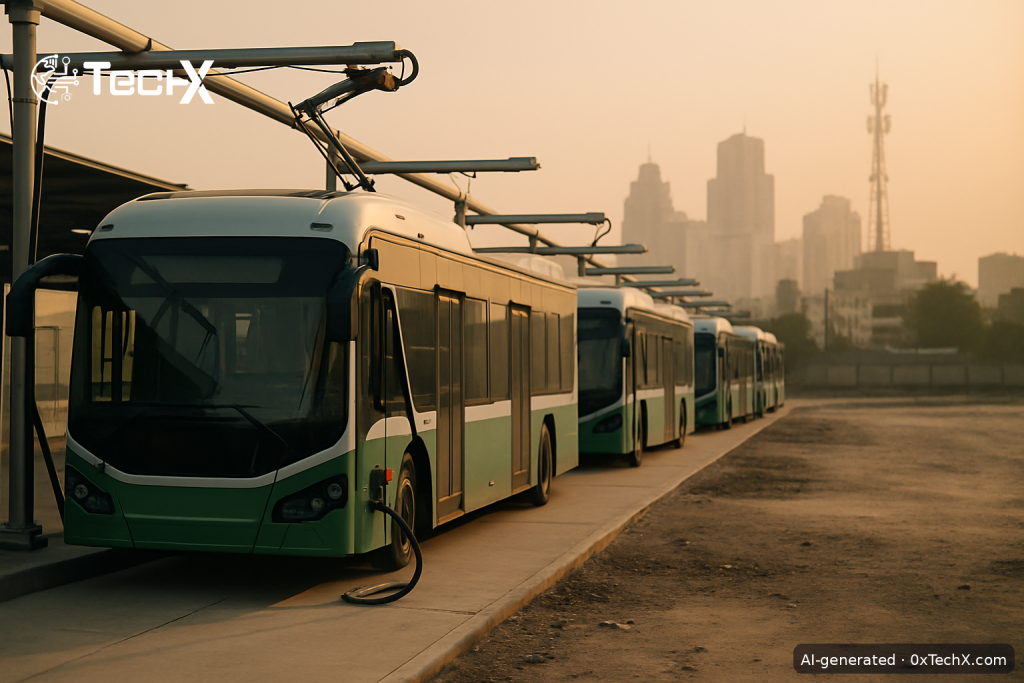
Punjab electric buses are at the centre of Pakistan’s boldest green transport push ever, but two problems could stop the plan before it really starts: a power grid that is already stretched thin, and a country with no formal system to recycle the batteries those vehicles will eventually leave behind.
What Punjab Has Announced
Punjab Chief Minister Maryam Nawaz said the province aims to run 5,000 electric buses over the next five years. The first phase is already moving. The chief minister noted that Punjab has also started assembling electric buses locally, and during the first phase, 1,500 electric buses will hit roads across 91 tehsils of the province.
The e-bike side of the plan is just as large. Punjab Chief Minister Maryam Nawaz has greenlit the distribution of 100,000 subsidized electric bikes. Under the Punjab e-Bike Scheme, youth will be provided modern electric motorcycles on two-year installments, with the aim of reducing petrol costs and providing cheap, clean travel. The government will provide a subsidy of Rs 50,000 on each bike.
The money behind all this is real. In Budget 2025-26, Punjab has committed at least Rs 49.5 billion to its EV transition plans, including Rs 46 billion for electric buses and Rs 3.5 billion for electric taxis. The budget also includes subsidies for electric bikes, electric rickshaws, and electric three-wheelers, with the government targeting around 120,000 beneficiaries under these electric mobility support programs.


The Charging Infrastructure Problem
Here is where the plan runs into hard numbers. As of 2025, there are just over 20 publicly accessible charging stations nationwide, mostly in big cities. That is tiny compared to the need. Putting 5,000 large electric buses and 100,000 e-bikes on Punjab’s roads while the whole country has barely two dozen public chargers is a serious mismatch.
Pakistan does have a target on paper. Pakistan has set a goal of installing 3,000 EV charging stations nationwide by 2030, with around 240 stations planned in the current fiscal year. But even reaching 3,000 stations is proving difficult. Despite the issuance of 13 licenses by NEECA and the arrival of five EV charging units at designated sites, progress has been slowed by procedural bottlenecks, including delays in electricity connections. These delays include prolonged installation of separate meters and pending no-objection certificates from power distribution companies and oil marketing firms.
The power grid itself is another worry. Power supply is a real concern, as Pakistan’s grid has frequent outages. A lack of local expertise and hard-to-scale charging infrastructure are other risks for Pakistan’s EV transition, according to Ahtasam Ahmad, energy finance lead at Renewables First. Even government officials have acknowledged that the lack of charging infrastructure remains a major obstacle, and that without major investment in this area, electric mobility will remain difficult to achieve.
The Battery Waste Crisis Nobody Is Talking About
The second problem is quieter but just as serious. Every electric bus and every e-bike carries a lithium-ion battery. Those batteries do not last forever, typically six to ten years, and when they die, they need to go somewhere safe. Right now in Pakistan, there is nowhere safe for them to go.
Pakistan currently has no formal lithium-ion recycling capacity. This means end-of-life batteries, which typically contain poisonous metals such as cobalt, manganese, nickel and lithium salts, will end up in waste sites, contaminating soil and water.
According to the Global E-waste Statistics Partnership, Pakistan has a 0% e-waste collection rate. Most lithium-ion batteries end up in landfills or are dismantled by informal workers without any safety measures, which can lead to chemical pollution, fire hazards and severe health risks.
The timeline for this crisis is not far away. Li-ion batteries have a lifecycle of six to ten years, and Pakistan is expected to start seeing significant end-of-life volumes from around 2029 onwards. The upcoming battery policy must include a structured collection and second-life usage or recycling mechanism to avoid making the country a jumble of expired lithium-ion batteries.
There is also an import risk few people discuss. Pakistan’s lithium-ion ecosystem is structurally shallow, with less than 20 per cent domestic value addition and heavy reliance on imports, with most of the batteries used in e-bikes and EVs imported. Without a policy for lithium waste, Pakistan risks becoming a dumping ground for its own green energy transition.
The National Picture
The Punjab plan sits inside a bigger federal goal. Pakistan plans to shift 30% of its vehicles to electric power over the next five years, aiming to save up to $4.5 billion in fuel imports. Pakistan is seeking to accelerate the adoption of electric vehicles under its New Energy Vehicle Policy 2025-30, which targets NEVs to account for 30% of new vehicle sales by the end of the decade.
Some private investment is arriving. Chinese EV giant BYD has partnered with Pakistan’s HUBCO Green to build charging stations across the country. 128 DC fast chargers are planned over three years via this partnership, with an initial 50 of those chargers targeted for installation by the end of 2025. That is a start, but it is a very small start against the scale of the Punjab electric buses plan and the broader national EV target.
Pakistan is also planning a National Energy Efficiency and Conservation Authority (NEECA)-led battery manufacturing policy for 2026-31. In 2024, Pakistan imported an estimated 1.25 GWh of lithium-ion battery packs. Demand is projected to increase to around 8.7 GWh by 2030, in line with the National Electric Vehicle Policy 2025-30. That growing import bill is exactly why local recycling matters so much. Recycled lithium can feed back into new batteries, cutting the need to keep buying from abroad.
For readers interested in how Punjab is using technology to manage other parts of its infrastructure, see how Punjab is using GPS tracking on dairy vans as another example of the province’s push to modernise public services through tech.
What Needs to Happen Next
Analysts and industry voices agree on the basic list. Pakistan needs charging stations built faster and closer to where buses and bikes will actually run, not just in city centres. It needs an honest policy on what happens to spent batteries. It needs trained mechanics who understand EVs, since good servicing networks are critical as EVs are more sensitive to potholes, which are common on South Asian roads. And it needs the grid to be stable enough to charge thousands of large bus batteries every night without causing more outages for everyone else.
The Punjab electric buses announcement is genuinely exciting for a country that spends billions of dollars importing petroleum every year. But excitement without infrastructure is just a press release. The next 12 to 18 months will show whether the government can close the gap between ambition and ground reality, before the batteries start dying with nowhere to go. Learn more about Pakistan’s technology regulation framework and how digital infrastructure decisions affect the country’s green transition.
Frequently Asked Questions
How many electric buses does Punjab plan to put on the road?
Punjab Chief Minister Maryam Nawaz has said the province aims to run 5,000 electric buses over the next five years. During the first phase, 1,500 electric buses will reach 91 tehsils across the province.
How many public EV charging stations does Pakistan have right now?
As of 2025, there are just over 20 publicly accessible charging stations nationwide, mostly in big cities. The government wants to reach 3,000 stations by 2030, but progress has been slow because of regulatory delays and grid connection problems.
What happens to old EV batteries in Pakistan?
With Pakistan’s e-waste collection rate effectively zero, most discarded batteries end up in landfills, posing serious environmental and health hazards. Pakistan currently has no formal lithium-ion recycling capacity. This is a major gap that needs to be fixed as more EVs arrive on the road.
How much has Punjab budgeted for its EV plan?
In Budget 2025-26, Punjab has committed at least Rs 49.5 billion to its EV transition plans, including Rs 46 billion for electric buses and Rs 3.5 billion for electric taxis. Additional funds cover subsidies for e-bikes, rickshaws, and three-wheelers.