
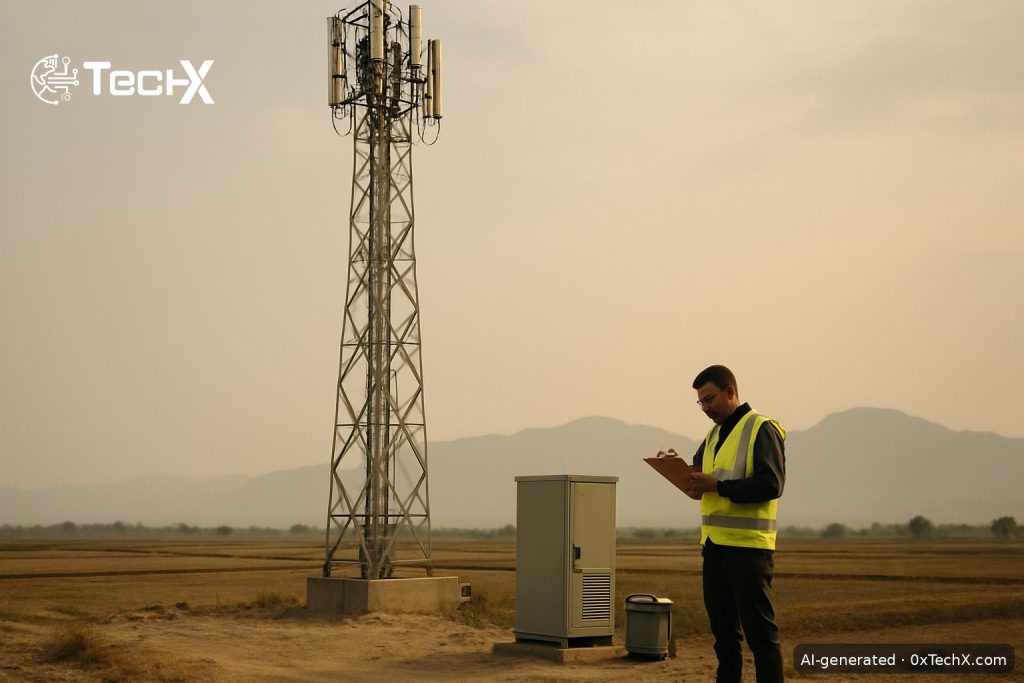
Pakistan telecom gaps are no longer just a statistic on a regulator’s desk. In mid-October 2026, the Pakistan Telecommunication Authority (PTA) moved its enforcement work out of the office and into the field, deploying all 10 of its Zonal Offices across six regions to measure real network performance and push operators to fix problems with hard deadlines.
What PTA’s October Field Drive Actually Covered
The PTA announced on October 16 that it had intensified nationwide monitoring, running its 10 Zonal Offices in a week-long drive from October 8 to 14 to assess ground-level service quality and address consumer complaints directly.
Zonal Office teams visited Thatta, Dera Ghazi Khan, Mandi Bahauddin, Quetta, Faisalabad, and Gilgit-Baltistan, covering a geographic spread that stretches from the coast of Sindh to the northern mountainous frontier. This is a telling list. These are not Pakistan’s wealthiest or most urbanised districts. They are places where everyday people have complained about dropped calls and slow internet for years.
The sweep was designed to evaluate mobile network coverage, voice call quality, and internet service performance in areas where consumer complaints have been most persistent. Telecom operators were directed to resolve the identified issues concerning mobile network coverage and quality of voice and internet services within the stipulated timeframe, and the issue involving the closure of a telecom site in Faisalabad was also resolved.
The October drive was not a one-off event. During the week from 30 September to 7 October 2026, PTA’s Zonal Office teams had already inspected 115 telecom sites across Pakistan, covering 39 sites in Lahore, 17 in Karachi, 16 in Sukkur, 14 each in Multan and Rawalpindi, 8 in Quetta, 4 in Abbottabad, and 3 in Gilgit. The regulator is clearly running a sustained, rolling programme rather than a single publicity exercise.
Why Pakistan Telecom Gaps Are So Stubborn
To understand why PTA has shifted into enforcement mode, it helps to look at the numbers behind Pakistan’s digital divide.
A PTA survey earlier in 2026 found that all cellular mobile operators had only partially complied with PTA Quality of Service standards during the first quarter of 2026, with none achieving full compliance across all key performance indicators. Not one operator, across any network, passed all the benchmarks. That is the backdrop to everything PTA is now doing in the field.
Pakistan scores 78.5 on meaningful connectivity but only 56.8 on universal connectivity, meaning those who are connected appear to be using digital services more meaningfully, but too many people are still outside the connected economy. The gap between these two scores captures a central problem: improving quality for the connected while millions remain offline entirely.
Users routinely report call drops, buffering, and average 4G speeds of only 17 to 20 Mbps, and mobile broadband penetration sits between 57 and 60 percent, with roughly 148 million 3G and 4G users out of about 196 million subscribers. More than 40 percent still rely on feature phones, while around 10 percent lack any mobile device at all.
Geography makes this harder. Prolonged load-shedding, fibre cuts, infrastructure theft and vandalism, right-of-way constraints, and security issues are among the major challenges that hold back connectivity in areas like Gilgit-Baltistan. These are not problems a single field drive can fully solve, but a firm regulatory push with set deadlines forces operators to at least prioritise the work.
The urban-rural split is sharp. While mobile internet usage in urban areas has reached 65 percent, only 50 percent of those living in rural areas have access, according to a recent GSMA report on mobile internet connectivity. And within rural areas, only 7 percent of women in rural Pakistan have internet access, compared to 26 percent of Pakistani women overall, with 22 million fewer women than men holding mobile phones nationwide. Pakistan’s telecom gaps are not just about geography. They are also about gender.
Regions Being Prioritised and Why
PTA’s choice of Thatta, DG Khan, Mandi Bahauddin, Quetta, Faisalabad, and Gilgit-Baltistan for its October drive reflects where complaints are loudest and where the digital divide bites hardest.
A substantial portion of the population, particularly in Balochistan and parts of Sindh and Khyber Pakhtunkhwa, still experiences limited or no connectivity despite the USF’s efforts to extend telecom services to unserved and underserved areas. Quetta and Thatta are both in that troubled zone. Meanwhile, Gilgit-Baltistan is a special case: its high-altitude terrain makes conventional infrastructure expensive and fragile.
Earlier in September 2026, the PTA identified continuing telecom and digital connectivity challenges in Gilgit-Baltistan in its Quality of Service survey for April to June 2026. PTA teams had conducted around 4,100 voice and SMS tests and 3,960 broadband tests across six high-altitude sites in AJ&K and GB. That earlier survey directly shaped the October field visits.
In addition to the field drives, PTA had already set a separate coverage deadline for the twin cities. The authority formally directed all mobile network operators to resolve coverage gaps across Rawalpindi and Islamabad by October 2026, setting one of its most time-bound and enforceable network improvement mandates in recent memory. Operators were instructed to ensure adequate coverage across all sectors of Islamabad, all parts of Rawalpindi, and along key corridors including Kashmir Highway and Islamabad Expressway.
The Tools PTA and the Government Are Counting On
Field monitoring and deadlines are only part of the solution. Pakistan’s longer-term plan to close its Pakistan telecom gaps relies on several tools running at the same time.
The Pakistan Telecommunication Authority works closely with the Universal Service Fund (USF), a government-backed subsidy mechanism that channels money into areas where private operators have no commercial reason to invest. Efforts are underway through the USF to expand coverage in unserved and underserved areas. At the recent APT Symposium in Islamabad, Pakistan’s Federal IT Minister announced that USF Pakistan has crossed $1 billion in deployed subsidies.
Satellite broadband is another key piece. PTA has recommended licensing multiple low-earth orbit (LEO) satellite service providers, including Starlink, OneWeb, and Amazon’s Project Kuiper, to deliver broadband to isolated rural communities and motorways where laying conventional fibre is commercially unviable.
Solar power is also part of the picture. Solar power is being used to bridge the digital divide by providing reliable off-grid electricity for remote telecom towers, and companies like Engro Enfrashare are using solar-powered setups for thousands of telecom towers across regions like Balochistan.
Pakistan is also pushing new fibre. Seventeen telecom projects are extending 1,825 km of optic fibre to over 500 underserved areas as part of the government’s broader connectivity push. You can read about related broadband policy discussions in our earlier coverage of how the APT Forum is pushing gigabit broadband as a universal service for Pakistan.
What Operators Need to Do Next
The monitoring exercise focuses on identifying issues including call connection failures, dropped calls, slow mobile internet speeds, and network coverage gaps, with field teams also reviewing consumer feedback and complaints to better understand service-related challenges.
Engagement with local administrations, elected representatives, and community members is being undertaken to facilitate the identification and resolution of issues affecting mobile services in different areas. This community-level engagement is often the piece that is missing from purely technical solutions. PTA seems to understand that closing Pakistan telecom gaps requires local buy-in, not just new towers.
Operators that miss the set deadlines face financial penalties. Operators that fail to demonstrate measurable improvement in service quality could face financial penalties. For the first time in a while, the threat feels real rather than theoretical.
Frequently Asked Questions
Which regions did PTA visit during its October 2026 monitoring drive?
PTA’s 10 Zonal Offices visited Thatta, Dera Ghazi Khan, Mandi Bahauddin, Quetta, Faisalabad, and Gilgit-Baltistan between October 8 and 14, 2026. These areas were selected because they have the most persistent consumer complaints about mobile coverage and internet quality.
What exactly are Pakistan telecom gaps?
Pakistan telecom gaps refer to areas and communities with weak or no mobile signal, poor internet speeds, and unreliable voice call quality. They are most common in rural regions, mountainous areas like Gilgit-Baltistan, and parts of Balochistan and interior Sindh. Gaps also exist along the gender dimension, with women in rural areas far less connected than men.
What happens if telecom operators ignore PTA’s directives?
Operators face financial penalties if they fail to show measurable improvement within the deadlines PTA sets. The regulator’s recent shift toward active field monitoring and legally binding timelines signals that enforcement is being taken more seriously than in previous years.
What is the Universal Service Fund and how does it help?
The Universal Service Fund (USF) is a government-backed fund managed to ensure that remote and underserved areas of Pakistan receive telecom coverage even when private operators see no commercial reason to invest there. It recently crossed $1 billion in total deployed subsidies and funds fibre, solar-powered towers, and satellite broadband projects in hard-to-reach communities.