
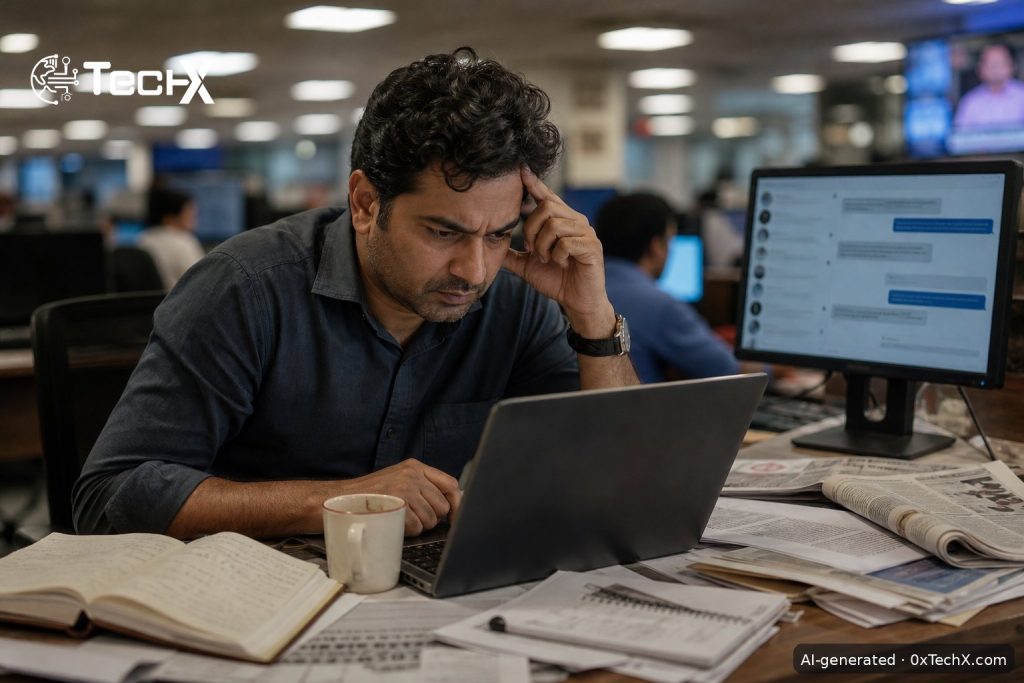
AI news errors are reshaping how editors and journalists think about their work, and Pakistan’s media industry is now squarely in that conversation. A fresh wave of AI-related blunders, from a US newspaper tool that replaced a reporter’s name with a murder suspect’s, to Dawn accidentally publishing an internal editing prompt, shows just how real the risks have become for newsrooms of every size.
What Triggered This Conversation About AI News Errors
The immediate spark came from the United States. Journalists at two Ohio newspapers began withholding their bylines on October 28, 2026, over DeeperDive, an AI-powered tool that generates summaries and answers questions about published reporting. Their complaint was specific and serious. According to the union, DeeperDive had produced multiple factual errors, including an incident in October in which an AI-generated summary substituted a reporter’s name for that of a murder suspect. That is not a typo or a minor slip. It is the kind of error that can ruin a journalist’s reputation overnight.
The publisher responded quickly. Axios reported on November 6, 2026, that the publisher had stopped DeeperDive’s AI summaries and limited the tool to a small group of beta users. But the damage to trust had already been done, and the case opened a wider debate: when AI makes a mistake in a published story, who is responsible?
AI News Errors Are Already Hitting Pakistan
Pakistani media has not been watching this from a safe distance. Pakistan’s leading English-language daily, Dawn, found itself in an embarrassing position after an apparent artificial intelligence editing glitch slipped into one of its published reports. Dawn inadvertently published an internal AI editing prompt appended to a business story; the paper apologized and said it launched an internal review. The incident went viral on social media and raised a pointed question: if Dawn, a well-resourced outlet with a strong editorial tradition, can let this happen, what about smaller digital newsrooms running leaner operations?
There is also a deepfake dimension specific to Pakistan. Dawn News bureau chief Ali Akbar complained to the NCCIA about videos allegedly using AI-generated visuals and a voice resembling his own to make allegations against public officials. AI-generated impersonation threatens professional credibility and public trust, particularly where audiences cannot immediately distinguish authentic statements from fabricated material.
Why Pakistani Newsrooms Are Especially Vulnerable
Capacity remains the most significant bottleneck of Pakistani media in AI adaptation. AI’s speed and efficiency are valued, but journalists and media practitioners remain wary of its judgment, with most newsrooms lacking formal protocols or ethical use guidelines. That gap between using AI tools and governing them responsibly is where errors slip through.
Findings from interviews with Pakistani media professionals revealed a careful but growing use of AI in Pakistani newsrooms, primarily for productivity tasks such as transcriptions, headline suggestions, and layout design. But productivity shortcuts can become editorial liabilities. A comparison of AI-written and human-written articles found that the AI version contained factual errors, such as misreporting the number of casualties, while the human variant had no errors of fact.
For Pakistani newsrooms operating under financial constraints and intense political scrutiny, AI offers real efficiency gains. But those same financial pressures mean there is often no budget for dedicated AI oversight roles, fact-check desks, or staff retraining. The result is that AI tools get adopted fast while safeguards lag behind.
Who Is Responsible When AI Gets It Wrong
Responsibility for published journalism must remain clear. An AI-generated error cannot simply be attributed to software when a newsroom has approved the content for publication. This is the standard that international wire services already follow. AP requires AI-generated output to be reviewed and edited before publication.
The Reuters Institute for the Study of Journalism examined emerging newsroom governance practices in research published in 2026, emphasizing that human oversight alone cannot guarantee safety. Effective governance also requires system design, defined responsibilities, and mechanisms for detecting and addressing errors.
The DeeperDive dispute exposes a fundamental weakness in some newsroom AI systems: the separation between the people producing verified journalism and the technology repackaging their work. The original reporting may remain accurate, but the journalist’s credibility can suffer because readers associate the error with the publication and its contributors.
Pakistan’s regulatory environment is slowly catching up. Pakistan’s Election Commission proposed labeling AI-altered election content in October 2026, while retaining media liability for accuracy, with stakeholder feedback due by November 20. That is a step forward, but newsrooms need internal rules well before any regulator enforces them from outside. The risks of AI go beyond elections. As Pakistan’s National CERT has also flagged, AI-driven fraud is growing across digital systems in Pakistan, and newsrooms are not immune to that broader threat environment.
Practical Steps Pakistani Editors Should Take Now
Pakistani newsrooms need stronger verification, editorial oversight and clear policies when deploying AI. Below are four concrete actions any newsroom can start this week.
- Write a simple AI use policy. Even a one-page document that tells staff which AI tools are allowed, which are banned, and when human review is required can prevent the kind of blunder Dawn experienced.
- Add a verification step before publication. AI outputs should be verified by journalists and editors before publication to prevent factual errors and misattributions. This is not optional for responsible outlets.
- Disclose AI use to readers. Undisclosed AI use can trigger reputational damage if errors emerge. A short label on AI-assisted content builds trust rather than undermining it.
- Train staff, not just on how to use AI, but on how it fails. Newsrooms across Pakistan have urged the need for foundational training on integrating AI without compromising journalistic values. Understanding how AI hallucinates facts or reproduces biases is as important as knowing how to run a prompt.
For international standards and guidance on responsible AI use in media, the Reuters Institute for the Study of Journalism at Oxford publishes ongoing research that Pakistani editors can access free of charge.
Frequently Asked Questions
What are AI news errors?
AI news errors are factual mistakes made by automated tools used in journalism, such as summary engines, chatbots, or translation tools, that produce wrong information, misattribute names, or reproduce biases from training data. They can appear in published articles, automated summaries, or on-screen captions without a human editor catching them first.
Has any Pakistani news outlet made a public AI error?
A high-profile error involved Dawn accidentally publishing an internal AI editing prompt in a business story. The paper apologized and said it began an internal review. It is likely not the only such incident in Pakistan, but it is the most publicly documented one so far.
Who is legally responsible for an AI mistake in a news article?
Under current frameworks in Pakistan and most countries, the publisher remains responsible for what it publishes, regardless of whether a human or a machine produced it. An AI-generated error cannot simply be attributed to software when a newsroom has approved the content for publication. Individual journalists may also face reputational harm even if they did not write the erroneous content themselves.
What can readers do when they spot an AI error in a news article?
Readers should report errors directly to the outlet’s corrections or editorial desk. Many major outlets now have corrections policies. Sharing errors on social media can also pressure newsrooms to act quickly, as the Dawn incident showed when social media backlash prompted a rapid apology. If the error involves defamation or electoral misinformation, Pakistan’s PEMRA provides a formal complaints mechanism for broadcast content.