
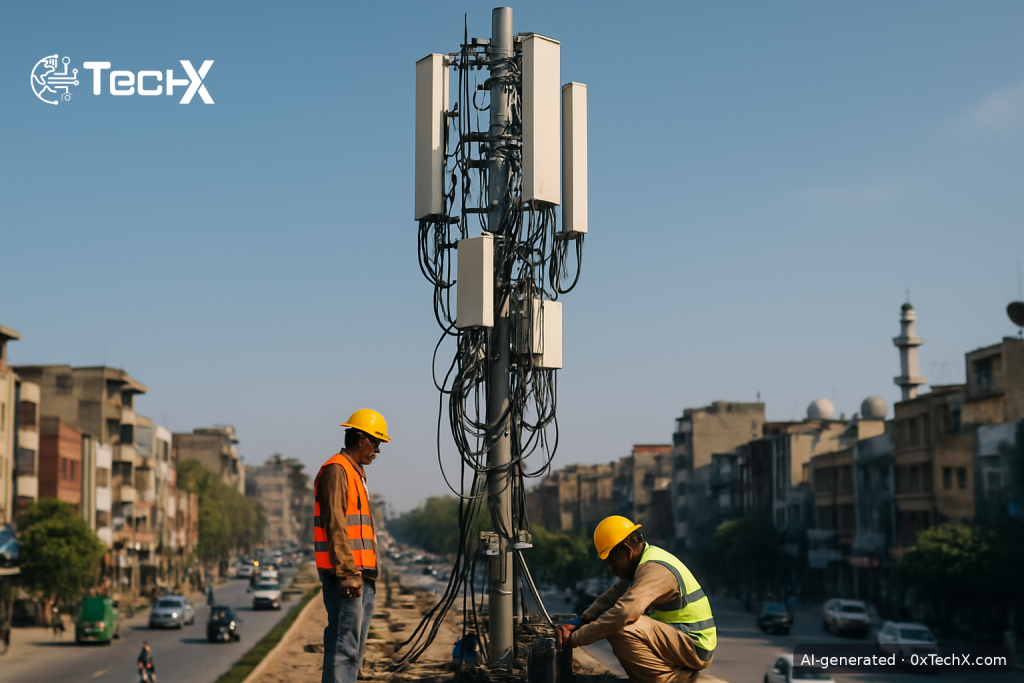
Pakistan’s 5G tower deployment race just got a firm deadline. The Pakistan Telecommunication Authority (PTA) has directed each mobile operator, Jazz, Zong, and the merged PTML (Ufone/Telenor), to install 1,000 new 5G sites within one year, while also pushing them to migrate the bulk of their existing tower infrastructure to 5G by August 14, 2026. The stakes are high: a PTA official has warned that at the current pace, Pakistan may not complete a nationwide 5G network until 2035.
Where Pakistan’s 5G Tower Deployment Stands Right Now
The numbers tell a sobering story. Pakistan currently has 449 active 5G tower sites spread across 22 cities. Islamabad leads with 79 towers, while some districts, Attock, Jhelum, Kasur, Rahim Yar Khan, and Sheikhupura, each have just one. Karachi, the country’s largest city and economic hub, has only 50 active 5G sites despite its size and population.
The National Assembly Standing Committee on Information Technology raised this gap directly, noting that Karachi has far fewer towers than Islamabad or Lahore. Following those concerns, PTA instructed operators to give Karachi special attention and accelerate infrastructure work there.
PTA Member Sadiq Memon put it plainly: if 5G tower deployment continues at the same slow rate, Pakistan could miss full nationwide coverage until 2035, by which time the technology may already be outdated.
The 1,000-Tower Obligation and the August 14 Push
Under PTA’s new directive, each mobile operator must install at least 1,000 new 5G cell sites every year. Of those, at least 200 must go into areas that currently have poor network performance, not just into already-connected city centres. Operators have also told the PTA they will migrate most of their existing tower stock to 5G-capable equipment by August 14, the national independence day deadline that the government has set as a symbolic and practical target.
This 5G tower deployment obligation is built into the licence conditions attached to the March 2026 spectrum auction, in which the government sold 480 MHz of spectrum across multiple bands for $507 million. Jazz, Zong, and Ufone all secured frequencies in that auction, giving them the spectrum they need to actually run 5G services, now the pressure is on infrastructure.
You can read more about how the E-Band spectrum assignment is supporting this backhaul push in our earlier piece on E-Band spectrum assigned to all four Pakistan telecom operators.
Who Is Moving Fastest, and Who Is Lagging?
The operators are not moving at the same speed. Based on industry estimates ahead of the August 14 milestone:
- Jazz is targeting approximately 1,000 5G cell sites and has already launched services across around 180 sites in Islamabad, all four provincial capitals, Rawalpindi, Multan, and Faisalabad. Jazz also holds the highest fiberization ratio among operators at 22 percent, giving it a backhaul advantage.
- Zong is aiming for 400 to 500 5G sites in the initial phase, focusing on high-frequency mid-band spectrum in dense urban areas. Its fiberization level sits at 19 percent.
- PTML (Ufone/Telenor Pakistan), following the merger of the two operators, is targeting 60 to 100 sites in this first phase, a much smaller number, reflecting the complexity of integrating two networks at the same time.
Engineering teams from all three operators are reportedly working around the clock in cities including Islamabad, Lahore, Karachi, Faisalabad, Multan, Peshawar, Quetta, Gujranwala, Sialkot, Hyderabad, and Sukkur to install radio equipment, fibre backhaul, and base stations.
What Is Slowing Things Down?
Operators have flagged an unresolved write-off issue in the sector as a key bottleneck. They told PTA that 5G tower deployment will accelerate once this outstanding financial matter is sorted out. High taxation on the telecom sector has also been raised as a pressure point, with industry representatives arguing it limits investment available for infrastructure.
Fiberization is another gap. Under 5G licence conditions, all operators must reach a minimum Fiber-to-the-Site ratio of 20 percent by 2028, rising to 35 percent by the 2032-35 phase. Right now only Jazz has crossed the 20 percent mark. Telenor stands at 16 percent and Ufone at just 9 percent, which will need to change fast if the merged PTML entity is to support a serious 5G network.
PTA has also been collecting network performance data from operators every 24 hours to monitor which towers go offline and how quickly services recover, a sign that the regulator is watching closely and is ready to act if targets slip.
What This Means for Ordinary Pakistani Users
If operators hit the 1,000-tower target each, Pakistan would add roughly 3,000 new 5G sites across the country in a single year, more than six times the 449 sites active today. For users, that means faster mobile data, lower lag on video calls, and better connectivity in areas that have been underserved for years.
Existing 4G data packages already work on live 5G networks without needing a separate subscription, so users with compatible Android devices on Jazz or Zong can start benefiting now where coverage exists. Early speed tests near Zong towers have recorded download speeds between 244 Mbps and 290 Mbps, far above anything 4G delivers.
The practical tip for users right now: if you are in Islamabad, Lahore, or Karachi and have a 5G-capable Android phone, check whether your operator has a tower near you. For everyone else, the August 14 push and the 1,000-tower rule are the fastest route to getting 5G within reach.
PTA’s role in pushing this forward follows a broader pattern of the regulator taking a more active hand in telecom oversight, including its recent work on online content governance with global platforms.
Frequently Asked Questions
What is PTA’s new 5G tower deployment rule?
PTA has made it a licence condition for each mobile operator to install at least 1,000 new 5G cell sites every year. At least 200 of those must be in areas with poor existing coverage. Operators must also migrate most current towers to 5G by August 14, 2026.
How many 5G towers does Pakistan have right now?
As of mid-July 2026, Pakistan has 449 active 5G tower sites across 22 cities. Islamabad has the most at 79, while Karachi, the biggest city, has 50. Several districts have just one 5G tower each.
Which operator is leading the 5G rollout in Pakistan?
Jazz is furthest ahead, targeting around 1,000 5G sites and already live across roughly 180 locations. Zong is targeting 400 to 500 sites, while the merged PTML (Ufone/Telenor) is aiming for 60 to 100 sites in the first phase.
Can I use 5G in Pakistan right now without a new data plan?
Yes. If you are in a covered area and have a 5G-capable device on Jazz or Zong, your current 4G data package works on the 5G network at no extra cost. You do not need to buy a separate 5G bundle to access the faster speeds where available.