
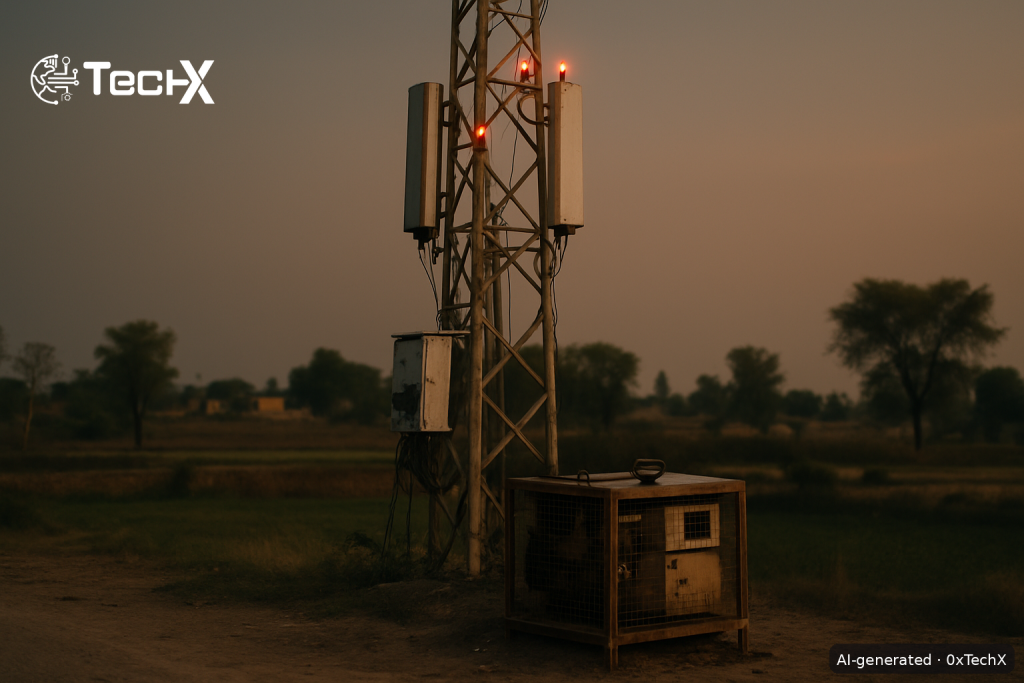
Telecom tower attacks in Pakistan have reached a scale that cannot be ignored. The Pakistan Telecommunication Authority (PTA) told a Senate sub-committee that more than 9,200 incidents of theft and vandalism hit the country’s telecom infrastructure in just 11 months, disrupting mobile and internet services and affecting nearly 16 percent of Pakistan’s cellular network. With the 5G spectrum auction on the horizon, this crisis puts a serious question mark over the country’s digital future.
Scale of Telecom Tower Attacks Pakistan Has Never Seen Before
The single most striking figure from the Senate hearing is that over 9,200 incidents of diesel theft occurred in the past eleven months alone. That averages out to more than 800 incidents per month, roughly 27 every single day.
Authorities said telecom towers have repeatedly been targeted for diesel theft, equipment theft, and deliberate vandalism, leading to service outages in multiple regions and increasing the cost of maintaining critical communications infrastructure.
The numbers are almost certainly an undercount. Despite hundreds of documented incidents in key districts, only about 34 percent of cases were formally reported, suggesting the real nationwide figure is even higher. PTA officials confirmed that telecom companies often fail to register First Information Reports (FIRs) after diesel theft incidents, making legal action against offenders difficult.
Province-by-Province Breakdown
The attacks are not limited to one troubled region. They are distributed across 120-plus districts spanning all four provinces, a pattern that points to systemic vulnerability in how Pakistan’s telecom infrastructure is secured, rather than localised crime in specific regions.
- Sindh: Sindh recorded the highest number of incidents, with 3,938 cases reported across 31 districts.
- Punjab: Punjab followed with 2,827 incidents in 38 districts.
- Khyber Pakhtunkhwa: KPK witnessed 1,668 incidents across 25 districts.
- Balochistan: Balochistan recorded 716 cases in 26 districts.
The Balochistan picture is especially alarming when you look at the Universal Service Fund (USF) network. Of more than 4,000 mobile towers under USF’s mandate, 330 have recorded theft incidents, and 229 of those are in Balochistan, meaning the province accounts for nearly 70 percent of reported tower theft cases within the USF network.
More concerning still, 90 telecom towers are experiencing repeat thefts. The same towers are being targeted again and again, pointing to organised activity rather than opportunistic crime.
Load-Shedding Makes the Crisis Worse
Theft and vandalism alone do not explain the full damage to mobile services. Load-shedding is directly making telecom tower attacks Pakistan-wide more damaging than they would otherwise be.
PTA’s report identifies load-shedding as a major challenge for service continuity. The two problems are directly connected: when power cuts force towers onto diesel generators, that diesel becomes the most valuable and most vulnerable asset at each site and the primary target for theft.
Operators are facing up to twelve hours of load-shedding daily, which their infrastructure simply cannot absorb. Battery backup at telecom towers, PTA confirmed, cannot sustain operations beyond one to two hours.
Senator Kamran Murtaza put the problem bluntly. He pointed out that even on Eid, when the government publicly announced a suspension of load-shedding, both electricity and gas outages continued. If the government cannot honour a public holiday commitment on power, how reliable is any promise of priority supply to telecom infrastructure?
Senator Sadia Abbasi said mobile and internet services have reached the same level of necessity as electricity and gas in modern Pakistani life. She called for stronger legislation to protect telecom sites.
What Regulators and Operators Are Doing
The Senate hearing was not just a complaint session. Concrete steps are being pushed on several fronts.
Security and Legal Action
PTA has directed all telecom operators to ensure FIRs are registered whenever diesel, batteries, or other equipment is stolen from telecom installations. Officials also said telecom operators are increasingly using surveillance cameras instead of security guards to monitor tower sites and prevent theft.
The sub-committee directed relevant departments to map high-theft hotspots and instructed district and provincial authorities to handle complaints strictly under the law.
Electricity and Solar
The Ministry of Information Technology is working with power distribution companies, NEPRA, and the Power Division to secure priority electricity supply for telecom infrastructure through dedicated express feeders and smart transformers. You can follow PTA’s official site for regulatory updates, and NEPRA’s portal tracks power sector decisions that affect these supply guarantees.
PTA officials confirmed that steps are being taken to transition telecom towers to solar power. Operators themselves are also moving in that direction. Solar would eliminate the diesel dependency that is currently the sector’s most exploited vulnerability, both by fuel thieves and by an unreliable supply chain.
The 5G Auction Still on Track
Despite all of this, Pakistan’s 5G plans have not been shelved. PTA expects the planned spectrum auction to increase available spectrum by more than 200 percent, raising average 4G speeds from around 4 Mbps to nearly 20 Mbps, while initial 5G services are expected to deliver speeds of up to 50 Mbps.
Mobile operators have committed to installing 1,000 new telecom sites annually, with 20 percent of those planned for previously uncovered locations. Plans also include expanding broadband coverage through USF projects, increasing the fiber-to-site ratio from 20 percent to 35 percent, and introducing national roaming on highways.
For Pakistan’s broader digital ambitions, fixing tower security is not optional. The country has surpassed 200 million telecom subscribers and 150 million broadband connections, a base that depends on the very infrastructure being stolen and damaged every single day. If you are interested in how Pakistan’s digital economy is growing despite these challenges, our piece on Pakistan IT exports hitting a record $4.5 billion in FY26 shows the stakes involved.
Frequently Asked Questions
How many telecom tower attacks happened in Pakistan?
More than 9,200 incidents of theft and vandalism were reported across Pakistan in an 11-month period, according to a PTA report presented to the Senate Sub-Committee on IT and Telecommunication. This works out to roughly 27 incidents every single day.
Which province has the most telecom tower attacks?
Sindh recorded the highest number with 3,938 cases across 31 districts, followed by Punjab with 2,827, KPK with 1,668, and Balochistan with 716. However, within the USF tower network, Balochistan accounts for about 70 percent of reported theft cases.
How does load-shedding make tower theft worse?
When the power goes out, towers switch to diesel generators. That diesel then becomes a direct theft target. Tower batteries can only last one to two hours, so long power cuts lasting up to twelve hours a day force heavy diesel use, creating a constant supply of fuel that thieves can steal.
Will this affect 5G in Pakistan?
PTA says the 5G spectrum auction is still going ahead and expects average speeds to jump from 4 Mbps to up to 50 Mbps once 5G rolls out. But analysts note that until tower security and reliable power supply are fixed, achieving those speed targets across the country will remain a serious challenge.