
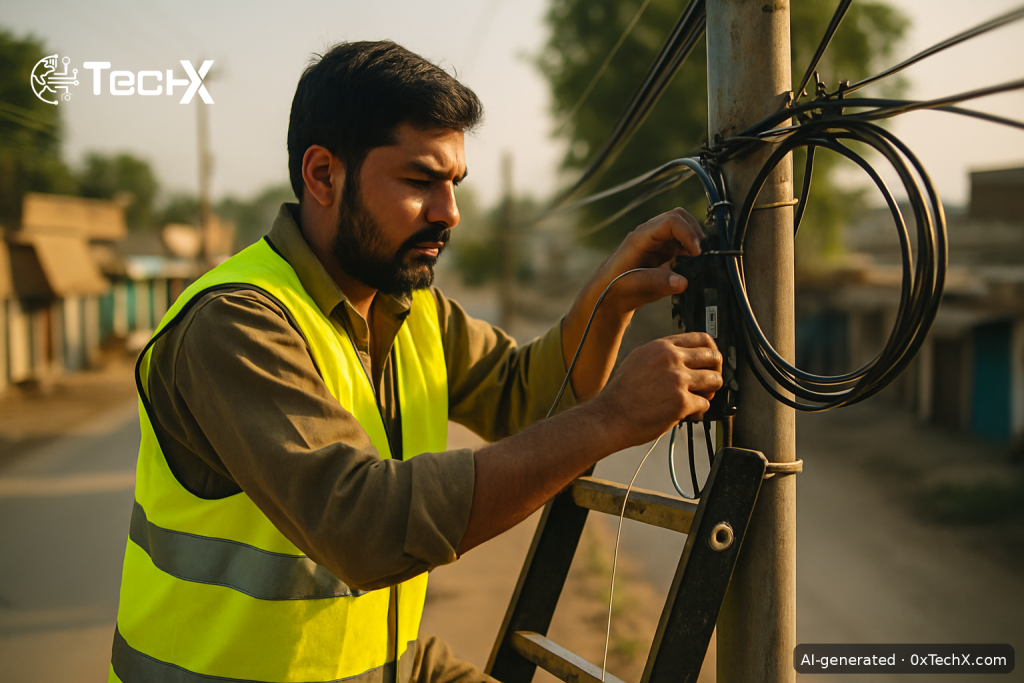
The Pakistan broadband expansion drive got a major push this week when a high-level government meeting reviewed the National Connectivity Plan and set some of the country’s most ambitious internet targets yet. Officials noted that FTTH subscriptions have grown to 2.8 million, backed by a fibre footprint of 234,000 kilometres, 5.1 million house passes, and six operational submarine cables. Now the government wants to go much further, much faster.
What the National Connectivity Plan Actually Promises
Federal Minister Ahad Cheema outlined key national targets under the plan, including expanding infrastructure to 10 million house passes, raising average fixed broadband download speeds to 85 Mbps, securing a place among the world’s top 50 countries for broadband performance, and increasing tower fiberisation to 60 percent.
To put those numbers in context: Pakistan is currently ranked 92nd in the world for broadband performance. The plan aims to increase Pakistan’s average fixed broadband speed from 30.32 Mbps to 85 Mbps, which is nearly three times higher. That single jump would make a real difference for anyone working from home, running an online business, or studying online.
Pakistan is preparing this nationwide plan with the aim of promoting the digital economy, reducing the digital divide, and improving digital infrastructure across the country. Prime Minister Shehbaz Sharif has directed authorities to finalize the National Connectivity Plan as soon as possible, and the Ministry of Information Technology and Telecommunication (MoITT) has intensified work on the plan following that directive.
Pakistan Broadband Expansion and the Fibre Foundation Behind It
The plan is not starting from zero. Pakistan already has a large fibre network in place. The MoITT, in collaboration with the World Bank, has launched the National Fiberisation Plan, which aims to connect 10 million households with high-speed 100 Mbps broadband by 2029. The plan also targets the fiberisation of 80 percent of mobile towers to improve mobile network services.
Submarine cables are a big part of the story too. Pakistan recently joined the SEA-ME-WE 6 submarine cable, one of the fastest undersea networks in the world, and this marks Pakistan’s third international cable added in just a year, dramatically increasing internet bandwidth. Transworld Associates, the landing partner for SEA-ME-WE 6, will initially provide 4 terabits per second of additional capacity, raising Pakistan’s total bandwidth by nearly 40 percent.
More cables are in the pipeline. Pakistan currently maintains international connectivity through seven fibre-optic submarine cables, with three new cables to be added in the next two years.
What This Means for Freelancers and Small Business Owners
Federal Minister Ahad Cheema said the government’s top priority is to help freelancers, e-commerce entrepreneurs, and other digital professionals living in remote areas who still face challenges due to slow and unreliable internet. He added that the government will take all necessary measures to ensure affordable, high-speed internet is available across the country so citizens can fully join the digital economy.
This is where the Pakistan broadband expansion story gets personal for millions of people. A freelancer in Faisalabad or a small online seller in Peshawar needs the same reliable connection as someone in Karachi or Islamabad. The plan will focus on extending broadband connectivity to small cities, rural communities, and remote areas.
For more on how Pakistan is working to bridge its wider digital gap, see how the GSMA has flagged smartphone affordability as a key barrier to digital access in Pakistan.
The Last-Mile Problem Most Coverage Misses
Most news about Pakistan’s internet plans focuses on big numbers like submarine cables and national speed targets. But the harder challenge is the last mile: getting fibre from a main road or exchange into homes and villages that private operators find too expensive to reach on their own.
That is where the Universal Service Fund (USF) plays a key role. The USF has approved Rs 13.05 billion (around US$47 million) in projects to expand connectivity to 5.55 million underserved users across 11 districts. These projects will provide high-speed internet and voice services to 5.55 million unserved and underserved residents across 178 towns and 753 villages in 11 districts, helping rural people join the digital economy.
Even with this investment, challenges remain. Execution risks are significant, including fragmented infrastructure, high deployment costs, and the need for coordinated policy and private investment. Given Pakistan’s large geography and significant rural population, satellite broadband is also emerging as an alternative for hard-to-reach areas where fibre deployment costs would be too high.
Key Targets at a Glance
- Current FTTH connections: 2.8 million
- Target house passes: 10 million
- Current average fixed broadband speed: 30.32 Mbps
- Target average speed: 85 Mbps
- Current global ranking: 92nd
- Target global ranking: Top 50
- Target tower fiberisation: 60 percent
- Submarine cables operational: 6 (with more coming)
The Ministry of Information Technology and Telecommunication (MoITT) is driving all of these targets under the broader National Connectivity Plan framework.
Also linked to this broader digital drive is the push to exempt telecom towers from load shedding, which you can read about in our earlier report on the telecom towers load shedding exemption and PM’s committee on 5G.
Frequently Asked Questions
What is Pakistan’s National Connectivity Plan?
It is a government framework being finalized by MoITT to improve internet infrastructure across Pakistan. It targets faster speeds, more fibre home connections, better rural coverage, and a higher global broadband ranking. The Pakistan broadband expansion under this plan is one of the biggest digital infrastructure drives the country has launched.
How many FTTH connections does Pakistan currently have?
FTTH subscriptions in Pakistan have grown to 2.8 million, supported by a fibre network of 234,000 kilometres and 5.1 million house passes. The government wants to grow house passes to 10 million.
Will rural areas benefit from this broadband expansion?
Yes. The USF has already approved over Rs 13 billion to bring connectivity to 5.55 million people in underserved districts. The National Connectivity Plan specifically focuses on extending broadband to small cities, rural communities, and remote areas. Satellite broadband may also fill gaps where laying fibre is too costly.
How does Pakistan’s broadband compare globally right now?
Pakistan’s current average fixed broadband speed is 30.32 Mbps. The National Connectivity Plan aims to raise this to 85 Mbps, which would place Pakistan among the top 50 nations globally for broadband performance. That is a big jump from the current 92nd position.