
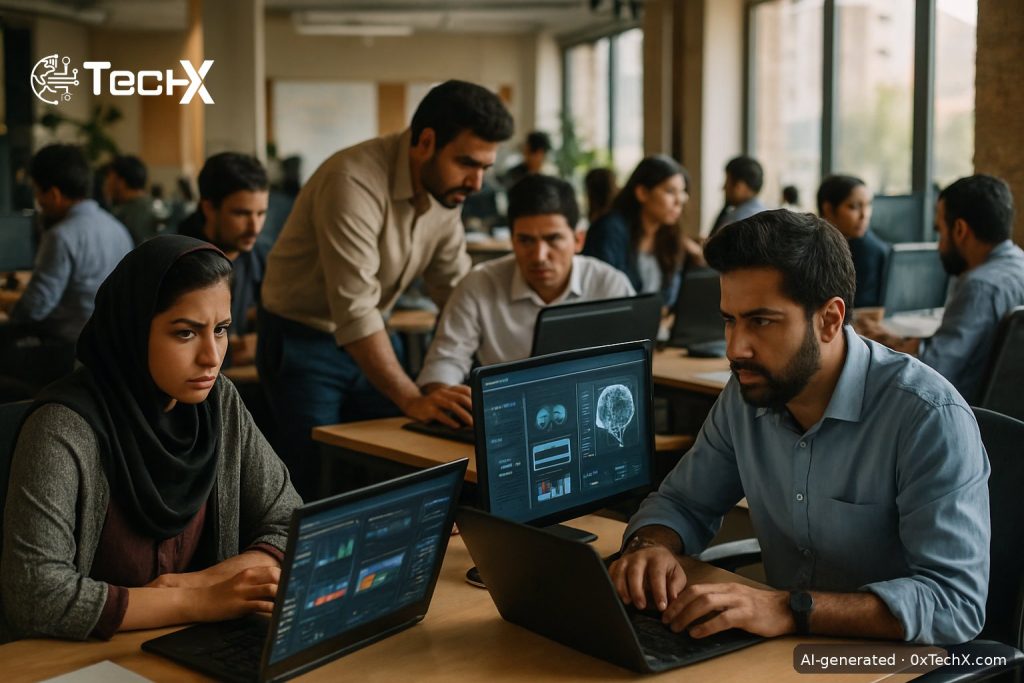
Pakistan service sector jobs are in the spotlight after a new World Bank report found that 61% of service workers hold roles with above-median exposure to artificial intelligence, raising urgent questions about who could lose work and who could benefit from the technology.
The report, titled Job Opportunities and AI in Pakistan, highlights opportunities to improve productivity alongside concerns about potential job losses. It is part of the World Bank’s Pakistan Development Update, published on 22 October 2026.
Earlier, the Bank’s broader World Development Report 2026: The Promise of AI (August 2026) had already flagged Pakistan as vulnerable to AI-driven displacement, especially for educated young workers. It identified Pakistan among the economies in the MENAAP region that are particularly vulnerable because of high youth unemployment, limited private-sector job creation and a shortage of high-quality employment opportunities. The new October report goes much deeper, mapping AI risk sector by sector for the first time.
What the Numbers Actually Mean for Pakistan Service Sector Jobs
The headline figure, 61%, sounds alarming, but the report is careful to explain what it does and does not mean.
High exposure does not mean that 61% of service-sector workers are expected to lose their jobs. It means their occupations involve tasks that AI could potentially perform or assist with.
The real picture becomes clearer when you break the data into two groups:
- Around 18% of employed workers in Pakistan hold jobs with both high AI exposure and strong potential for human-AI collaboration. These workers are likely to become more productive, not redundant.
- Only 8% work in highly exposed occupations with limited opportunities for AI assistance, suggesting that a smaller proportion of jobs face a greater risk of replacement.
That 8% figure is the real headline. It is a far smaller number than the top-line 61%, and it is where reskilling efforts need to focus most urgently.
Which Sectors Are Most Exposed?
More than 80% of workers in wholesale and retail trade, finance, insurance, real estate, and education hold jobs with high AI exposure.
By contrast, the risk drops sharply outside services. While 61% of service-sector workers are employed in occupations with above-median AI exposure, the corresponding shares stand at just 7% in manufacturing, 5% in other industrial sectors and less than one percent in agriculture.
This matters a great deal for Pakistan’s economy. Agriculture still employs tens of millions of Pakistanis, and those workers are largely shielded from immediate AI disruption. The pressure lands squarely on city-based, educated, white-collar workers: the bank teller, the insurance agent, the real estate coordinator, the retail supervisor.
Wholesale and Retail Trade: A Special Case
Wholesale and retail trade combines a large workforce with high AI exposure. This sector deserves particular attention because it employs a substantial number of workers and includes both AI-complementary and potentially substitutable roles. AI tools can automate stock management, customer queries, and billing, but they can also help a skilled salesperson serve more customers per day.
Real Estate and Education: A Better Outlook
Real estate and education primarily show complementary exposure, which points to room for AI-assisted productivity gains. A teacher who uses AI to personalise lessons, or a property agent who uses AI to match buyers faster, is likely to be more effective, not replaced.
Pakistan’s Double-Edged Position
What makes Pakistan’s situation unusual is that the country is both a target of AI disruption and a growing supplier of AI services globally.
The World Bank describes Pakistan as an exporter of AI services that relies on its talent, with about 75,000 IT graduates a year and record ICT services exports of $4.6 billion in the 2025/26 fiscal year, ranking Pakistan among the top five global suppliers across more than 2,700 skill areas on major online platforms.
Pakistan recorded the highest absolute number of AI-related conversations in the region, though usage is concentrated in graphic design, content creation and translation rather than software development, possibly reflecting its large presence on international freelance platforms.
This is the core tension. Pakistani freelancers and IT firms earn dollars by providing AI-related services. At the same time, AI tools are starting to do some of those very services automatically, leaving workers exposed to shifts in demand as AI starts replacing some outsourced tasks. The BPO (business process outsourcing) sector has already seen a notable drop in job postings as AI tools take over routine data and customer-service tasks.
To address this, Pakistan has set a target of training 200,000 people annually in AI and providing 3,000 postgraduate scholarships, according to the World Bank. The government’s broader plan is a $1 billion AI programme through 2030, announced by the Prime Minister earlier this year.
Who Needs Reskilling and What Should They Learn?
Jobs involving information processing, administrative duties, and knowledge-intensive tasks are particularly likely to change as organisations adopt AI tools.
The World Bank cautions that the actual employment impact will depend on the pace of AI adoption, access to relevant skills, and investment in technologies that support workers. High occupational exposure alone cannot predict job losses.
For workers in finance, retail, or education, the practical advice is clear: learn to work with AI tools rather than waiting to be replaced by them. Skills in prompt engineering, AI-assisted data analysis, customer experience design, and digital workflow management are increasingly in demand. Demand for digital and AI skills has risen sharply, with Pakistan among the countries recording double-digit percentage-point gains in the share of job postings requiring digital skills between 2021 and 2025.
For policymakers, the World Bank’s Pakistan Development Update is direct: invest in electricity, internet connectivity, computing infrastructure, and local AI training ecosystems. Without these, the benefits of AI will flow abroad while the job losses stay at home.
Pakistani tech companies and educators have a role to play too. Platforms that offer affordable, practical AI training in Urdu and English, covering tools workers actually use at their desks, can close the skills gap faster than any government scholarship alone. You can also read about how Pakistan’s Buraq Urdu AI model aims to keep local data inside the country, a step that could support home-grown AI training tools.
Frequently Asked Questions
Does 61% exposure mean 61% of Pakistan service workers will lose jobs?
No. High AI exposure means those jobs include tasks AI can assist with or automate. The World Bank separates this into two groups: 18% of all Pakistan workers can gain productivity through human-AI collaboration, while only 8% face roles where AI may genuinely replace them with little room for collaboration.
Which Pakistan service sector jobs face the highest AI risk?
Roles in wholesale and retail trade, finance, insurance, real estate, and education all have more than 80% of their workers in high-exposure occupations. Administrative, data-processing, and customer service roles within these fields face the most direct substitution risk from AI tools.
What can workers do now to stay relevant?
The World Bank recommends building skills that pair well with AI rather than competing against it. Practical training in AI tools, data skills, digital workflow management, and prompt engineering makes workers more productive and harder to replace. Pakistan’s goal of training 200,000 people annually in AI is a step in the right direction.
Is Pakistan’s agriculture sector safe from AI disruption?
For now, yes. Less than 1% of agricultural workers in Pakistan hold jobs with high AI exposure, making it the most insulated major sector. Manufacturing and other industries are also relatively low-risk at 7% and 5% respectively. The pressure is concentrated almost entirely in the services economy.