
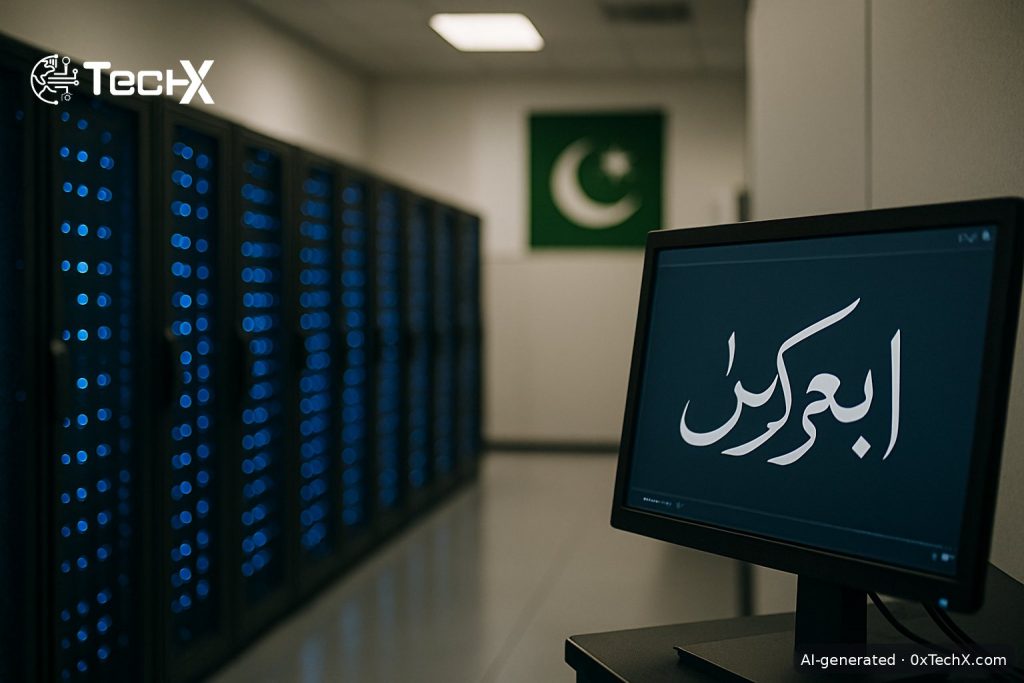
The Buraq Urdu AI model is Pakistan’s government-backed large language model (LLM) designed to understand and generate Urdu and other regional languages, with a firm promise that Pakistani data will never leave the country. The announcement came this week from the federal IT minister at a major international summit, and it signals a serious shift in how Pakistan plans to build AI for its 240 million citizens.
What Was Announced and Where
Pakistan is building Buraq, its own large language model trained on Urdu and regional languages, and procuring sovereign compute capacity so that Pakistani data is processed within Pakistan, the Federal Minister for IT and Telecom said at the Global AI and Digital Summit 2026 in Seoul.
The Global AI and Digital Summit was hosted in Seoul from October 19 to 22 by the World Bank Group, together with South Korea’s Ministry of Science and ICT and its Ministry of Finance and Economy. Federal IT Minister Shaza Fatima Khawaja delivered a keynote address presenting Pakistan’s blueprint for AI governance and digital transformation.
Pakistan was set to become the first country to sign the Digital and AI Compact during the summit. That is a significant step, and the Buraq announcement is at the heart of it.
Why the Buraq Urdu AI Model Matters for Ordinary Pakistanis
Right now, when you use any major AI tool like ChatGPT or Gemini, your words and questions go to servers in the United States or Europe. That means your data, and potentially sensitive government or financial data, sits on foreign computers under foreign laws.
Buraq changes this. The sovereign compute approach enables organisations to train and deploy AI models, process large datasets, and run real-time applications without relying on offshore cloud regions, covering sensitive data types including financial transactions, medical imaging, telecom data, and government records, ensuring none of it leaves Pakistan.
There is also a language problem that Buraq directly addresses. Urdu accounted for just 0.03% of global URLs collected by Common Crawl in July 2026. This means global AI models have very little Urdu training data, so their Urdu output is often awkward or wrong. A dedicated model trained specifically on Urdu text from the start can fix this at a national level.
The Four Pillars Behind Buraq
The minister told a World Bank panel on digital government service delivery that Buraq, and the public compute capacity behind it, form the AI layer of a programme built on four foundations.
- Digital identity: NADRA provides verified identity to more than 100 million Pakistanis, now extended into a digital identity that authenticates citizens online and records and enforces consent.
- Payments: The State Bank’s Raast instant payment rail turns an AI model’s identification of a qualifying household into delivery.
- Data sharing: WASL, the national exchange layer of the Digital Public Infrastructure stack built under the World Bank-supported Digital Economy Enhancement Project, lets institutions share data with every transaction authenticated, encrypted, and logged.
- Safeguards: The National Data Governance Policy sets a single rulebook for classifying, sharing, protecting, and publishing public data.
The minister summed it up clearly: AI is the last layer, not the first. In other words, Pakistan is building the roads before putting cars on them. That is exactly the right order, and it is what many other developing countries skip.
Pakistan Is Not Starting From Zero on Urdu AI
Buraq is a government initiative, but private Urdu AI work is already happening. Earlier in 2026, a Pakistani student in the United States named Taimoor Hassan released a model called Qalb. The model was trained on 1.97 billion tokens and tested using more than seven international benchmarking frameworks, with its creators saying Qalb performs better than existing Urdu-focused AI systems on several real-world tasks.
Urdu is spoken by more than 230 million people globally, including in Pakistan, India, and diaspora communities, but remains under-represented in advanced AI systems. Efforts to localize AI have increasingly been seen as critical for widening participation in digital economies, particularly in developing countries.
Buraq, as a state-level project with sovereign compute and a government mandate, goes much further. It is not just a research model. It is meant to power real public services, from welfare delivery to health records to tax systems.
What This Means for Pakistan’s Tech Sector
For developers and IT companies, a locally hosted sovereign AI model opens new doors. Businesses that handle sensitive data, such as hospitals, banks, and fintech startups, have so far been cautious about using cloud AI because they cannot guarantee where their data goes. Buraq and Pakistan’s sovereign compute infrastructure solve that problem.
This also links to a broader pattern in Pakistan’s digital economy. As we have covered, Pakistan’s IT sector is growing fast but AI is already reshaping which roles survive. A homegrown Urdu AI model could create a new wave of local AI product development, giving Pakistani startups an edge in building Urdu-first apps and services for both the domestic market and the wider South Asian diaspora.
The minister also announced a $1 billion national funding commitment through 2030, alongside sweeping regulatory reforms and public sector AI deployments. That budget, if spent well, gives Buraq real teeth.
The minister warned that when governments skip the foundations, they do not get AI in public services. They get pilots that never scale and systems that citizens do not trust. Pakistan appears to be taking that warning seriously with this layered approach.
Frequently Asked Questions
What is the Buraq Urdu AI model?
The Buraq Urdu AI model is a large language model being built by the Pakistani government. It is trained on Urdu and regional languages and is designed to run entirely on servers inside Pakistan, so no Pakistani data is sent abroad.
Who announced Buraq and when?
Pakistan’s IT Minister Shaza Fatima Khawaja attended the Global AI and Digital Summit 2026 in Seoul to highlight the country’s future roadmap on digital transformation and artificial intelligence. The Buraq announcement was made on October 22, 2026, at a World Bank panel on digital government.
Why does Pakistan need its own Urdu AI model?
Global AI models are mostly trained on English and have very limited Urdu data. Urdu accounted for just 0.03% of global URLs collected by Common Crawl in July 2026. This makes global AI tools poor at understanding Pakistani users. Buraq aims to fix that, while also keeping sensitive government, health, and financial data from leaving the country.
What is sovereign compute and why does it matter?
Sovereign compute means government-owned or government-contracted computing power (servers and GPUs) that sits physically inside Pakistan. When Buraq runs on this infrastructure, all data processing happens locally. This protects citizen privacy, meets data residency rules, and reduces dependence on foreign tech companies. It also means Pakistan’s PTA and other regulators can enforce their own rules without relying on foreign platforms to cooperate.