
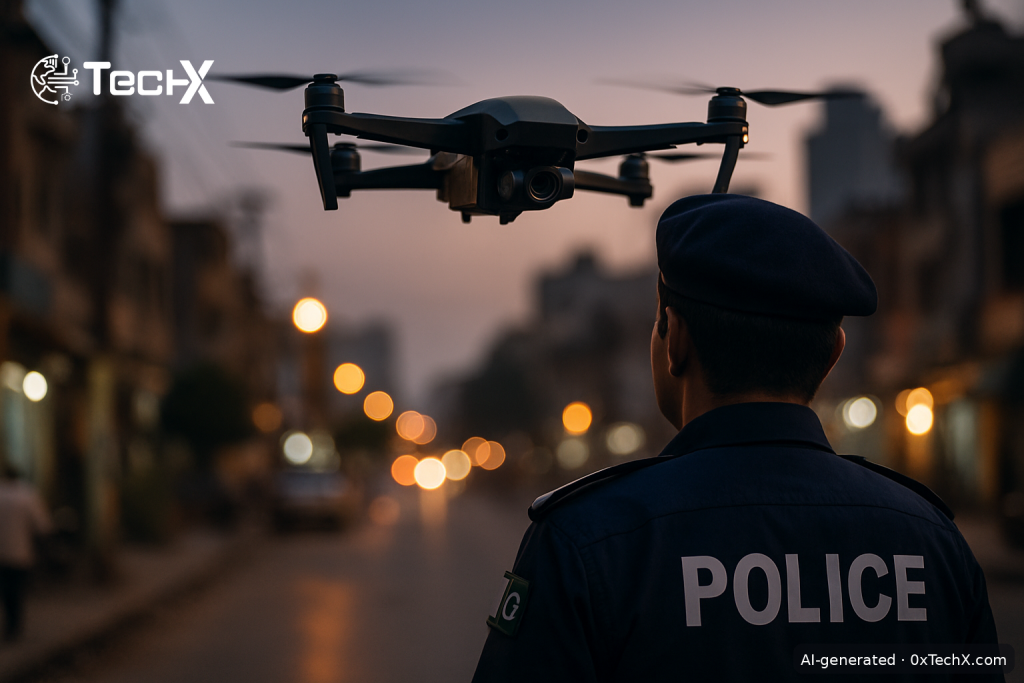
Pakistan police AI drones are no longer a distant idea. On 6 August 2026, Interior Minister Mohsin Naqvi announced a wide-ranging policing reform package that includes advanced drone induction, a China-inspired investigation centre in Islamabad, and permanent overseas training for police officers. The plan is ambitious, but it also opens up serious questions about privacy, oversight, and whether Pakistan has the legal framework to manage this technology responsibly.
What Naqvi Actually Announced
The announcement came during a meeting with Assistant Superintendents of Police (ASPs) who had just returned from training courses in China and Türkiye. Speaking to the group, Naqvi said foreign training would now become a permanent part of every Pakistani police officer’s career path, not a one-off event.
The centrepiece of the reform is a pilot Law Enforcement Investigation Centre in Islamabad, modelled on a Chinese policing facility. The centre would bring detention, investigation, and summary trial processes under a single roof, with the stated aim of clearing minor criminal cases faster and cutting procedural delays.
On the technology side, the Ministry of Interior’s Aviation Wing will receive state-of-the-art drones to support aerial surveillance and field operations. Naqvi also said specialized investigation rooms will be set up at the National Police Academy, and interrogation will be added as a dedicated subject in the training curriculum.
Pakistan Police AI Drones Are Already Being Deployed Across Provinces
The federal announcement is not happening in a vacuum. Provincial forces have been moving in the same direction for months. Khyber Pakhtunkhwa (KP) Police recently received 76 AI-powered thermal imaging drones. The KP Inspector General formally handed over DJI Mavic 4T surveillance drones to representatives of 27 districts and seven police units at a ceremony in Peshawar. Counter Terrorism Department units in sensitive districts received DJI Matrice 400 RTK drones with advanced thermal capabilities for intelligence-based missions.
The drones can work at night, track suspicious movements across large areas, support search-and-rescue operations, and monitor public gatherings. Police officials described them as a step toward technology-led policing in a province that faces significant security challenges.
Sindh Police is not far behind. The provincial force is setting up a dedicated Aerial Surveillance Division to keep watch over urban centres, highways, railway tracks, and riverine areas that are hard to police on the ground. A high-level committee led by Additional IG Iqbal Dara has been formed to prepare a roadmap covering AI systems, drone units, cybercrime wings, and specialized investigation teams.
The China Model and What It Means in Practice
The phrase ‘China-style’ carries weight. China’s law enforcement model is known for integrating facial recognition cameras, AI-assisted monitoring, and centralized data systems into everyday policing. Naqvi visited the Beijing Police College in January 2026, where both sides agreed that ASPs at the National Police Academy would complete a one-month training course there.
Pakistan’s plan, at least as announced, stops short of a full surveillance grid. The focus so far is on drone aerial surveillance, faster case processing, and better-trained officers. But as the World Bank’s 2026 report on Pakistan and AI risk shows, the country is already navigating difficult tradeoffs as it adopts powerful technology across sectors. Law enforcement use of AI is arguably the most sensitive area of all.
The Privacy and Oversight Gap Nobody Is Addressing Yet
Pakistan approved its first National AI Policy in July 2025. The policy classifies law enforcement as a high-risk AI application, meaning it requires extra scrutiny, human oversight, and accountability mechanisms. But the policy is a framework, not a binding law with teeth. Specific penalties and enforcement rules are meant to follow through separate regulations that are still being written.
The country also lacks a finalised Personal Data Protection law. That means there is currently no clear legal rule about how drone footage is stored, who can access it, how long it is kept, or what rights a citizen has if they believe they were wrongly monitored.
A 2024 UNDP survey found that only 12 percent of Pakistani government officials had received any formal training in AI principles or public administration applications. Deploying AI surveillance tools into a system where most decision-makers have no formal AI training is a real risk, not a hypothetical one.
Legal experts have called for a public registry of AI tools used in policing, independent audits, and clear rules on algorithmic fairness before wide deployment. Without those safeguards, even well-intentioned technology can entrench existing problems rather than solve them.
What Comes Next
The Islamabad pilot will be the first real test. If the Law Enforcement Investigation Centre works as described, speed and efficiency in the criminal justice system could genuinely improve. If drone surveillance expands without a data protection law, civil liberties groups will have legitimate grounds to push back.
Pakistan has shown it can move fast on digital infrastructure when there is political will. The NCCIA’s takedown of the Tycoon 2FA phishing ring with Interpol showed that local law enforcement can work effectively with modern cyber tools. The challenge with physical surveillance technology is different: the systems are bigger, the data is more personal, and the risks of misuse are higher.
The government says it wants policing that is faster, smarter, and more responsive. For that to earn public trust, transparency about how these Pakistan police AI drones are operated, what data they collect, and who holds the police accountable will matter as much as the technology itself.
Frequently Asked Questions
What did Interior Minister Naqvi announce about police technology?
On 6 August 2026, Naqvi announced a pilot China-style Law Enforcement Investigation Centre in Islamabad, new drones for the Ministry of Interior’s Aviation Wing, specialized investigation rooms at the National Police Academy, and permanent overseas training for police officers in countries like China and Türkiye.
Are Pakistan police AI drones already in use?
Yes. KP Police have already received 76 AI-powered thermal drones covering 27 districts. Sindh Police is building a dedicated Aerial Surveillance Division. The federal government’s latest announcement adds more drones at the national level through the Interior Ministry’s Aviation Wing.
Does Pakistan have laws to regulate AI surveillance by police?
Pakistan’s National AI Policy 2025 labels law enforcement as a high-risk AI area requiring human oversight. However, the policy is a roadmap, not a binding law. Pakistan still lacks a finalised Personal Data Protection Act, which means there are currently no clear legal rules on how police drone footage is stored, shared, or challenged by citizens.
What is the China-style Law Enforcement Investigation Centre?
It is a single facility that combines detention, investigation, and summary trial functions in one building. The model is drawn from Chinese policing practice and is intended to speed up the processing of minor criminal cases. The pilot will run in Islamabad first before any national rollout is considered.