
Pakistan’s NEV Policy is one of the most ambitious transport plans the country has ever set. The government wants 2.2 million electric vehicles on Pakistani roads by 2030, and in early July 2026 it briefed the Senate Standing Committee on Industries and Production with a full set of numbers. The plan looks impressive on paper. But senators pushed back hard, and the gaps in the plan are real. Here is what you need to know.
What the Pakistan NEV Policy Actually Says
The target forms part of Pakistan’s broader New Energy Vehicle (NEV) Policy 2025-30, which seeks to accelerate EV adoption, reduce fuel imports, and strengthen local manufacturing. The strategy aims to transition 30 percent of all new vehicle sales to electric power by the end of the decade, to cut a massive fossil fuel import bill.
The government also shared claimed savings from this shift. Officials estimate the transition could save 2.07 billion litres of fuel annually, generate around $1 billion in foreign exchange savings each year, and reduce carbon emissions by 4.5 million tonnes. That is a big number, and it is the figure ministers are leaning on hardest to sell the policy to investors and the public.
The Hard Numbers from the Senate Briefing
The committee was informed that approximately 2.2 million electric vehicles of different categories are projected to be on Pakistan’s roads by 2030. To date, over 12,800 electric vehicles and around 160,000 electric motorcycles have been manufactured locally. That local production figure shows some early momentum, though it is still a tiny share of Pakistan’s total vehicle stock.
Pakistan’s transport sector remains overwhelmingly dependent on petroleum, with the vast majority of the country’s estimated 31 to 33 million registered vehicles relying on internal combustion engines. So 12,800 electric cars and 160,000 e-bikes, while a start, still represent well under one percent of total vehicles on the road.
The Rs 9 Billion E-Bike Subsidy
The government has allocated Rs 9 billion in subsidies for two- and three-wheelers, while eligible buyers receive a subsidy of Rs 80,000 for purchasing an electric motorcycle. To qualify, around 5,700 beneficiaries have availed bank financing under the scheme. Officials informed the committee that applicants must provide a valid CNIC, bank account, and crossed cheque to qualify.
Senators raised a concern about how the subsidy reaches buyers. Senator Anusha Rahman recommended that the subsidy be transferred directly to Original Equipment Manufacturers (OEMs) to improve transparency and implementation. She also noted that businesses often invest money but later face changes in taxes and regulations, stressing that the Ministry of Industries and Production must protect its policies to maintain investor confidence.
There is also a condition attached to the subsidy: ownership of subsidized electric motorcycles cannot be transferred for two years. This protects against resale abuse but may put off some buyers who need flexibility.
The Charging Station Problem
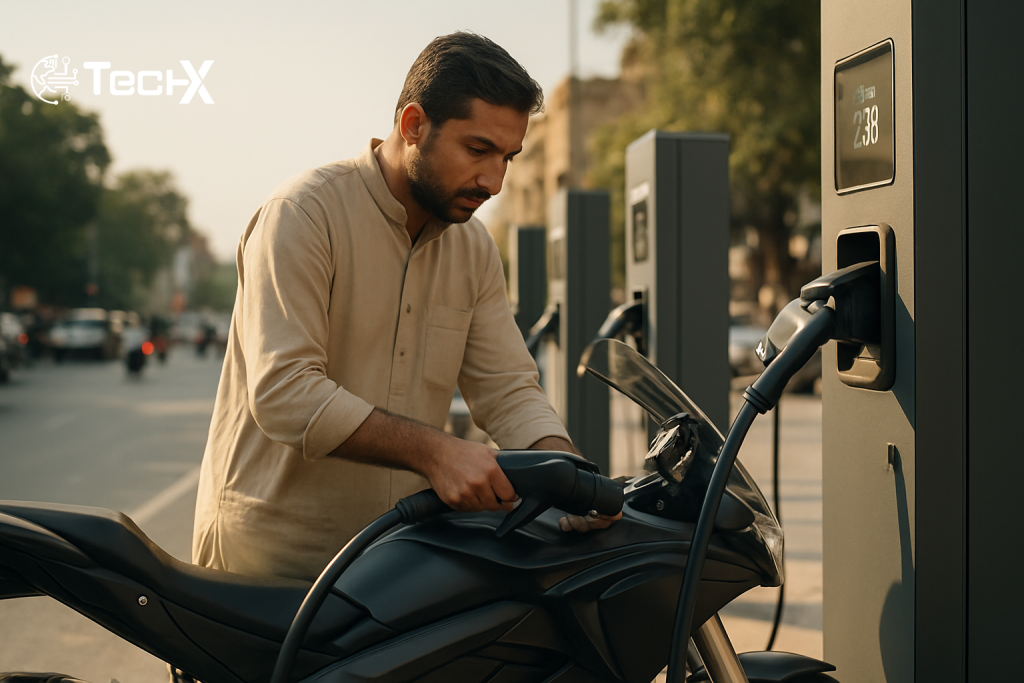
This is where Pakistan’s NEV Policy faces its most serious test. The government aims to establish 3,000 electric vehicle charging stations by 2030, and more than 72 licenses for the installation of electric charging stations have already been issued. Charging stations would be developed under a public-private partnership model, with government support to bridge investors’ viability gap.
But the numbers do not add up to what Pakistan actually needs. The Senate Standing Committee raised serious questions after Senator Saleem Mandviwalla pointed out that Karachi alone may need around 4,000 to 5,000 charging stations, while the government’s national target is to set up 3,000 charging stations by 2030. One city’s need is bigger than the entire national plan. That is not a small gap.
Senator Mandviwalla shared his personal experience of facing difficulty finding charging facilities during travel. He stressed that charging stations must also extend to remote areas, not only big cities.
Companies including Star Charge and HUBCO have shown interest in establishing charging infrastructure in Pakistan, which is a positive sign. But interest and actual installation are very different things.
The Grid Reliability Question
Even if 3,000 stations were built tomorrow, Pakistan’s electricity grid would still be a challenge. As electricity costs continue to rise and load-shedding becomes more commonplace, it can affect the home-charging landscape. Despite having installed generation capacity, inefficiencies in transmission and financial constraints continue to trigger outages.
There is a practical bright spot, though. Electric motorcycles equipped with 3 to 7 kilowatt batteries require only a standard 220-volt power supply for charging. That means most e-bike owners can charge at home using a normal socket, without needing a dedicated public station. This is important because the e-bike segment is where most of Pakistan’s early EV adoption is happening anyway.
For four-wheelers, the picture is harder. Fast charging requires a stable supply, and frequent load shedding in Pakistan continues to disrupt industrial and commercial operations, forcing many businesses to rely on diesel generators. A public EV charging station that loses power during peak demand hours offers little comfort to a driver mid-journey.
Is the 2030 Target Realistic?
The policy has real strengths. The subsidy for e-bikes directly targets the middle-class and working-class buyer, which is the right segment to focus on. Senator Ateeb stressed that to survive the petrol crisis, policy focus must shift toward vehicles the public can actually afford, noting that focus should be on smaller cars rather than big luxury vehicles. That logic is sound. Pakistani families are not buying luxury EVs. They are buying motorcycles and small cars, and that is exactly where the subsidy is aimed.
The $1 billion annual foreign exchange savings claim is also grounded in a real calculation. The transition is projected to save 2.07 billion litres of fuel annually, amounting to nearly $1 billion in foreign exchange savings, and the policy is expected to reduce carbon emissions by 4.5 million tonnes and cut health-related costs by $405 million per year. These figures are credible if the 30 percent sales target is actually hit.
The problem is getting from here to there. With only 72 charging licenses issued so far and a plan that falls short of even one city’s need, infrastructure remains the biggest barrier. Members said the government must ensure that the EV policy is not only announced on paper but also implemented through proper planning, strong infrastructure, and clear coordination among ministries.
Senator Anusha Rahman recommended that the Ministries of Industries and Production, Petroleum and Power jointly present a comprehensive briefing on the implementation of the EV policy at the committee’s next meeting. That kind of cross-ministry coordination is exactly what has been missing from Pakistan’s policy rollouts in the past.
You can read more about Pakistan’s official EV National Electric Vehicle Policy on the Ministry of Climate Change website, and track EV charging standards through NEPRA, Pakistan’s electricity regulator, which oversees tariff-setting and grid compliance for charging stations.
Frequently Asked Questions
What is Pakistan’s NEV Policy?
Pakistan’s NEV Policy (New Energy Vehicle Policy 2025-30) is the government’s plan to shift 30 percent of all new vehicle sales to electric by 2030. It covers subsidies for e-bikes, charging station targets, and goals for local EV manufacturing.
How much is the subsidy for electric bikes in Pakistan?
The government has set aside Rs 9 billion for two- and three-wheeler electric vehicle subsidies. Each eligible buyer of an electric motorcycle gets Rs 80,000 off the price. Buyers need a CNIC, bank account, and crossed cheque to apply, and cannot sell the bike for two years.
How many EV charging stations does Pakistan plan to build by 2030?
The plan calls for 3,000 EV charging stations by 2030, built under a public-private partnership model. However, senators pointed out that Karachi alone may need 4,000 to 5,000 stations, which means the national target is already below what just one city requires.
Can you charge an electric motorcycle at home in Pakistan?
Yes. Electric motorcycles with 3 to 7 kilowatt batteries only need a standard 220-volt household power supply. This makes home charging practical for most e-bike owners, even though grid reliability and load-shedding remain concerns across the country.