
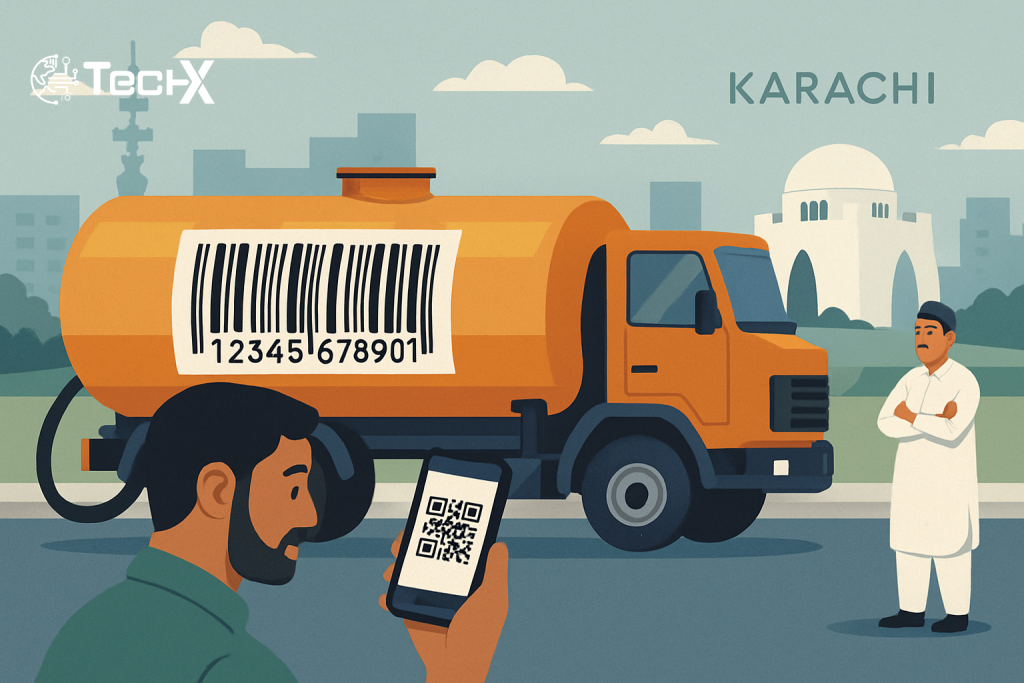
The Karachi water tanker barcode system is now live across all registered tankers in the city. Mayor Barrister Murtaza Wahab announced on June 27, 2026 that Karachi Water and Sewerage Corporation (KWSC) has fitted every legal water tanker with a unique, scannable barcode. The goal is simple: let citizens and officials check in seconds whether a tanker is properly registered or part of the city’s long-running illegal water mafia.
What the Karachi Water Tanker Barcode System Does
The idea behind the Karachi water tanker barcode is straightforward. Each registered tanker now carries its own barcode on the vehicle. When a resident scans it, they get a full profile of that tanker, including:
- The driver’s name and photograph
- The tanker’s registered route
- The fitness status of the vehicle
- The water source, confirming whether the water is chlorinated and safe
Mayor Wahab urged all Karachi residents to scan the barcode of any tanker that arrives at their home before accepting water. If the scan shows no record, or the details do not match, citizens should report the tanker to authorities. A barcode is a machine-readable label that stores data as a pattern of lines or squares, readable by any smartphone camera.
Why Karachi Needed This System
Karachi’s water problem is one of the most serious in any major South Asian city. The city needs roughly 1,200 million gallons of water every day, but the supply system delivers far less. This gap has kept an illegal tanker industry alive for decades.
Operators running unregistered tankers and illegal hydrants tap directly into KWSC water lines. They extract water without paying for it, then sell it back to residents at inflated prices. Families in low-income areas can spend between 15 and 60 percent of their monthly income just on water. In contrast, a household with a working pipeline connection pays only a small monthly bill.
The crackdown using the Karachi water tanker barcode follows years of partial measures. KWSC has previously installed GPS trackers on registered tankers and built a digital hydrant management centre. Rangers and KWSC teams have also demolished hundreds of illegal hydrants under an anti-theft drive. But unregistered tankers have continued to operate because there was no easy way for an ordinary person to tell a legal tanker from an illegal one, just by looking at it.
How Citizens Can Use the Barcode
Using the system requires nothing more than a smartphone. Here is the process a resident should follow:
- When a water tanker arrives, look for the barcode sticker on the vehicle.
- Open any standard QR or barcode scanner app on your phone and scan it.
- Check that the driver’s photo matches the person in the vehicle.
- Check that the listed route covers your neighbourhood.
- If anything looks wrong or the scan returns no result, do not accept the water and call KWSC to report the vehicle.
The mayor also called on citizens to stay alert and report suspicious tankers, saying public cooperation is a key part of making the system work. Each scan gives residents real-time data, which is the same information KWSC officials see on their end.
The Scale of the Tanker Mafia Problem
To understand why the Karachi water tanker barcode system matters, it helps to look at the problem it is trying to fix. Analysts have estimated that as much as 30 percent of Karachi’s total water supply is stolen through illegal hydrants. These operations have historically received protection from political connections and corrupt officials, making them very hard to shut down through inspections alone.
The number of official KWSC hydrants in the city has dropped from 23 to just 7. Those seven hydrants dispatch between 40,000 and 50,000 tanker trips a day, supplying roughly 30 to 40 million gallons. Meanwhile, dozens of illegal hydrants continue to operate quietly in parallel, stealing from the same mains.
When tanker prices spike during summer months, the impact on poor neighbourhoods is severe. Areas like Orangi Town, Liaquatabad, Surjani Town, Korangi, Malir, and Lyari face regular dry spells and are heavily dependent on tanker deliveries. A 1,000-gallon tanker from a General Public Service hydrant is supposed to cost around Rs 1,560. In practice, commercial and black-market rates are much higher, and contractors often set their own prices freely.
Part of a Broader Digital Push
The Karachi water tanker barcode move fits into a wider effort by the city administration to digitise public services. KWSC launched a mobile app earlier in 2026 that lets residents book tankers, track complaints, and access water-related services in Urdu, English, and Sindhi. The mayor has also described a vision of a fully digital financial model for the Karachi Metropolitan Corporation, covering fines, rents, and development payments.
The Pakistan Rangers have been part of enforcement operations alongside KWSC, leading to the demolition of over 243 illegal hydrants and the filing of more than 200 cases under the Water Corporation Act. The barcode system now gives regular citizens a tool to join that effort at street level.
Similar digital tracking moves have been seen in other Pakistani cities. Lahore recently set a July 1 deadline for QR-based panic buttons on public transport, showing that barcode and QR technology is becoming a wider tool for urban accountability across Pakistan.
Does the System Actually Work?
Early public reaction in Karachi has been cautious. Many residents have seen promises of reform come and go over the years. The fundamental issue, a gap of hundreds of millions of gallons between supply and daily demand, is not fixed by a barcode alone. Long-term solutions, such as the K-IV water supply project which aims to add 260 million gallons per day to the system, are still years away from full delivery.
But the Karachi water tanker barcode does address a specific, practical problem: residents had no reliable way to verify whether a tanker was legal. Now they do. If enough citizens actually scan and report, it becomes much harder for illegal operators to work openly in residential streets. The system’s success will depend on how consistently it is enforced and whether authorities follow up on reports from the public.
Frequently Asked Questions
What information does the Karachi water tanker barcode show?
Scanning the barcode shows the driver’s name and photograph, the tanker’s registered route, its vehicle fitness status, and the water source. This lets a resident confirm the tanker is legally registered before accepting a delivery.
How do I report an illegal or unregistered tanker in Karachi?
If a barcode scan returns no valid record, or the details do not match, you should refuse the water and contact KWSC directly. KWSC can be reached through its official website at kwsc.gos.pk or through their helpline. The mayor has specifically asked citizens to report suspicious vehicles to the relevant authorities.
Are all water tankers in Karachi now registered and barcoded?
The system applies to registered tankers only. The whole point is that any tanker without a valid barcode is either illegal or unregistered, and residents should treat it with suspicion. A large number of unregistered tankers are still believed to be operating across the city.
Will the barcode system solve Karachi’s water shortage?
No, not on its own. The barcode tracks and identifies tankers but does not increase the city’s water supply. Karachi’s demand is around 1,200 million gallons daily while supply falls well short of that. The barcode system is a transparency and accountability tool, not an infrastructure fix. Larger projects are needed to fully close the supply gap.