
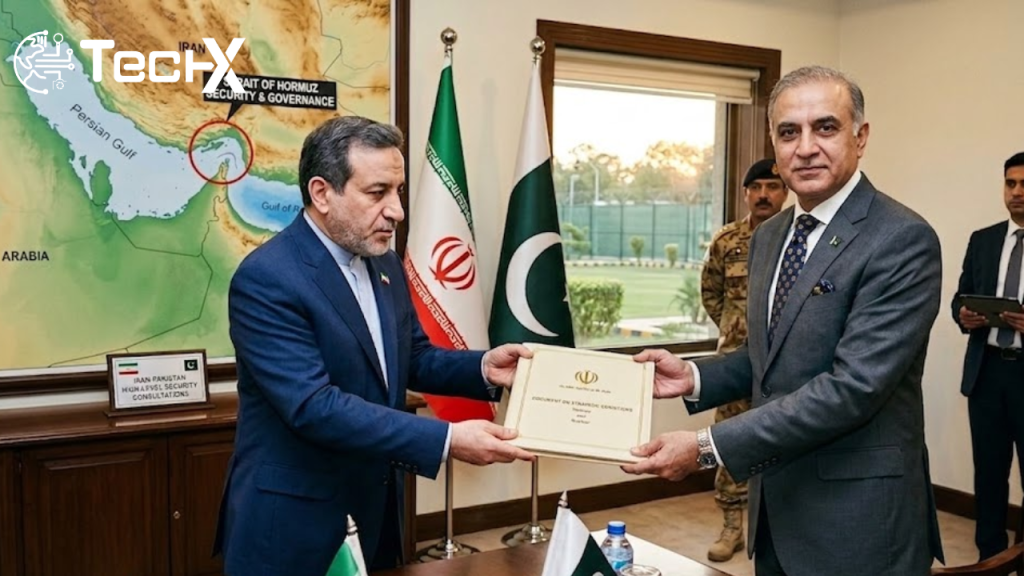
The Pakistani capital, Islamabad, has emerged as the primary diplomatic bridge in the ongoing 2026 conflict between Iran and the United States. Following a series of high-stakes meetings with Prime Minister Shehbaz Sharif and Field Marshal Asim Munir, Iranian Foreign Minister Abbas Araghchi has utilized Pakistan’s neutral ground to transmit a formal written framework to the White House. This diplomatic initiative represents the most significant attempt to date to secure a permanent end to the war that has destabilized the Middle East.
The Strategic Decoupling of Hormuz and Nuclear Issues
A cornerstone of Iran’s new written proposal is a strategic three-phase approach that seeks to separate the immediate maritime crisis from the long-term nuclear deadlock. Tehran has expressed a willingness to immediately reopen the Strait of Hormuz a vital artery for global oil in exchange for the United States lifting its current naval blockade on Iranian ports. By addressing the “freedom of navigation” issue first, Iran hopes to de-escalate the economic pressure while deferring the more contentious nuclear negotiations to a later stage.
Iran Non Negotiable Red Lines on Nuclear Sovereignty
Despite the offer for maritime de-escalation, the document outlines firm red lines regarding Iran’s nuclear programme. While Tehran has indicated that the specific levels of uranium enrichment are negotiable, it insists on maintaining its fundamental right to a civilian nuclear program. Furthermore, the Iranian delegation has demanded concrete guarantees against future strikes, asserting that any final settlement must include compensation for the infrastructure damage sustained during recent air campaigns.
The US Response: Trump Maximum Leverage Strategy
The diplomatic momentum faces a significant challenge due to the White House’s current strategy. President Donald Trump has asserted that the United States holds significant leverage and intends to maintain the naval blockade as its primary tool for negotiation. Trump has reiterated a singular objective: “Iran cannot have a nuclear weapon.” While he has signaled an openness to potential talks, the White House remains skeptical of any deal that does not address denuclearization in the very first phase.
A Regional Diplomatic Marathon: From Muscat to Moscow
FM Araghchi’s return to Islamabad marks the latest stop in an intensive regional tour designed to build a unified front. Before transiting through Pakistan, Araghchi held crucial meetings in Muscat with Sultan Haitham bin Tariq, who has long served as a secret back-channel for US-Iran relations. The Iranian Foreign Minister is also engaging with other regional powers and Russia to ensure that Iran’s allies are aligned as the pressure for a sustainable ceasefire grows.
The Stakes of the Current Stalemate
As of late April 2026, the region remains in a delicate state. While the written conditions presented to Pakistan offer a potential roadmap, the gap between Washington’s demand for “immediate denuclearization” and Tehran’s demand for “immediate economic relief” remains vast. The success of the Pakistan-mediated talks in the coming days will determine whether the Middle East moves toward a lasting peace or a broader, more devastating escalation.
Disclaimer: This Image is AI Generated and It is Use For Informational Purposes Only.