
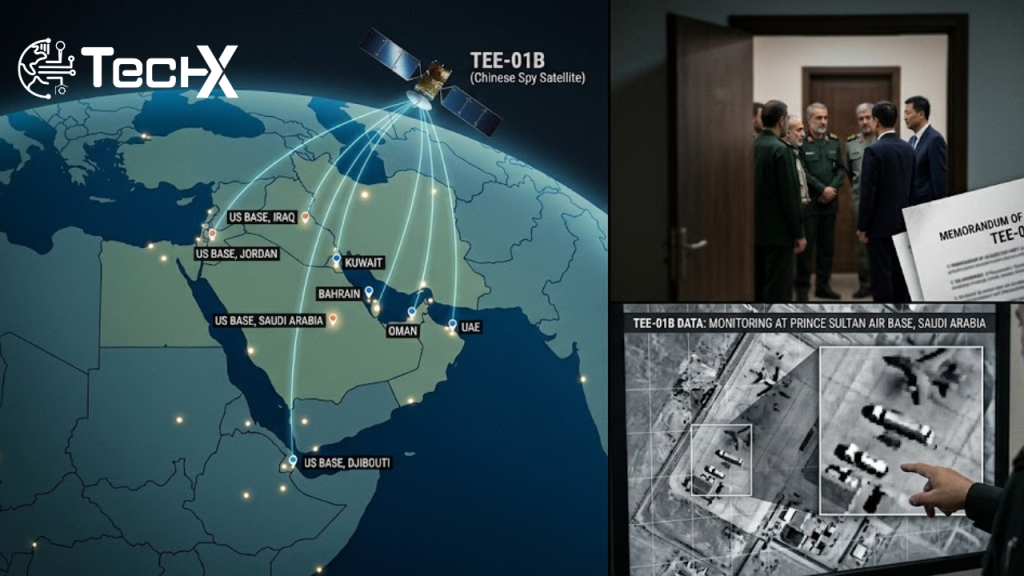
Recent reports suggest that Iran may have gained enhanced surveillance capabilities through a Chinese-developed spy satellite, allegedly enabling it to monitor US military installations across the Middle East during a recent period of conflict. The information is based on leaked Iranian military documents cited by the Financial Times.
Satellite Allegedly Acquired in Late 2024
According to the report, the satellite known as TEE-01B was acquired by Iran’s Islamic Revolutionary Guard Corps (IRGC) Aerospace Force in late 2024 after being launched from China. It is claimed that the system has significantly improved Iran’s intelligence-gathering capacity.
Monitoring Across Multiple Strategic Locations
The leaked documents reportedly indicate that surveillance activities covered several countries in the region, including Saudi Arabia, Jordan, Bahrain, Iraq, Kuwait, Djibouti, Oman, and the United Arab Emirates. These locations are believed to include US military bases as well as critical infrastructure sites.
Military vs Civilian Space Program Distinction
Experts quoted in the report suggest that the satellite is being operated by Iran’s military wing rather than its civilian space agency. This distinction has raised concerns among analysts, as it indicates potential military use of advanced space-based surveillance technology.
Expert Analysis on Strategic Implications
According to Iran expert Nicole Grajewski, the operation of the satellite by the IRGC Aerospace Force strongly suggests a military application. She noted that such capabilities could enhance Iran’s situational awareness and intelligence reach across the region.
Broader Security Concerns in the Region
If verified, the development highlights growing concerns over the use of space technology in regional military intelligence gathering. It also reflects increasing competition among global and regional powers to strengthen surveillance and defense capabilities in the Middle East.