
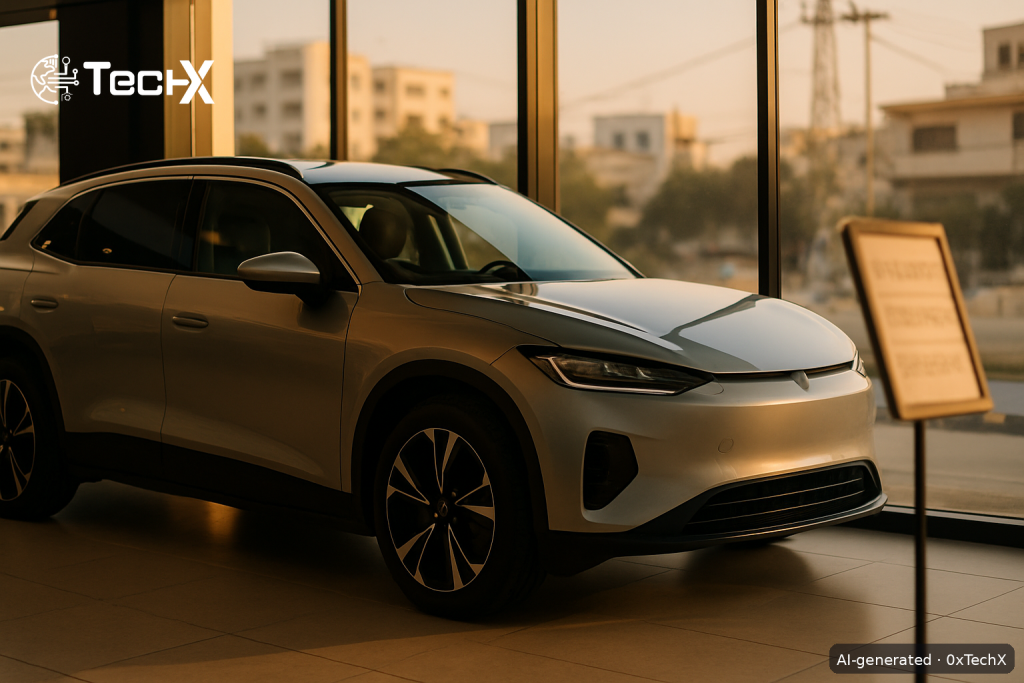
The Finance Act 2026 EV taxes are already changing what Pakistani car buyers pay at the showroom. Audi Pakistan has revised its entire price list, cutting most models by millions of rupees, but also hiking one flagship model sharply. The reason is a new dual-track tax system that rewards local EV assembly while taxing expensive imported electric cars heavily. Here is a plain-language breakdown of what happened, who wins, and what you should know before your next car purchase.
Audi Pakistan Slashes Prices After Finance Act 2026 EV Taxes Take Effect
Audi Pakistan issued a new recommended price list after Budget 2026-27 passed into law on July 1, 2026. The company confirmed the reason simply: the government lowered customs duties on imported cars and Audi passed that saving on to buyers. The result is that seven variants received price cuts, with reductions ranging from Rs150,000 all the way up to Rs8.15 million.
The biggest winner is the Audi A6 Sportback e-tron Executive. Its price fell from Rs42 million to Rs33.85 million, a saving of Rs8.15 million for one car. The Audi Q6 SUV e-tron Performance dropped by Rs5.8 million to Rs36.2 million, while the Q3 Sportback S line TFSI fell by Rs3.9 million to Rs23.7 million. Even entry-level models got cheaper: the A3 Sedan S line TFSI now starts at Rs20.8 million, down Rs3.7 million from Rs24.5 million.
But not every model got cheaper. The Audi Q8 55 TFSI quattro is the only model in the lineup to receive a price hike, and it is a big one, jumping Rs15.1 million. That is the Finance Act 2026 EV taxes policy working in reverse for large-engine vehicles: the new Special Excise Duty on cars above 2,000cc means bigger petrol vehicles now cost significantly more.
How the New Finance Act 2026 EV Taxes Actually Work
The Finance Act 2026 replaced the old, flat approach to vehicle taxes with a two-speed system. The law became official from July 1, 2026, and applies immediately to all imported and locally assembled vehicles.
For imported luxury EVs: new FED tiers by dollar value
The old rule gave all imported electric vehicles a blanket zero Federal Excise Duty (FED). That is gone. Now the FED on a Completely Built Unit (CBU) imported electric car depends on how much it costs in US dollars:
- Up to $75,000: No FED (exempt)
- $75,001 to $110,000: 30% FED
- Above $110,000: 40% FED
In Pakistani rupee terms, this means imported electric vehicles priced up to Rs20 million face 0% FED, those between Rs20 million and Rs30 million face 30% FED, and anything above Rs30 million faces 40% FED. These Finance Act 2026 EV taxes hit the premium end of the market, models like high-spec Audi e-trons, Porsche electric variants, and top-end BMWs that previously benefited from green energy exemptions meant for affordable EVs. The government’s reasoning was clear: subsidies on clean transport were never designed for buyers of multi-crore luxury cars.
For locally made EVs: low taxes stay in place
The picture is very different for locally assembled vehicles. The 1% sales tax on locally manufactured EVs and the 8.5% rate on locally made hybrid cars up to 1800cc remain firmly in place. The 1% customs duty on EV-specific CKD (Completely Knocked Down) components, including batteries, motors, and controllers, has been extended through June 30, 2027. This means companies that build EVs inside Pakistan face very little tax friction.
This is a deliberate policy choice. Brands with local assembly lines, including several Chinese manufacturers who have been expanding in Pakistan, are much better placed under this structure. If you want to read about another EV brand that has set global assembly records, our coverage of BYD’s 17 million NEV milestone explains how China’s top EV maker reached that scale, and why local assembly deals in Pakistan are central to their growth plans.
For large petrol and diesel cars: a new Special Excise Duty
Large combustion engine vehicles also face new taxes. Cars and SUVs with engines between 2,000cc and 3,000cc now carry an 86% ad valorem Special Excise Duty. Vehicles above 3,000cc face a 92% rate. Customs duties on all imported vehicles have also been cut across different engine sizes, which is why smaller imported cars like certain 1,300cc to 1,500cc models also became cheaper alongside the Audi reductions.
Token Tax Change for Islamabad Owners
There is a third change that many car owners in the capital have missed. The old fixed annual token tax based on engine size is gone for most vehicle categories registered in Islamabad. Owners of cars between 1,001cc and 2,000cc will now pay 0.25% of the vehicle’s invoice value per year as token tax. Owners of vehicles above 2,000cc will pay 0.35%. Only small cars up to 1,000cc keep a fixed Rs20,000 annual fee. This means the annual ownership cost of an expensive car now scales with its actual price, a notable shift for luxury car owners in Islamabad.
What This Means for Pakistani Car Buyers Right Now
If you are shopping for a car in Pakistan today, the Finance Act 2026 EV taxes create a clear set of winners and losers.
Who benefits: Buyers of mid-range Audi models (A3, Q3, Q3 Sportback, Q6 e-tron at lower spec), buyers of smaller imported cars in the 1,300cc to 2,000cc range, and buyers of locally assembled electric vehicles from brands with active Pakistan assembly operations. The government also launched the Pakistan Accelerated Vehicle Electrification (PAVE) scheme, which offers subsidised loans for e-bikes and e-rickshaws, a direct benefit for everyday transport users.
Who pays more: Buyers of large-engine luxury imports above 2,000cc (the Q8 price hike is a real-world example), buyers of premium imported EVs priced above $75,000, and Islamabad-based owners of high-value vehicles who will see their annual token tax rise significantly.
If you are considering a locally assembled car in the Changan or similar segment, our breakdown of Changan Alsvin 2026 prices in Pakistan is a useful reference point for what the budget means for that price bracket.
One thing that remains unresolved is the Auto Policy 2026-31, which is expected to be released soon. That policy is expected to go further, potentially offering a 16% price reduction for qualifying plug-in hybrids that can drive at least 50km on pure electric power. Until that document is official, prices in the mid-range hybrid segment remain uncertain.
Frequently Asked Questions
Why did Audi Pakistan cut prices so suddenly?
The government reduced customs duties on imported cars under Budget 2026-27, which became law as the Finance Act 2026 on July 1, 2026. Audi passed these savings on to buyers. The cuts are not a promotion, they reflect lower import taxes applied at the border.
Which Audi models got cheaper and which got more expensive?
Seven models got cheaper, including the A3, Q3, Q3 Sportback, Q6 e-tron, and A6 Sportback e-tron. The A6 Sportback e-tron fell the most, saving buyers Rs8.15 million. The Q8 55 TFSI quattro is the only model that rose in price, jumping by Rs15.1 million due to the new Special Excise Duty on large-engine vehicles.
Do the Finance Act 2026 EV taxes affect affordable electric cars?
No. Imported EVs priced below $75,000 (roughly below Rs20 million) remain exempt from Federal Excise Duty. Locally assembled EVs keep their very low 1% sales tax rate. The new Finance Act 2026 EV taxes only hit high-end imported electric models that cost significantly above that threshold.
Will more car brands reprice their vehicles after Finance Act 2026?
Very likely. Audi was among the first to announce changes, but all brands importing cars to Pakistan are working under the same new duty structure. Buyers can expect other luxury and premium brands to issue updated price lists in the coming weeks, with the direction depending on which segment their models fall into.