
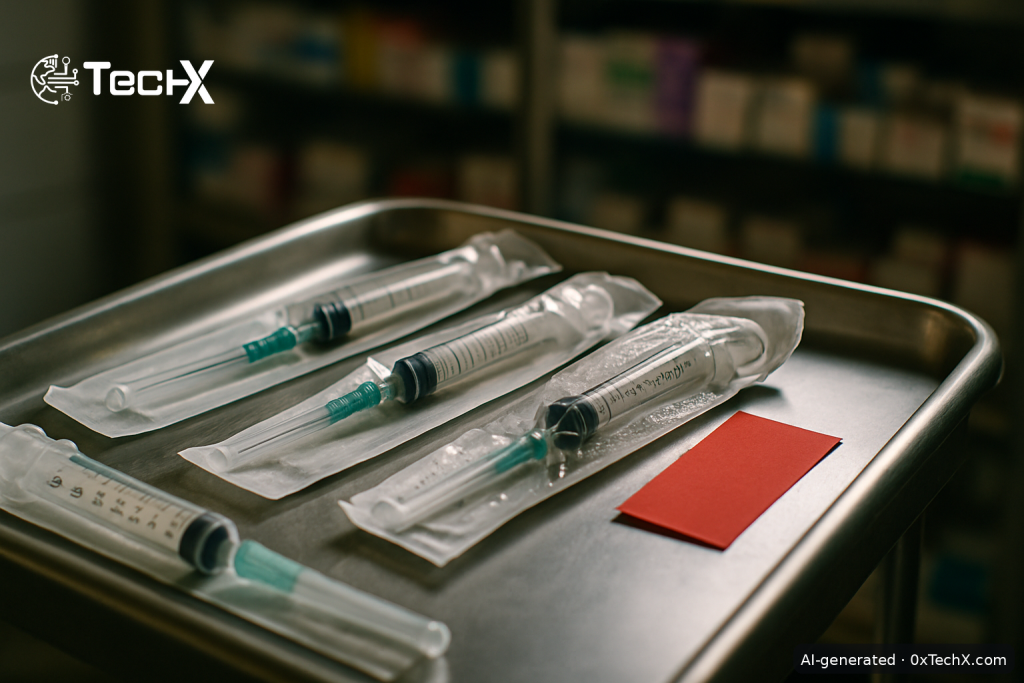
A new DRAP syringe recall has put two medical syringe batches out of circulation across Pakistan after the country’s drug regulator found them substandard through laboratory testing. The affected products are made by a single Lahore-based company and failed two different safety checks, raising real infection risks for patients who may have already received injections with them.
Which Syringes Are Affected by the DRAP Syringe Recall?
The Drug Regulatory Authority of Pakistan (DRAP) issued a recall alert for two batches of medical syringes after they were declared substandard following laboratory testing, with the Central Drugs Laboratory (CDL) in Karachi finding that the products had failed critical quality tests.
The two recalled products are:
- BD 10 mL Syringe (MDMR-0000035), Batch No. 5349764, and Accuject Auto-Disable Syringe 5 mL (MDMR-000507), Batch No. S502E26, both manufactured by Faiz Surgical and Medical Industries (Pvt.) Ltd. in Lahore.
Both products come from the same manufacturer, which makes this recall especially significant for any hospital or clinic that stocks Faiz Surgical products in bulk.
Why Did These Syringes Fail?
The two batches failed for different reasons, and both matter a great deal for patient safety.
BD 10 mL Syringe: Absorbance Test Failure
The BD syringe batch failed an absorbance test, suggesting the presence of excessive extractable substances that could affect the product’s safety and quality during medical use. In plain words, this means the plastic or rubber parts of the syringe may leak chemical residues into whatever liquid is drawn into it. Those residues then enter the patient’s body during injection, which can cause unexpected reactions or harm.
Accuject Auto-Disable 5 mL: Sterility Test Failure
The Accuject syringe batch failed a sterility test, raising concerns about possible microbial contamination. A sterility failure means the syringe was not properly free of bacteria or other micro-organisms at the time of testing. Using a non-sterile syringe can introduce infection directly into a patient’s bloodstream.
The regulator said using the affected syringes could increase the risk of infection, including potentially serious systemic infections. A systemic infection is one that spreads through the whole body, and it can be life-threatening, especially for patients who are already unwell.
What Has DRAP Ordered?
This DRAP syringe recall comes with clear instructions for everyone in the supply chain.
- DRAP has instructed its regulatory field teams and provincial drug control authorities to conduct immediate market inspections and remove the affected batches from circulation.
- Manufacturers, importers, and distributors have also been directed to recall the products in line with regulatory requirements.
- Pharmacies and medical stores have been told to stop supplying them at once, quarantine any remaining stock, and return it to suppliers.
- Healthcare professionals have been advised to check their inventories for the affected batches and report any adverse reactions or suspected quality issues to DRAP’s National Pharmacovigilance Centre.
This Is Not an Isolated Incident
This latest recall is part of a much bigger pattern. Pakistan has seen a wave of syringe safety enforcement actions in 2026.
Earlier, DRAP issued a nationwide recall alert for five batches of auto-disable syringes manufactured by three different companies after laboratory testing found them to be substandard and potentially unsafe for medical use.
Before that, DRAP initiated a nationwide crackdown against substandard auto-disable syringes, declaring 17 batches manufactured by 11 companies as non-compliant with required safety standards.
The root concern behind all these actions is serious. Pakistan has an estimated 10 million people living with hepatitis C, the highest number of any country according to the World Health Organization, and around 110,000 people are newly infected each year, with unsafe medical injections accounting for about 62 percent of new infections.
The authority has warned that defective syringes could contribute to the spread of diseases such as Hepatitis B, Hepatitis C and HIV, and that reuse of contaminated syringes can also result in cross-contamination, healthcare-associated infections and other serious health complications.
A Full Syringe Ban Is Coming in 2027
These individual batch recalls are happening against the backdrop of a sweeping policy shift. DRAP has approved a nationwide ban on the manufacture, import, and sale of reusable syringes, with the new regulations taking effect from January 1, 2027.
Under the new policy, only syringes equipped with reuse-prevention technologies, such as auto-disable, retractable, or auto-lock mechanisms, will be permitted after the deadline, and manufacturers and importers have until December 31, 2026, to phase out conventional reusable products.
The decision was approved by DRAP’s Medical Devices Board after reviewing recommendations from a federal task force formed to investigate the recent rise in HIV cases linked to unsafe injection practices and the reuse of disposable syringes.
For context, the move follows repeated HIV outbreaks linked to unsafe injection practices, including cases reported in Larkana, Khairpur, and Karachi’s Pathan Colony, where investigators identified the reuse of disposable syringes as a major contributing factor.
You can verify product registration status and check official recall notices directly on the DRAP official website.
What Should You Do Right Now?
If you work in a hospital, clinic, pharmacy, or medical store, here are the steps to take immediately:
- Check your syringe stock for Batch No. 5349764 (BD 10 mL) and Batch No. S502E26 (Accuject Auto-Disable 5 mL).
- Stop using or selling any units from these batches at once.
- Quarantine the remaining stock and contact your supplier to arrange return or replacement.
- If a patient has already been injected using these syringes and shows any unusual reaction, report it to DRAP’s National Pharmacovigilance Centre without delay.
The key lesson from this DRAP syringe recall is that checking batch numbers before using any medical device is not a bureaucratic exercise. It is a basic patient safety step.
Frequently Asked Questions
What is the DRAP syringe recall about?
DRAP has recalled two syringe batches made by Faiz Surgical and Medical Industries in Lahore. The BD 10 mL syringe (Batch No. 5349764) failed an absorbance test and the Accuject Auto-Disable 5 mL (Batch No. S502E26) failed a sterility test. Both pose infection risks and must not be used.
What does a sterility test failure mean for a patient?
It means the syringe may carry micro-organisms such as bacteria. Using it can introduce those organisms directly into a patient’s body, potentially causing serious infections that can spread through the bloodstream.
Are auto-disable syringes always safe?
Auto-disable syringes are designed to lock after one use to prevent reuse, which is a key safety feature. However, as these recalls show, even auto-disable syringes can fail quality tests if they are poorly manufactured. Always check that the product comes from a DRAP-registered batch.
Will conventional syringes be fully banned in Pakistan?
Yes. DRAP has announced that the manufacture, import, and sale of conventional non-insulin disposable syringes will become illegal after December 31, 2026. From January 1, 2027, only safety-engineered syringes with auto-disable or auto-lock mechanisms will be allowed in the market.