
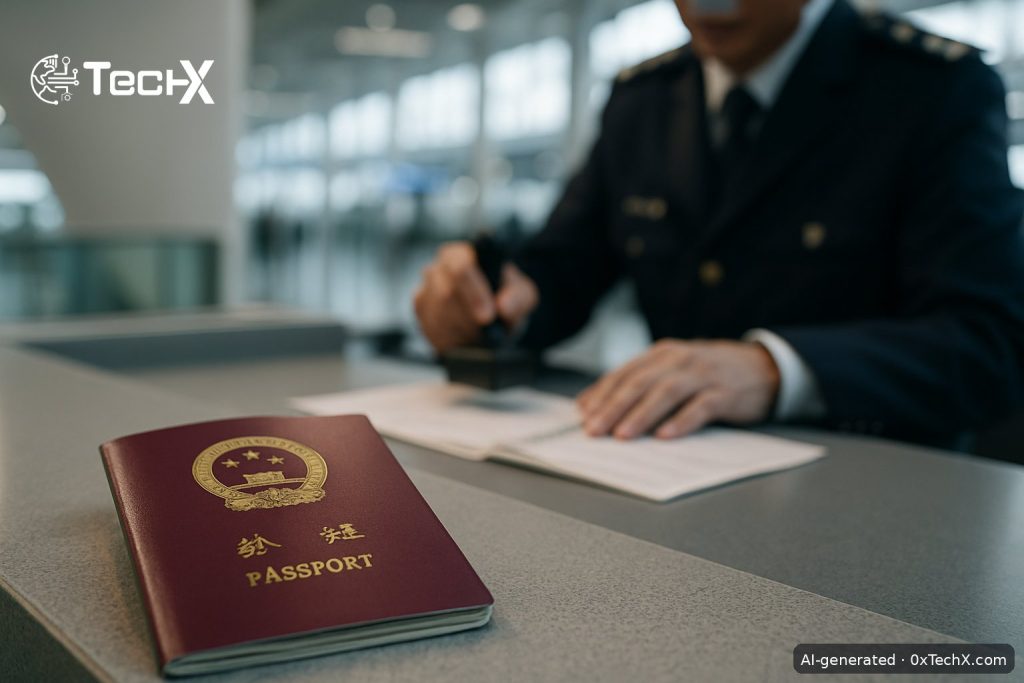
The China tech exit ban took effect on September 15, 2026, and it directly touches one of Pakistan’s most important trade relationships. New border control rules in China can now ban citizens from leaving the country if they engage in illegal activity that endangers national or industrial security. For Pakistani companies that buy phones, chips, telecom gear, and factory machinery from China every single month, this is a policy shift worth understanding carefully.
What the China Tech Exit Ban Actually Says
China tightened travel curbs as new exit-and-entry rules took effect, barring citizens deemed a potential threat to national technology security from leaving the country. The rules are not brand new in spirit, Beijing has long watched certain travellers closely, but the specific language on technology is new and sharper.
China unveiled the new rules in July, saying they targeted violations of export controls or technology import and export rules in a way that may endanger industrial or technological security. In plain terms: a Chinese engineer, sales agent, or company executive who moves restricted technology or data outside China without permission can now be stopped at the airport.
A new regulation allows authorities to bar people from leaving the country if their violations could endanger national industrial and technological security, and no maximum duration for such travel bans is specified. That open-ended time frame is one of the sharpest parts of the rule. A separate clause sets an exit ban ranging from six months to three years on citizens who return to China after committing illegal or criminal acts abroad that harm national security or interests.
The rules, part of a broader overhaul of border regulations, reflect in part heightened government concern about the export of technology at a time of growing competition with the United States in artificial intelligence and other emerging areas.
The Cyberspace Administration of China sought to calm concerns that the new rules would make travel more difficult. The measures target people involved in illegal cross-border activities, not ordinary citizens with legitimate reasons to travel abroad, the agency said.
Why the China Tech Exit Ban Matters for Pakistani Businesses
Pakistan is one of China’s largest technology customers in South Asia. Pakistan imported USD 15.99 billion worth of electrical and electronic equipment from China in 2024, according to the United Nations COMTRADE database. That figure covers everything from semiconductors to telephone equipment to power transformers.
Look at just one recent month: in April 2026, the top exports of China to Pakistan were cars at USD 172 million, telephones at USD 140 million, and semiconductor devices at USD 91.5 million. These are not small numbers. And many of those shipments move because Chinese engineers, sales teams, and logistics managers travel freely between the two countries to close deals, install equipment, and support projects.
ZTE Corporation alone has active contracts across Pakistan’s telecom and digital TV infrastructure under CPEC agreements. Many other Chinese firms are similarly embedded in Pakistan’s tech supply chain. If a key engineer or manager at one of these firms is hit with a China tech exit ban, the practical effect on a project timeline could be immediate.
Under CPEC’s information technology cooperation framework, Chinese firms have built fibre optic links, supported 4G rollouts, and are now pushing deeper digital cooperation under CPEC 2.0. As recently as August 2026, a high-level Communist Party of China delegation held detailed discussions on giving Pakistan-China cooperation a new political and institutional dimension under CPEC 2.0. Any disruption to the free movement of Chinese tech staff could slow that agenda.
What Kinds of Actions Could Trigger an Exit Ban
The rules are deliberately broad. The new regulation names violation of export control or technology trade management as a specific trigger, and experts say unauthorized exports of dual-use items or transferring key industrial technology abroad will fall under its scope.
In an explanatory note, the authorities cited cases in which Chinese citizens had illegally transferred technology abroad after an unauthorized departure from the country. Beijing is particularly focused on sensitive sectors: rare earth processing, battery chemistry, chip design, and AI-related software. As the United States, Japan, and the European Union build alternative rare earth supply chains, they have leaned on experienced Chinese engineers to get the projects going, pushing Beijing to crack down harder on talent and data outflows.
Pakistan mostly imports finished consumer electronics and telecom hardware rather than raw intellectual property. But any Chinese supplier representative who helps a Pakistani firm bypass official export channels, mislabel shipment contents, or obtain components that appear on a restricted list could fall inside the ban’s reach. That covers a lot of informal trade activity that has long been common in electronics markets from Hafeez Centre in Lahore to Saddar in Karachi.
The Pakistan Angle Most Coverage Is Missing
Global media has focused on the Taiwan angle and the impact on Western companies in China. What they are not saying clearly: Pakistan sits in a uniquely sensitive position. It is both a heavy importer of Chinese tech hardware and an active partner in CPEC 2.0, which is now explicitly targeting digital economy cooperation.
Pakistan’s IT and ICT exports reached a record USD 4.6 billion during the last fiscal year. The government’s ambition is to grow that number fast. Pakistan’s next goal is not merely the export of services, but the promotion of technology products, digital platforms, and technology-driven industries. To do that, Pakistani firms need smooth access to Chinese hardware, components, and technical expertise. A China tech exit ban that freezes key Chinese contacts, even temporarily, creates real friction in that pipeline.
Pakistani importers should also note the rules for foreign nationals. Foreign nationals may also be denied entry for one to five years for false statements made in visa applications. Pakistani businesspeople who visit China to sign hardware deals, attend trade fairs, or inspect factories need to be sure their paperwork is fully clean and accurate.
What Pakistani Firms Should Do Now
- Know your supplier’s compliance status. Ask Chinese partners directly whether they have export licences for the specific components they send you. For telecom gear and semiconductors, this matters most.
- Keep contracts formal and documented. Informal deals, verbal agreements, or underdeclared shipment values are the kinds of arrangements that attract scrutiny under the new rules.
- Identify backup contacts. If a key Chinese account manager or technical engineer is restricted from travelling, do you have an alternate point of contact? Build that redundancy now.
- Check re-export rules. Pakistan should not unknowingly become a re-export route for restricted Chinese components heading toward sanctioned destinations. That would expose Pakistani firms to risk on both the Chinese and international regulatory sides.
- Stay updated through official channels. The Chinese Ministry of Commerce publishes export control lists and updates. Pakistani importers dealing in electronics and tech should monitor these or work with a trade compliance adviser who does.
Frequently Asked Questions
When did the China tech exit ban take effect?
The rules took effect on September 15, 2026. They were first announced by China’s State Council in July 2026 and came into force two months later.
Does this ban affect Pakistani citizens travelling to China?
The exit ban primarily targets Chinese citizens. However, the same regulation also allows China to deny entry to foreign nationals for up to five years if they provide false information on visa applications or have prior border-related violations. Pakistani businesspeople visiting China should ensure all documentation is accurate and complete.
Which Chinese products imported by Pakistan are most sensitive under these rules?
Semiconductors, telecom equipment, and AI-related software are the categories Beijing is most focused on protecting. Pakistan imported USD 2.21 billion in semiconductor devices and USD 1.92 billion in telephone and telegraph equipment from China in 2024 alone, making these the most exposure-heavy categories for Pakistani buyers.
Will this slow down CPEC tech projects?
Not automatically, and the Chinese government says ordinary business travel is not the target. But if Chinese engineers or executives working on CPEC digital projects are found to have violated any technology trade rules, they could face an exit ban that disrupts project work. Building backup contacts and keeping contracts fully compliant is the practical safeguard.