
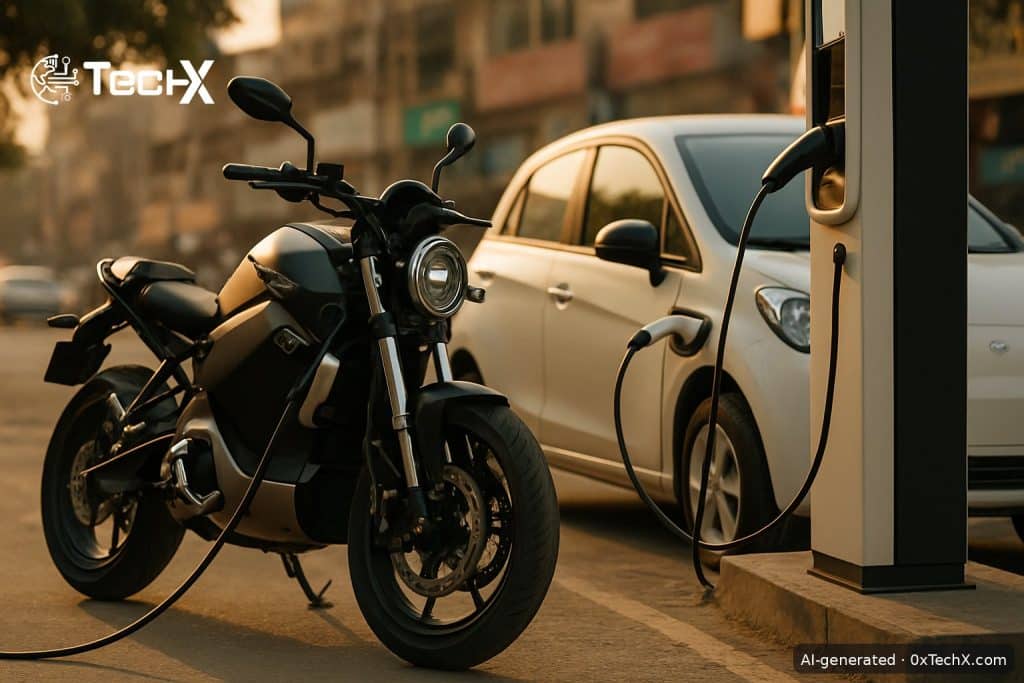
Pakistan’s EV adoption target of converting 30% of new vehicle sales to electric power by 2030 may now be reached years early. That is the view of Haroon Akhtar, the Prime Minister’s adviser on industries and production, who told Bloomberg this week that a sharp rise in fuel costs has completely changed the economics of owning an electric vehicle in Pakistan.
Why the EV Adoption Target May Come Early
The trigger is simple: since the Middle East war started in February, petrol and diesel prices have jumped 54% and 43%, respectively, according to Pakistan State Oil Company. As of October 8, the petrol price in Pakistan is PKR 396.65 per litre, and the highest petrol price in Pakistan’s history was Rs 458.40 per litre on April 3, 2026.
You can track the latest daily fuel rates on our petrol price update for October 8, 2026.
Pakistan expects to reach its EV adoption target ahead of schedule as consumers increasingly switch from petrol- or diesel-powered cars, with Haroon Akhtar telling Bloomberg: “I feel that the target we had set in our electric-vehicle policy last year, we will achieve it much earlier as the rise in oil prices has brought cost recovery of EVs to one to one-and-a-half year.”
This has shortened the time it takes for buyers to recoup the higher upfront cost of an EV. In plain terms: a Pakistani who buys an electric car or motorcycle today can expect to recover the extra cost through fuel savings in roughly 12 to 18 months. At older fuel prices, that calculation used to take several years.
What Pakistan’s EV Policy Actually Says
The NEV Policy 2025-2030, launched by the Ministry of Industries and Production, is the most specific and operationally detailed EV commitment Pakistan has produced. Key goals include transitioning 30% of all new vehicle sales to electric by 2030, gradually increasing to 50% by 2040 and aiming for full EV adoption by 2060.
The numbers behind this shift are striking. Officials estimate the transition could save 2.07 billion litres of fuel annually, generate around $1 billion in foreign exchange savings each year, and reduce carbon emissions by 4.5 million tonnes. For a country that spends heavily on oil imports, those savings matter enormously for the rupee and for ordinary families.
When the 2019 EV policy was introduced, there were just 567 registered electric vehicles in the country. By June 2025, that figure had crossed 80,000, driven almost entirely by electric two- and three-wheelers. The market is already moving fast.
The PAVE Subsidy Program Explained
To push the EV adoption target further, the government launched the Pakistan Accelerated Vehicle Electrification (PAVE) program. The policy introduces subsidies through PAVE, with the government allocating 9 billion rupees specifically for subsidies, covering an estimated 116,000 electric motorcycles and over 3,000 electric rickshaws.
Subsidies are structured as up to 50% for electric motorcycles and up to 80% for electric rickshaws. For a daily rider or a rickshaw driver, those numbers represent a real and immediate saving, not a distant promise.
More than 123 applications have been received for the establishment of EV charging stations nationwide. The NEV policy also calls for 3,000 public charging stations across major cities and highways.
New Auto Policy Adds Tax Breaks and Easy Loans
Alongside the NEV policy, a fresh auto policy for 2026-31 adds another layer of support. Pakistan is planning major tax incentives and financing support for electric and new energy vehicle buyers, with the policy proposing financing of up to Rs 10 million for new energy vehicles for a period of five years, along with measures to expand charging infrastructure and battery-swapping facilities.
Under the draft, the government will impose only 1% sales tax on NEVs, their completely knocked-down kits, parts, inputs and raw materials, and will also exempt NEVs from federal excise duty, Capital Value Tax and withholding tax.
Original equipment manufacturers would also be allowed to import new energy vehicle-related parts at a 1% customs duty under the proposed framework. That directly reduces the cost of locally assembled EVs, which is good news for buyers.
What This Means for Pakistani Consumers Right Now
The combination of sky-high fuel prices and generous government incentives has created a turning point. In March 2026, conflict in the Middle East triggered the largest fuel price increase in Pakistan’s history, with petrol hitting Rs 342 per litre. Since then, prices have climbed even higher.
For an average Pakistani household spending Rs 15,000 to Rs 20,000 a month on petrol, switching to an electric motorcycle or a small EV is no longer a lifestyle choice. It is fast becoming a financial necessity. The government is betting that this economic pressure will do much of the heavy lifting that policy alone could not achieve.
If implemented at scale, this transition could save over 2 billion litres of fuel annually, reduce emissions by 4.5 million tonnes of CO₂, and unlock thousands of new jobs across manufacturing, charging, and services.
The one gap that most coverage misses: even with subsidies and tax breaks, charging infrastructure outside major cities remains very thin. The government has approved 123 applications for charging stations, but rural Pakistan still runs almost entirely on petrol. Reaching the EV adoption target early in cities is plausible. Reaching it across the whole country is a bigger challenge.
For more context on how global fuel volatility feeds directly into Pakistan’s economy, see the official Oil and Gas Regulatory Authority (OGRA) website, which publishes daily fuel price notifications. Pakistan’s broader EV framework is also described on the Ministry of Industries and Production website.
Frequently Asked Questions
What is Pakistan’s EV adoption target?
Pakistan’s NEV Policy 2025-2030 sets a target of 30% of all new vehicle sales being electric by 2030. The goal rises to 50% by 2040 and aims for a fully zero-emission vehicle fleet by 2060.
Why does Pakistan expect to hit its EV adoption target early?
Surging oil prices, driven by Middle East conflict, have raised petrol costs by 54% since February 2026. This has cut the payback period for buying an EV to just one to one-and-a-half years, making the economic case for switching much stronger and faster.
What subsidies are available for EV buyers in Pakistan?
The PAVE program offers up to 50% subsidy on electric motorcycles and up to 80% on electric rickshaws. The government has set aside Rs 9 billion for these subsidies in the current financial year, covering an estimated 116,000 e-bikes and 3,000 rickshaws.
What tax breaks does the new auto policy offer on EVs?
Under the draft Auto Policy 2026-31, EVs will attract only 1% sales tax on parts and CKD kits. They will also be exempt from federal excise duty, Capital Value Tax, and withholding tax. Buyers may also access financing of up to Rs 10 million over five years for a new energy vehicle.