
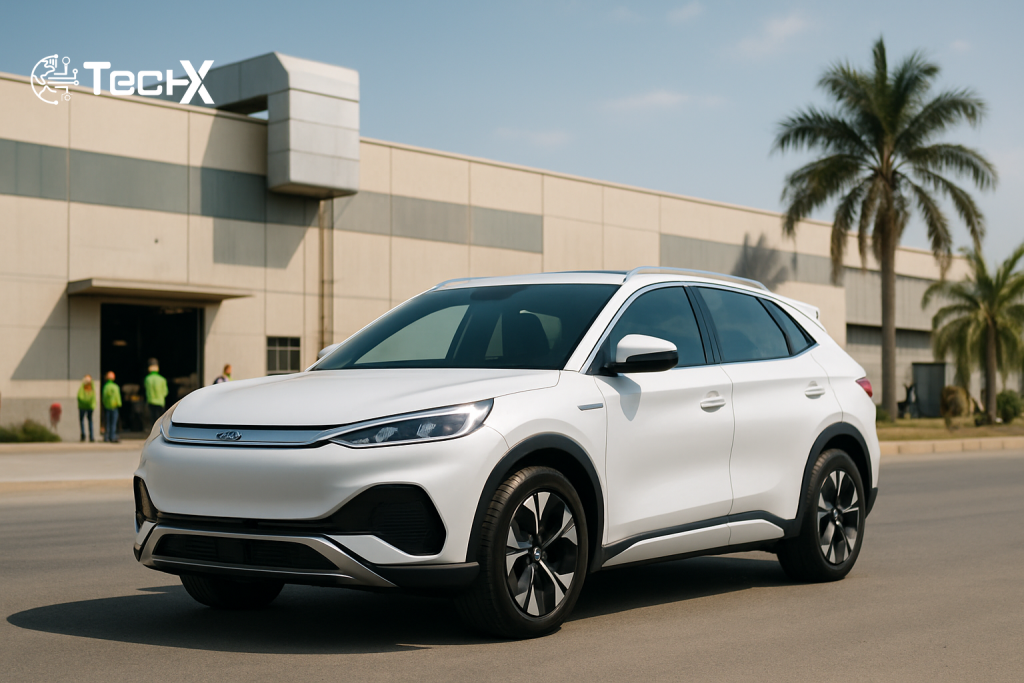
BYD Pakistan assembly marks a turning point for the country’s electric vehicle landscape. The world’s largest EV maker is preparing to roll out its first locally assembled car by July or August 2026 from a new plant near Karachi, a move that could reshape how Pakistanis buy and drive electric and hybrid vehicles for years to come.
The Karachi Plant: What We Know So Far
The plant is being built near Karachi in a partnership between BYD and Mega Motor Company, a subsidiary of Pakistani utility Hub Power. It will initially have the capacity to produce 25,000 units a year operating on a double shift.
The plant will start by assembling imported parts, with some local production of non-electric components, and will initially produce vehicles for the domestic market, with potential to export to right-hand drive countries in the region depending on freight costs and business economics.
The Pakistan plant is designed to address rising demand from emerging markets and allows the company to take advantage of incentives offered by the Pakistani government. For consumers, the longer-term significance is clear: local assembly in 2026 may affect the price of future BYD electric cars in Pakistan by decreasing import duties and reducing costs in the long run.
BYD Pakistan Assembly and the Government’s EV Push
Pakistan’s government has taken several steps to encourage electric vehicle adoption ahead of this moment. The government slashed power tariffs for chargers by 45% in January to encourage EV uptake and private charging stations. These policy changes have created a more hospitable environment for manufacturers like BYD to invest in local production rather than simply import finished vehicles.
Plug-in hybrids offer a more practical option in Pakistan as the country faces a lack of charging stations for all-electric vehicles. This is a key reason why analysts and BYD’s own team expect plug-in hybrid electric vehicles (PHEVs) to be among the most popular models assembled at the new facility in the near term.
BYD’s Early Performance in Pakistan
Before the local plant even opens, BYD has already made a strong start in the Pakistani market. BYD started delivering imported EVs in Pakistan in March 2025, and sales of a few hundred cars exceeded internal targets by 30%.
The company expected the market size of EVs and plug-in hybrid cars in Pakistan to grow three to four times in 2025 from around 1,000 total units in 2024, and BYD is targeting a 30 to 35% share of that segment. Based on a Hub Power filing, BYD Pakistan made around Rs444 million ($1.56 million) in profit in the 2025 March quarter.
The model lineup currently available in Pakistan through Hub Power’s Mega Motor Company includes the BYD Atto 2, Atto 3, Seal, Sealion 7, and the Shark 6 plug-in hybrid pickup truck. The BYD Atto 2, launched in January 2026, is a modern electric SUV designed to meet the demands of Pakistan’s growing electric vehicle market. It comes equipped with a 130 kW electric motor delivering 290 Nm of torque, and its 45.12 kWh Blade battery provides a range of up to 380 km on a full charge.
BYD’s Global Momentum Behind the Pakistan Move
The Karachi plant is not an isolated bet. It is part of a sweeping global expansion by BYD as the company seeks to grow its footprint outside a cooling Chinese domestic market. Between January and April 2026, BYD sold 455,707 vehicles overseas, up nearly 60% year-on-year, putting it on track toward its ambitious 1.5 million overseas sales target for 2026.
The company began trial production at its first European passenger vehicle factory in Szeged, Hungary, in January, with series production expected in the second quarter of 2026, and it also operates additional plants in Thailand, Brazil, Indonesia, and Uzbekistan. Pakistan fits naturally into this emerging-market strategy.
On the technology side, BYD continues to push hard on innovation. BYD recently unveiled what it calls China’s most powerful chip for self-driving cars, a move aimed at differentiating its vehicles in an increasingly crowded global market. The company has also launched more than 10 new models equipped with ultra-fast flash charging capabilities and second-generation Blade Battery technology.
Meanwhile, at home, BYD has recorded its steepest quarterly profit decline since 2020, with net profit in the first quarter of 2026 declining by 55.4% from the previous year, falling to 4.09 billion yuan, approximately $597 million. The Chinese market for electric cars is fiercely competitive, and price wars in the home market are intense. This pressure at home is precisely what is accelerating international expansion, including the BYD Pakistan assembly project.
What This Means for Pakistani Consumers
For Pakistani buyers, the most immediate question is whether local assembly will make BYD vehicles more affordable. The full impact on pricing will depend on how much localisation increases over time, the level of duties applied to locally assembled vehicles under Pakistan’s EV policy, and the exchange rate. In the short term, prices are unlikely to fall dramatically since the plant will initially rely on assembled imported kits. However, as supply chains mature and local content rises, the cost argument for EVs and PHEVs should strengthen.
Charging infrastructure remains the other key variable. The charging infrastructure in Pakistan is still maturing as EV adoption continues to rise, and early adopters tend to rely on home charging setups. The government’s decision to cut electricity tariffs for chargers by 45% is a step in the right direction, but meaningful public charging networks will need to expand significantly before fully electric vehicles become the mainstream choice over plug-in hybrids.
For Pakistan’s broader industrial ambitions, the BYD Pakistan assembly plant also carries significance beyond just car sales. Local manufacturing creates jobs, develops technical skills in the workforce, and could position Karachi as a base for supplying right-hand-drive regional markets, something BYD’s own executives have acknowledged as a possibility.
Frequently Asked Questions
When will BYD Pakistan assembly begin?
BYD plans to roll out its first car assembled in Pakistan by July or August 2026 to capture growing demand for electric and plug-in hybrid vehicles in the region.
Where is the BYD Pakistan assembly plant located?
The plant is under construction near Karachi in a partnership between BYD and Mega Motor Company, a subsidiary of Hub Power.
How many vehicles will the Pakistan plant produce?
The facility is expected to have an initial production capacity of 25,000 units annually on a double shift schedule. BYD has also stated that it does not foresee excess capacity, as domestic demand is expected to grow rapidly.
Will locally assembled BYD cars be cheaper in Pakistan?
BYD’s local assembly in 2026 may affect the price of future BYD electric cars in Pakistan by decreasing import duties and reducing costs in the long run. However, the plant will initially work with imported component kits, so significant price reductions may take time as local content increases.