
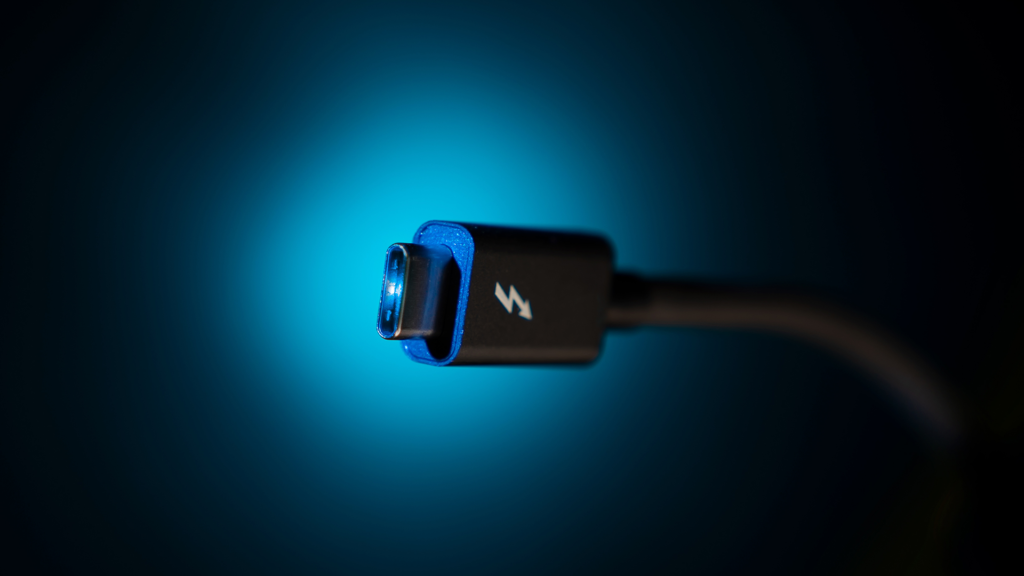
With the USB4 version, achieving 80 Gbps of bandwidth using copper cabling is an incredible effort, the maximum length of passive lines that can achieve those speeds is only 1 meter.
In the meantime, the naming convention is as bad as you’d expect for a USB specification, as less tech-savvy users might mistake it for USB 2.0, a standard that was launched more than 20 years ago and has a top speed of 480 Mbps.
The USB4 Version 2.0 specification, a significant improvement that would allow transfer rates up to 80 Gbps using USB-C cables and connections, was released by the USB Promoter Group.
Thunderbolt 4 and USB4 Version 1.0, by contrast, can only provide a maximum bidirectional speed of 40 Gbps.
The standard’s enhanced data rates are made possible via a new physical layer (PHY) architecture, which is said to be compatible with both existing 40 Gbps USB Type-C passive cables and newly defined 80 Gbps USB Type-C active cables.
The updated specification will work with Thunderbolt 3 and earlier USB revisions like USB4 Version 1.0, USB 3.2, and USB 2.0.
The improved data and display methods in the new standard help make greater use of the extra bandwidth.
Additionally, it permits USB 3.2 data tunneling to reach 20 Gbps. The most recent DisplayPort and PCIe specs are supported, therefore DisplayPort 2.0 and PCIe 5.0 are probably included (PCIe 6.0 only came out earlier this year).
According to the USB Promoter Group, which consists of Texas Instruments, Apple, HP, Intel, Microsoft, Renesas Electronics, STMicroelectronics, and Texas Instruments, the revised standard should be released before the November USB DevDays developer gatherings.
So it’s likely that we won’t see devices that support the new specification until the following year.
In related news, the EU wants all phones introduced after fall 2024 to come standard with USB-C.
To read our blog on “By ‘fall 2024,’ USB-C will be required for phones sold in the EU,” click here.