
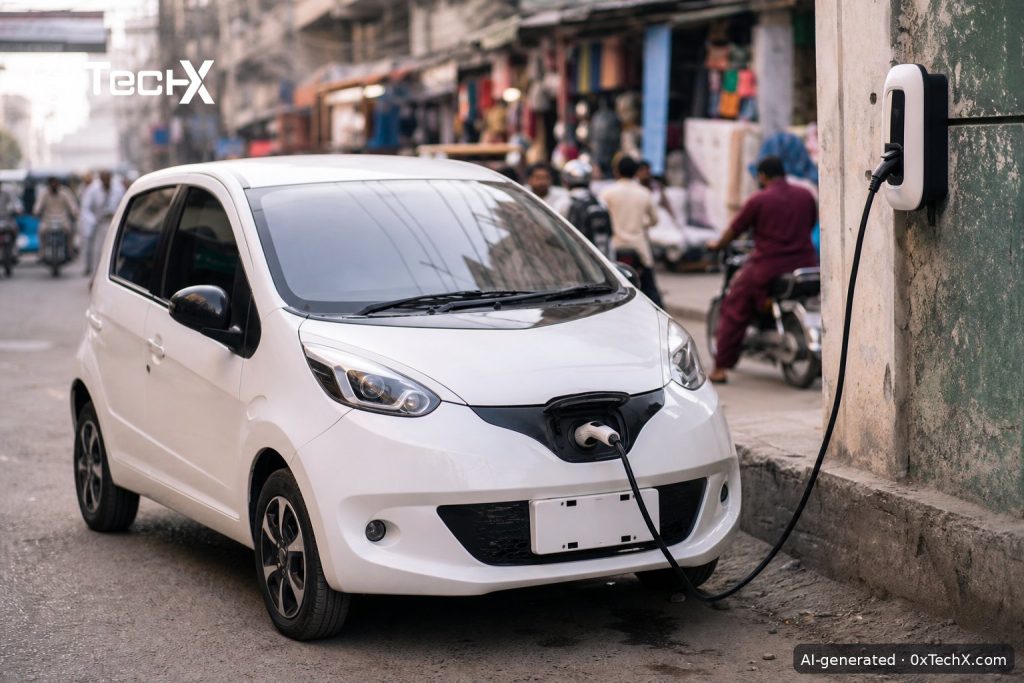
Affordable Chinese EVs are coming from an unexpected corner of Pakistan’s business world. Thatta Cement, a company best known for making cement, has announced it will enter Pakistan’s electric vehicle market through a new wholly owned subsidiary that will import small, budget-friendly electric cars from China.
Affordable Chinese EVs From a Cement Maker
The move was made public on 5 November 2026 through a formal notice to the Pakistan Stock Exchange (PSX). The board of directors had approved an investment in the new subsidiary, which will initially bring in completely built-up (CBU) electric vehicles straight from Chinese factories.
What makes this interesting is not just who is doing it, but why. Thatta Cement is not an auto company. It is a building materials firm that also owns Thatta Power (Private) Limited. Its decision to pivot into EV distribution signals that Pakistani industrialists outside the traditional auto sector now see electric vehicles as a real business opportunity, not just a niche experiment.
Mass Market, Not Premium
The company has been clear about its target. Affordable Chinese EVs for everyday buyers, not for affluent customers who can already afford a BYD Seal or an MG4. The company intends to introduce compact, small electric vehicles designed to match the budgets of a broader set of Pakistani consumers. This is a segment that has largely been ignored by existing importers, who have mostly focused on mid-range and premium models.
This gap in the market is real. Pakistan’s auto sector still runs mostly on small petrol cars, many of them ageing 1,000cc models. If Thatta Cement can bring in a genuinely affordable Chinese EV at a competitive price, it would be entering territory that no established auto brand has fully captured yet.
Why This Matters for Pakistan’s EV Push
Pakistan’s EV market has been growing fast in 2026. Imports of Chinese plug-in hybrid vehicles surged by nearly elevenfold in unit terms during the first half of the year, with trade data showing imports worth $191 million between January and June 2026, up from just $16.3 million a year earlier. Electric motorcycles also nearly quintupled in import value, reaching $69.9 million, as urban commuters look for cheaper ways to get around.
The government has set a target of converting 30% of Pakistan’s vehicles to electric power by 2030. Supporting that goal are tax concessions and incentives for EV imports and local assembly. This policy environment is exactly the kind of push that encourages non-auto companies like Thatta Cement to take a chance on the sector.
As of 2026, BYD is the largest supplier of electric vehicles to Pakistan, while MG Motors and Seres Corporation (DFSK) also have established presences. Thatta Cement would be entering an increasingly crowded import market, but the affordable segment it is targeting remains relatively open.
You can read more about related shifts in Pakistan’s energy sector in our coverage of Pakistan’s electric bike policy and local EV production, which shows how two-wheeler electrification is growing in parallel.
What We Still Do Not Know
Several important details have not been shared yet. The company has not named a specific Chinese brand or model. It has not disclosed the investment amount it plans to put into the subsidiary. It has not given a launch date or even a rough timeline for when the first cars might arrive. And it has not explained how it will handle after-sales service, spare parts, or charging support for buyers.
These are not small questions. Pakistan’s EV buyers have already raised concerns about service networks and parts availability for existing Chinese brands. Without answers, it is too early to say whether Thatta Cement will truly deliver affordable Chinese EVs to the mass market or simply add another name to a growing list of import businesses.
The proposed Auto Policy 2026-31, which is still awaiting final approval, could also change the rules around EV imports and financing. That adds further uncertainty to any company planning to build a business around bringing in fully assembled vehicles from China.
A Broader Signal for Pakistan’s Auto Sector
Even if the details are thin, the move itself sends a message. When a cement maker decides to get into electric vehicles, it shows that Pakistan’s EV market has become credible enough to attract investment from outside the traditional auto industry. It also suggests that Chinese EV supply chains are affordable and accessible enough that a local industrial company feels confident it can enter the distribution business without being a car company first.
For Pakistani consumers, the best outcome would be genuine competition in the affordable EV segment. More players chasing budget-conscious buyers means more pressure on pricing. That is good news for anyone hoping to buy an electric car without spending premium money. For now, though, Thatta Cement’s EV plan is still more announcement than reality. The real test will come when it names a model and puts a price tag on it.
Learn more about Pakistan’s national EV targets and policy framework at the National Energy Efficiency and Conservation Authority (NEECA), the body that oversees electric vehicle policy in Pakistan.
Frequently Asked Questions
What is Thatta Cement planning to do in the EV market?
Thatta Cement is setting up a wholly owned subsidiary that will import affordable, compact Chinese electric vehicles into Pakistan. The plan was announced through a filing to the Pakistan Stock Exchange on 5 November 2026. The company wants to target everyday buyers, not the premium market.
Which Chinese EV brand will Thatta Cement import?
Thatta Cement has not named a specific Chinese brand or model yet. The PSX notice only confirmed that the subsidiary will start by importing completely built-up (CBU) electric vehicles from China. Pricing and product details have not been shared.
Why is a cement company entering the EV market?
Pakistan’s EV market is growing rapidly and the government is offering tax incentives to support electric mobility. Companies from outside the traditional auto sector see this as a business opportunity. Thatta Cement’s move shows that Chinese EV supply chains are affordable enough for non-auto Pakistani businesses to enter distribution.
When will Thatta Cement’s affordable Chinese EVs be available in Pakistan?
No launch date or timeline has been announced. The company has also not disclosed how much it is investing in the new subsidiary. Until those details come out, buyers will need to wait for a follow-up announcement before they can consider these vehicles as a real purchase option.